
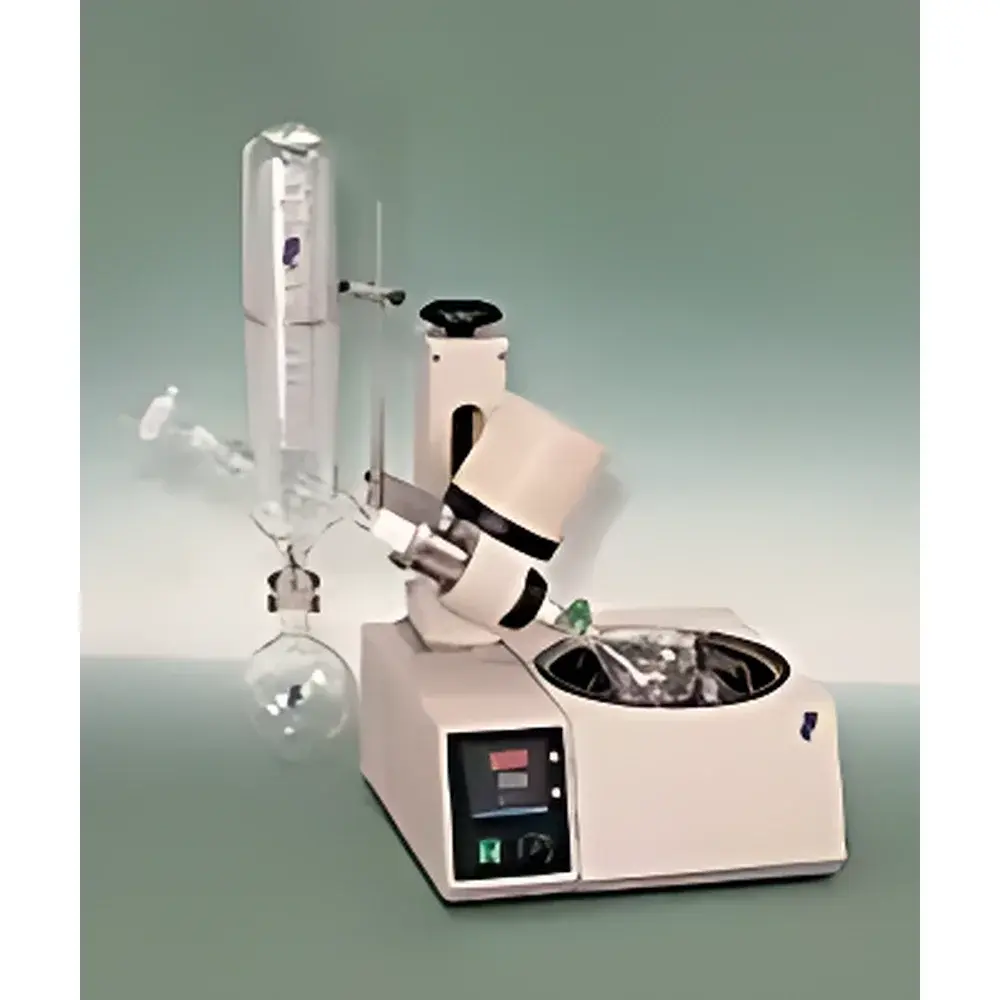
RE52AA Rotary Evaporator by Yarong
| Brand | Yarong |
|---|---|
| Origin | Shanghai, China |
| Model | RE52AA |
| Capacity | 2 L |
| Ultimate Vacuum | 3 mmHg |
| Rotation Speed | 0–150 rpm |
| Temperature Control Range | 0–100 °C |
| Heating Bath Accuracy | ±1 °C (typical for digital PID-controlled stainless steel bath) |
| Condenser Surface Area | ≥0.12 m² (vertical dual-layer coil with high-efficiency coolant path) |
| Power Input | 1000 W |
| Voltage/Frequency | 220 V / 50 Hz |
| Construction | Electropolished 304 stainless steel frame, PTFE-coated heating bath, borosilicate glassware (24/29 standard taper) |
Overview
The RE52AA Rotary Evaporator is a precision-engineered benchtop purification system designed for efficient solvent removal, concentration, and recovery under reduced pressure. Based on the fundamental principle of rotary evaporation—where a rotating flask increases surface area while simultaneous vacuum application lowers boiling points—the RE52AA enables controlled, gentle thermal processing of heat-sensitive compounds. Its architecture integrates a digitally regulated heating bath, microprocessor-driven rotational drive, and vertically oriented condensation assembly optimized for high vapor capture efficiency. The system is widely deployed in synthetic organic chemistry labs, pharmaceutical process development, natural product isolation, and quality control environments where reproducible, scalable sample workup is required without thermal degradation.
Key Features
- Digital PID temperature controller with ±1 °C stability across 0–100 °C range; real-time display and auto-cut-off protection prevent overheating.
- Stepless electronic speed regulation (0–150 rpm) via brushless micro-motor ensures smooth, vibration-minimized rotation—even at low speeds critical for viscous or foaming samples.
- Vertical double-layer condenser with extended cooling path and large-diameter evaporative tubing enhances condensate recovery rate and minimizes vapor bypass.
- PTFE-coated stainless steel heating bath (304 grade) combined with transparent polycarbonate safety shield provides thermal insulation, splash resistance, explosion mitigation, and contamination control.
- Motorized lift mechanism enables precise vertical positioning of the evaporation flask relative to the bath—critical for optimizing heat transfer and preventing bumping during volatile solvent removal.
- All wetted glass components conform to ISO 3585 specifications for borosilicate 3.3 glass; standard 24/29 taper joints ensure interchangeability with common labware.
Sample Compatibility & Compliance
The RE52AA accommodates a broad spectrum of solvents—including acetone, ethanol, dichloromethane, ethyl acetate, and toluene—as well as aqueous and semi-viscous mixtures up to ~500 cP. Its 2 L capacity supports batch processing aligned with early-stage R&D and pilot-scale preparation workflows. The unit complies with IEC 61010-1:2010 safety standards for laboratory electrical equipment and meets CE marking requirements for electromagnetic compatibility (EMC) and low-voltage directive (LVD). While not certified for GMP production use, its design facilitates adherence to GLP documentation practices through consistent operational parameters and traceable thermal/rotational profiles.
Software & Data Management
The RE52AA operates as a standalone analog-digital hybrid instrument without embedded firmware or network connectivity. All operational parameters—including setpoint temperature, rotation speed, and runtime—are manually configured and monitored via front-panel LED displays. For laboratories requiring audit-ready records, external data loggers (e.g., USB-connected thermocouple + tachometer interfaces) may be integrated to capture time-stamped temperature and rpm traces. This architecture aligns with FDA 21 CFR Part 11 readiness when paired with validated third-party logging software supporting electronic signatures and secure data archiving.
Applications
- Concentration of crude reaction mixtures prior to chromatographic analysis or crystallization.
- Removal of low-boiling solvents (e.g., hexane, diethyl ether) from lipid extracts or essential oil distillates.
- Recovery and recycling of expensive or hazardous solvents in medicinal chemistry synthesis.
- Drying of thermolabile APIs and intermediates under mild conditions (e.g., <40 °C at ≤5 mmHg).
- Preparative-scale solvent exchange protocols—such as replacing DMF with methanol prior to lyophilization.
- Teaching laboratories: demonstration of colligative properties, vapor pressure depression, and mass transfer kinetics under vacuum.
FAQ
What is the maximum recommended operating vacuum for the RE52AA?
The system achieves an ultimate vacuum of 3 mmHg when paired with a compatible two-stage vacuum pump (e.g., diaphragm or rotary vane type) and properly sealed joints.
Is the heating bath temperature calibrated to NIST-traceable standards?
Factory calibration is performed per internal quality protocol; users may perform field verification using a Class A PT100 probe and reference thermometer per ASTM E74-22 guidelines.
Can the RE52AA be used with corrosive solvents such as concentrated HCl or bromine solutions?
No—only chemically resistant solvents compatible with borosilicate glass, PTFE, and 304 stainless steel should be processed. Hydrohalic acids, oxidizers, and strong bases require specialized corrosion-resistant variants.
Does the unit include vacuum control or pressure regulation capability?
The base configuration does not include a vacuum regulator or feedback-controlled valve; manual vacuum throttling via stopcock or external pressure controller is required for fine-tuned boiling point management.
What maintenance intervals are recommended for long-term reliability?
Weekly inspection of O-rings and ground glass joints; biannual lubrication of lift mechanism gears; annual verification of bath temperature uniformity across zone using multi-point probe mapping.



