
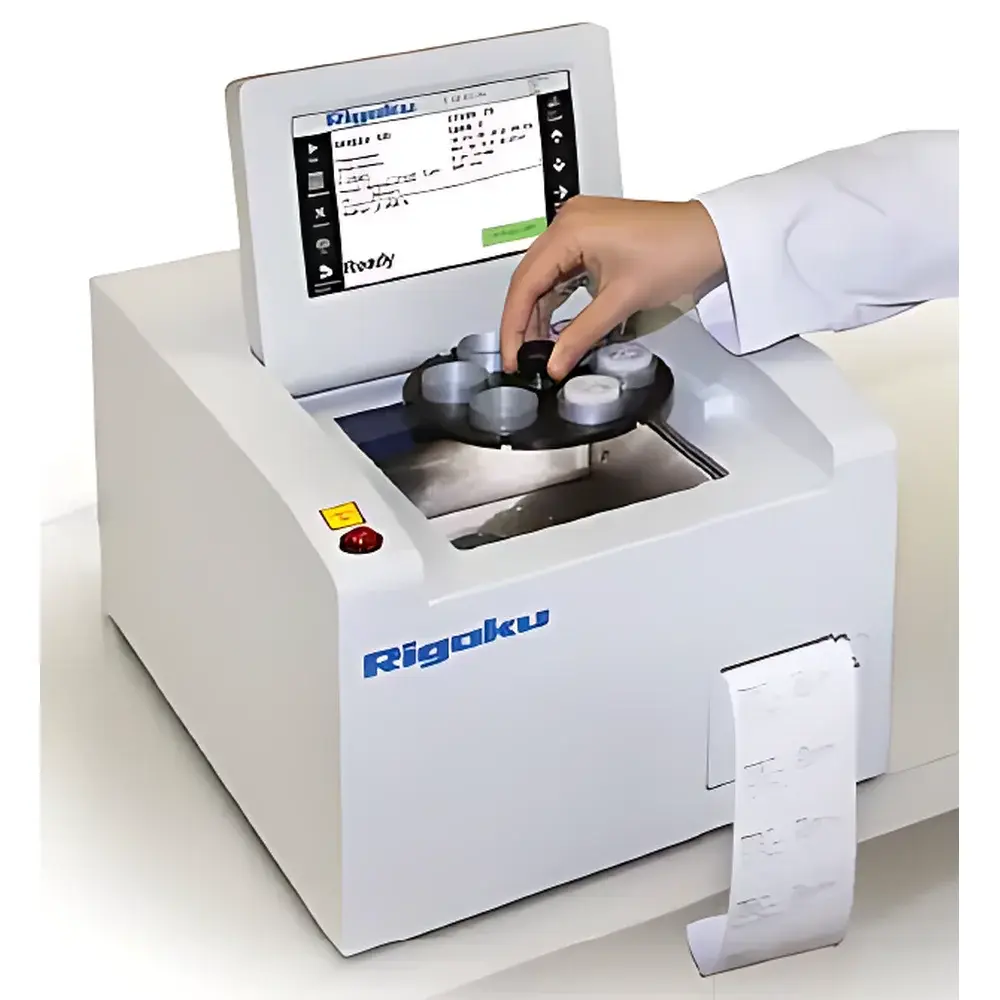
Rigaku NEX QC Energy-Dispersive X-Ray Fluorescence Total Sulfur Analyzer for Crude Oil, Vacuum Gas Oil, and Residue
| Key | Brand: Rigaku |
|---|---|
| Origin | USA |
| Model | NEX QC |
| Detection Principle | Energy-Dispersive X-Ray Fluorescence (EDXRF) |
| Analyte | Total Sulfur |
| Detection Limit | 5 ppm |
| Measurement Range | 0–10 wt% |
| Sample Volume | 5 mL |
| Analysis Time | 1–999 s (default 300 s) |
| Calibration Method | Compton Scattering C/H Ratio Correction |
| Data Output | USB + Ethernet |
| Environmental Requirements | RH < 85% (no condensation), vibration-free, non-corrosive atmosphere |
| Compliance Standards | ASTM D4294, GB/T 17040 |
Overview
The Rigaku NEX QC Energy-Dispersive X-Ray Fluorescence (EDXRF) Total Sulfur Analyzer is a benchtop yet highly portable instrument engineered for rapid, non-destructive quantification of total sulfur in liquid petroleum streams—including crude oil, vacuum gas oil (VGO), and atmospheric or vacuum residue. Based on fundamental EDXRF physics, the system irradiates the sample with a high-stability X-ray tube, inducing characteristic sulfur Kα emission (2.307 keV). The energy-resolved detector captures the full fluorescence spectrum, enabling direct matrix-independent quantification via Compton-scatter-based C/H ratio normalization—eliminating the need for extensive calibration with certified reference materials across diverse hydrocarbon matrices. Designed for refinery laboratories, custody transfer terminals, and field service teams, the NEX QC delivers laboratory-grade accuracy without requiring vacuum pumps, cryogenic cooling, or complex sample preparation.
Key Features
- Optimized EDXRF architecture with Peltier-cooled silicon drift detector (SDD) for high count-rate performance and long-term spectral stability.
- Multi-layer composite primary beam filters to enhance signal-to-background ratio for low-Z elements—specifically tuned for sulfur detection in high-carbon matrices.
- Integrated sample cup holder with precise 5 mL volume definition and automated positioning for reproducible geometry and minimal air gap effects.
- Onboard thermal printer supporting immediate hard-copy reporting with timestamp, operator ID, analysis time, and raw intensity data.
- Robust mechanical design compliant with MIL-STD-810G for shock and transport resilience—enabling reliable operation in mobile labs or offshore platforms.
- Embedded ARM-based controller running real-time OS; no external PC required for routine analysis.
Sample Compatibility & Compliance
The NEX QC accommodates undiluted, homogenized liquid samples including black oils, heavy fuel oils, and residua with viscosities up to 1000 cSt at 40 °C. Samples are introduced into disposable polypropylene cups sealed with Mylar film (6 µm thickness), ensuring consistent excitation geometry and eliminating contamination risks. The analyzer fully complies with ASTM D4294–22 (“Standard Test Method for Sulfur in Petroleum and Petroleum Products by Energy-Dispersive X-Ray Fluorescence Spectrometry”) and Chinese national standard GB/T 17040–2019 (“Petroleum Products—Determination of Total Sulfur Content—Energy Dispersive X-Ray Fluorescence Spectrometry”). Its measurement protocol satisfies traceability requirements under ISO/IEC 17025:2017 for testing laboratories and supports audit-ready documentation for refinery quality control (QC) systems operating under API RP 500 and ISO 8502-9 frameworks.
Software & Data Management
The embedded firmware provides intuitive touchscreen navigation for method selection, calibration management, and report generation. All spectral data—including raw counts, net peak area, background subtraction, and Compton-normalized intensity ratios—are stored locally with metadata (date/time, operator, sample ID, analysis parameters). Data export is supported via USB mass storage or Ethernet TCP/IP to LIMS or SCADA systems using standard CSV or XML formats. Audit trail functionality records all user actions, parameter changes, and calibration events with immutable timestamps—meeting FDA 21 CFR Part 11 requirements when deployed in regulated environments. Optional remote monitoring via Modbus TCP enables integration into centralized refinery process analytics platforms.
Applications
- Routine total sulfur screening of crude slates prior to desalting and distillation to optimize feedstock blending strategies.
- Quality assurance of vacuum gas oil (VGO) entering fluid catalytic cracking (FCC) units, where sulfur content directly impacts catalyst life and SOx emissions.
- Final product verification of marine fuel oil (MFO) and residual fuel oil (RFO) against IMO 2020 sulfur cap (0.50 wt%) and regional specifications (e.g., US EPA 15 ppm).
- Process troubleshooting during hydrotreating operations by tracking sulfur removal efficiency across reactor beds.
- Supporting environmental compliance reporting for stack emissions modeling and refinery-wide sulfur balance calculations.
FAQ
Does the NEX QC require helium purge or vacuum for sulfur analysis?
No—its optimized EDXRF configuration operates reliably in ambient air, eliminating gas consumption and associated infrastructure costs.
Can it analyze solid or semi-solid samples such as asphalt or coke?
Not without homogenization and liquefaction; the method is validated exclusively for liquid-phase hydrocarbons meeting ASTM D4294 viscosity and density criteria.
How frequently must the instrument be recalibrated?
Calibration stability exceeds 12 months under routine use; verification with a single check standard (e.g., SRM 2722) is recommended before each analytical shift.
Is spectral deconvolution performed onboard or externally?
All peak fitting, background modeling, and Compton normalization are executed in real time by the embedded processor—no post-acquisition software is required.
What safety certifications does the system hold?
It conforms to IEC 61010-1:2010 for electrical safety and IEC 62471:2006 for LED/X-ray radiation safety, with interlocked shielding and automatic beam cutoff upon lid opening.






