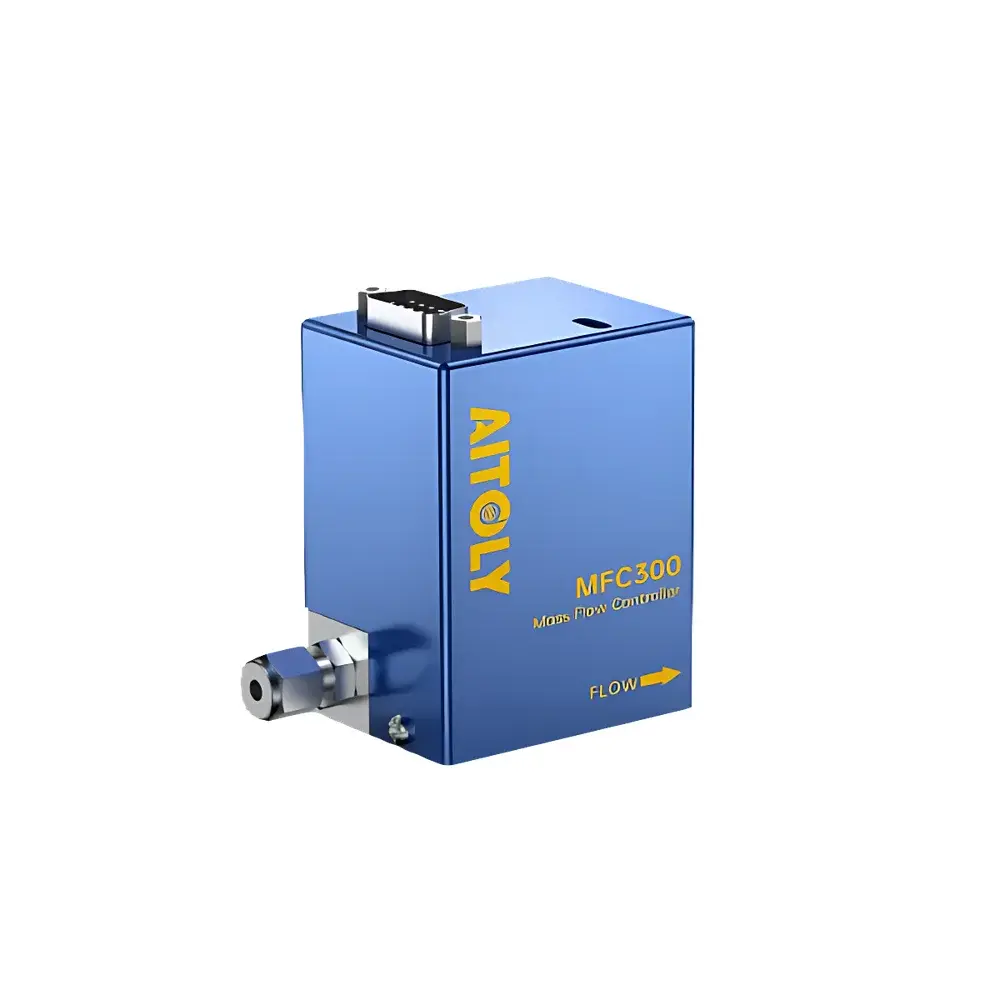
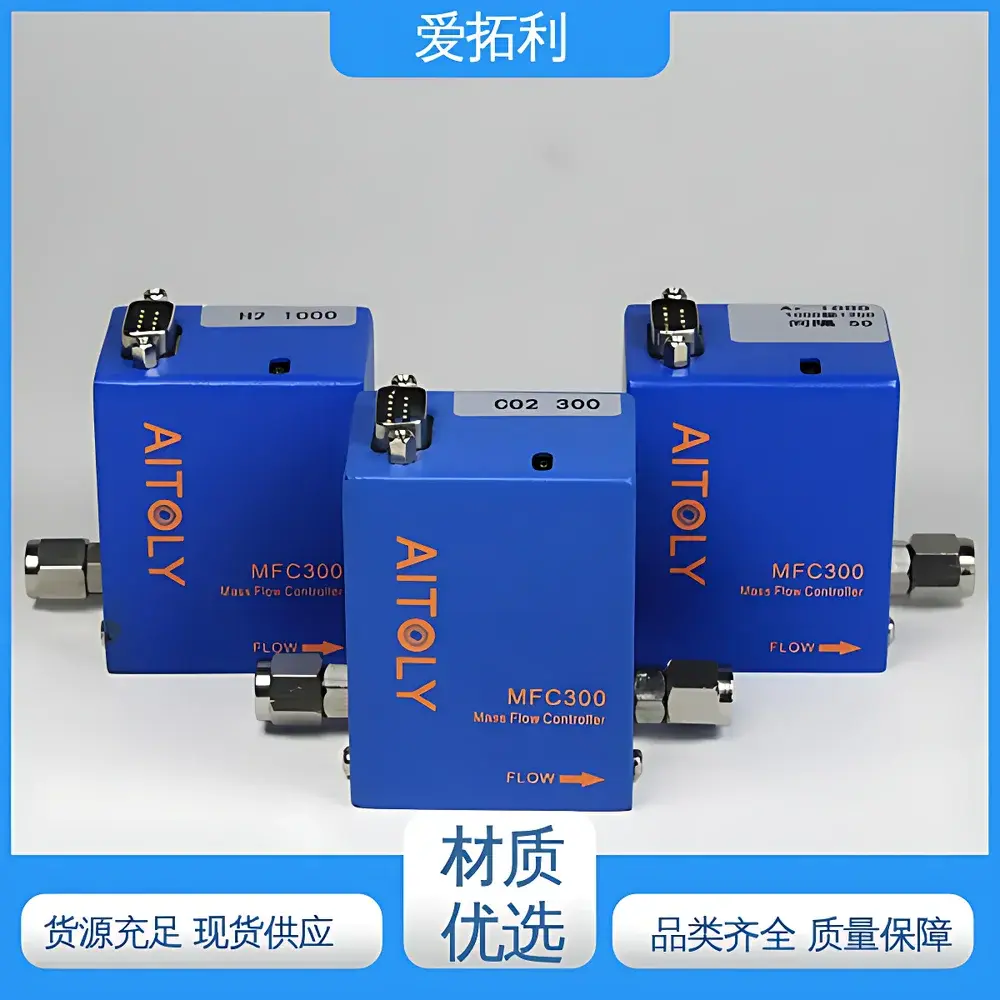
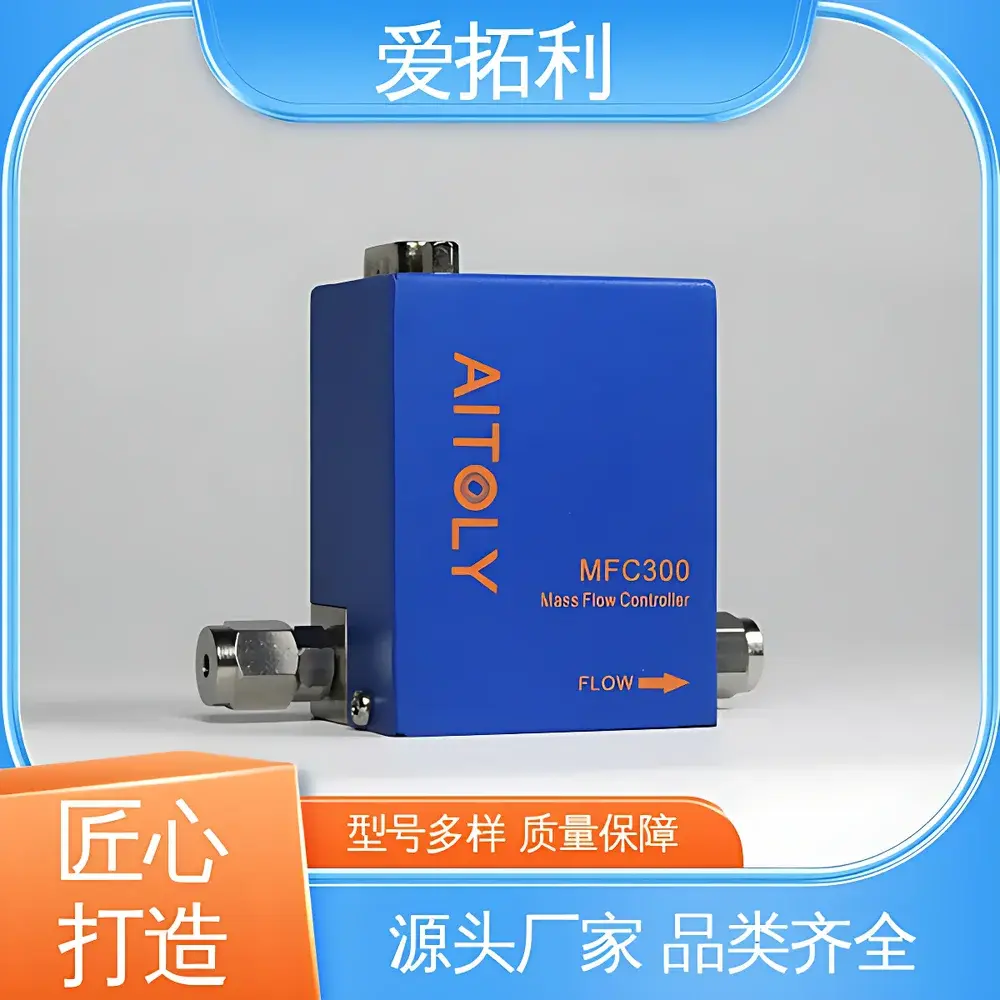
Aitoly MFC300 Series Thermal Mass Flow Controller
| Brand | Aitoly |
|---|---|
| Origin | Jiangsu, China |
| Model | MFC300 |
| Type | Thermal Mass Flow Controller |
| Sensor Technology | MEMS-based |
| Response Time (Measurement) | 5 ms |
| Response Time (Control) | 300 ms |
| Flow Range Ratio | Up to 100:1 |
| Pressure Drop | Low |
| Installation | Flexible (Inline/Panel Mount) |
| Power Supply | 24 VDC |
| Output Signal | 0–5 V / 0–10 V / 4–20 mA |
| Communication Interface | RS-485 (Modbus RTU) |
| Temperature & Pressure Compensation | Integrated |
| Warm-up Time | None Required |
Overview
The Aitoly MFC300 Series Thermal Mass Flow Controller is an engineered solution for precise, real-time gas mass flow measurement and closed-loop control in laboratory, pilot-scale, and light industrial applications. Unlike volumetric flow devices, the MFC300 employs constant-temperature anemometry (CTA) based on micro-electromechanical systems (MEMS) sensor technology. This principle relies on heat transfer dynamics between a heated element and the flowing gas stream, enabling direct mass flow measurement independent of pressure and temperature fluctuations—provided integrated compensation is active. The device delivers true mass flow output in standard cubic centimeters per minute (sccm) or standard liters per minute (slm), traceable to NIST-traceable calibration gases. Its compact footprint and low-pressure drop make it suitable for integration into gas delivery subsystems where space, energy efficiency, and system stability are critical—such as semiconductor process tooling, analytical instrument carrier gas regulation, fuel cell test benches, and controlled atmosphere reactors.
Key Features
- MEMS-based thermal sensing architecture: Enables high sensitivity across low-to-moderate flow ranges with inherent immunity to particulate fouling and long-term drift.
- Integrated temperature and pressure compensation: Onboard sensors and algorithmic correction ensure accuracy over ambient variations (10–40 °C, 80–110 kPa), meeting ISO 17025-compliant operation when calibrated against certified reference gases.
- Ultra-fast dynamic response: 5 ms measurement response time supports transient gas event capture; 300 ms closed-loop control settling time enables stable regulation under rapid setpoint changes.
- Wide turndown ratio up to 100:1: Maintains ±1% reading accuracy from 1% to 100% of full scale, eliminating the need for multiple range instruments in variable-flow applications.
- Zero warm-up requirement: Operational immediately upon power application—no stabilization delay—supporting on-demand startup in automated sequences and unattended operation.
- Flexible mechanical integration: Available in both inline and panel-mount configurations with standardized 1/4″ NPT or M6×1 thread interfaces; compatible with stainless steel, brass, and aluminum wetted materials per gas compatibility requirements.
Sample Compatibility & Compliance
The MFC300 is validated for use with non-corrosive, non-condensing gases including N₂, O₂, Ar, He, H₂, CO₂, CH₄, and synthetic air. Custom calibration options are available for specialty gas mixtures (e.g., 5% H₂ in N₂) to meet ASTM E2654 or ISO 8503-3 traceability requirements. All units undergo factory calibration using gravimetric and bubble-meter reference standards, with calibration certificates provided per ISO/IEC 17025 guidelines. While not intrinsically safe or explosion-proof rated, the MFC300 complies with CE marking directives (EMC Directive 2014/30/EU and LVD Directive 2014/35/EU) and meets RoHS 2011/65/EU material restrictions. For regulated environments, audit-ready data logs—including setpoint history, actual flow, valve position, and environmental compensation values—can be exported via Modbus for GLP/GMP-aligned record retention.
Software & Data Management
The MFC300 supports configuration and monitoring via Aitoly’s cross-platform PC utility (Windows/macOS/Linux), which provides intuitive access to PID tuning parameters, flow unit selection, alarm thresholds, and multi-step ramp/soak profiles. The software implements local data logging at user-defined intervals (100 ms to 10 s resolution) with CSV export capability. For system-level integration, the RS-485 interface supports Modbus RTU protocol (Function Codes 03h/06h/10h), enabling seamless communication with PLCs, SCADA systems, or LabVIEW-based DAQ platforms. All configuration changes are timestamped and stored in non-volatile memory; firmware updates are performed via serial bootloader without hardware modification. The controller retains full functionality in standalone mode—no host dependency for basic control operation.
Applications
- Gas flow regulation in gas chromatography (GC) carrier and detector gas supplies
- Mass flow control in plasma etch and CVD tool purge lines
- Calibration verification of secondary flow sensors in HVAC and cleanroom monitoring
- Fuel and oxidizer metering in micro-combustion and catalytic reaction studies
- Gas blending and dosing in bioreactor sparging and fermentation control loops
- Leak testing subsystems requiring repeatable, low-flow gas delivery
FAQ
Does the MFC300 require external temperature or pressure transmitters for compensation?
No—the unit incorporates co-located Pt1000 temperature and piezoresistive pressure sensors within the flow body, and applies real-time compensation algorithmically.
Can the MFC300 be used with corrosive gases such as Cl₂ or NH₃?
Not in standard configuration. Wetted parts are 316 stainless steel and glass-reinforced PPS; alternative materials (e.g., Hastelloy, PTFE seals) and custom calibrations are available upon request.
Is Modbus communication compatible with common industrial PLCs?
Yes—RS-485 Modbus RTU implementation conforms to standard slave-mode addressing and register mapping, verified with Siemens S7-1200, Allen-Bradley Micro850, and Mitsubishi FX5U controllers.
What is the recommended recalibration interval under continuous operation?
Aitoly recommends annual recalibration against traceable standards; extended intervals may be justified per ISO/IEC 17025 internal quality procedures if historical performance trending demonstrates stability.
Does the controller support fail-safe shutdown or alarm outputs?
Yes—configurable digital alarm outputs (open-collector) can trigger on flow deviation, sensor fault, or communication timeout, and are assignable to discrete I/O points in supervisory systems.