
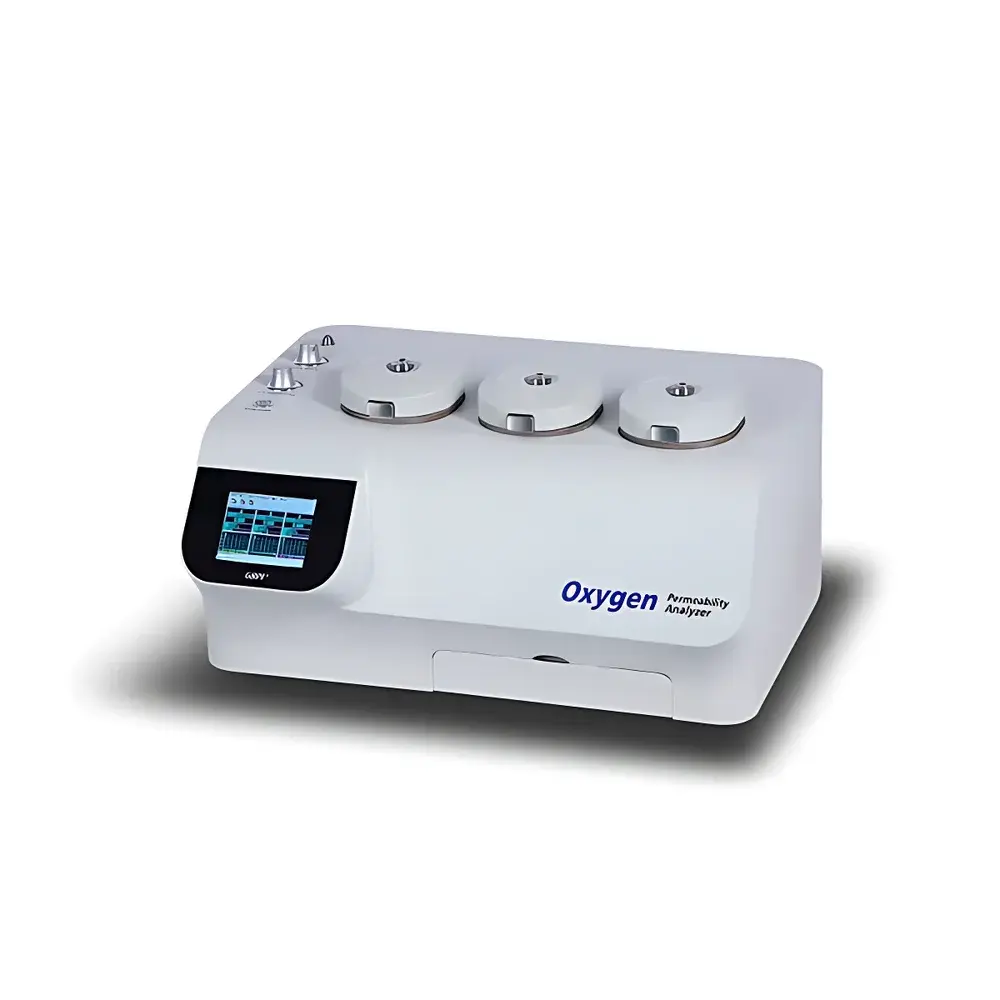
GBPI Y310-A1 Oxygen Transmission Rate (OTR) Analyzer for Pharmaceutical Packaging Materials
| Brand | GBPI |
|---|---|
| Origin | Guangdong, China |
| Manufacturer Type | Direct Manufacturer |
| Regional Classification | Domestic (China) |
| Model | Y310-A1 |
| Price Range | USD 14,000 – 70,000 |
| Test Range | 0.02–16,500 cm³/(m²·24h) (film) |
| O₂ Resolution | 0.001 cm³/(m²·24h) |
| Temperature Control | 15–45°C (optional 5–50°C), ±0.1°C accuracy |
| Humidity Control | 0%RH (dry), 30–90%RH, 100%RH |
| Test Area | 50.24 cm² |
| Specimen Size | Ø100 mm |
| Max Thickness | ≤3 mm |
| Sample Capacity | 1–3 independent chambers |
| Carrier Gas Pressure | 0.1–0.2 MPa |
| Gas Inlet | 1/8″ stainless steel tubing |
| Dimensions | 700 × 560 × 370 mm |
| Weight | 100 kg |
| Power | 750 W, AC 220 V, 50 Hz |
| Compliance | GB/T 19789–2005, ASTM D3985, ASTM F1927, ASTM F1307, ASTM F2622, ISO 15105-2, YBB00082003–2015, DIN 53380-3, JIS K-7126-B |
Overview
The GBPI Y310-A1 Oxygen Transmission Rate (OTR) Analyzer is a gravimetric and coulometric sensor-based instrument engineered for precise, traceable, and repeatable measurement of oxygen permeation through packaging materials used in pharmaceutical, biologics, and sterile device applications. It operates on the principle of dynamic gas transmission under controlled temperature and humidity conditions, employing a dual-stream humidity generation system and high-stability electrochemical oxygen sensors to quantify oxygen flux across planar films or rigid containers. The instrument complies with internationally harmonized test methodologies—including ASTM D3985 (coulometric sensor method), ASTM F1927 (moisture-assisted OTR), ASTM F1307 (container testing), and ISO 15105-2—ensuring data compatibility across global regulatory submissions. Its design prioritizes metrological integrity: GBPI holds National Standard Substance Certification (GBW(E)130497/8) and a Manufacturing License for Metrological Instruments (State Administration of Market Regulation), enabling traceable calibration using certified reference films and gases per ISO/IEC 17025-aligned practices.
Key Features
- Triple independent test chambers enable concurrent evaluation of up to three dissimilar specimens—each with autonomous start/stop, real-time parameter logging, and individual report generation—maximizing throughput without cross-contamination.
- High-resolution OTR detection down to 0.001 cm³/(m²·24h), validated for ultra-high-barrier materials including aluminum foil, SiOx-coated PET, and multilayer laminates used in blister packaging and parenteral vial stoppers.
- Programmable environmental control: temperature regulated via electromagnetic stepwise PID algorithm (±0.1°C stability); humidity delivered via dual-gas mixing (dry N2 + saturated humidified N2) with ±1%RH precision across 0–100%RH ranges.
- ARM-based embedded control architecture allows standalone operation—no host PC required for routine testing—reducing software dependency and enhancing system robustness in GLP-compliant labs.
- Full GMP Annex 11 & FDA 21 CFR Part 11 compliance: role-based user authentication (Administrator, Operator, Reviewer), hierarchical permission management, and immutable audit trails covering system events, method changes, and raw data modifications.
- Modular hardware design facilitates field maintenance: oxygen sensors are hot-swappable; pneumatic manifolds use standardized SS316 fittings; electrical subsystems adhere to IEC 61000-4 immunity standards.
Sample Compatibility & Compliance
The Y310-A1 accommodates flat specimens (films, foils, sheets) up to 3 mm thick and Ø100 mm diameter, as well as rigid or flexible containers—including HDPE bottles, Alu-PVC blisters, Tyvek pouches, and thermoformed trays—using optional fixtures and OTR face masks. It supports extended-range testing up to 260,000 cm³/(m²·24h) for low-barrier materials such as LDPE bags or non-laminated paperboard. All test protocols align with pharmacopoeial requirements: YBB00082003–2015 (Chinese Pharmacopoeia), USP , and EP 3.2.1, ensuring suitability for stability protocol validation and container closure integrity assessment (CCIT). Instrument qualification documentation includes IQ/OQ templates compliant with ASTM E2500 and ISO 13485.
Software & Data Management
The proprietary Windows-based OTR Analysis Suite features intuitive workflow configuration, real-time overlay of OTR, O2 concentration, temperature, and RH curves with zoom/pan functionality, and automated endpoint detection based on slope convergence criteria. Reports conform to ALCOA+ principles: each export includes metadata (operator ID, timestamp, calibration status, environmental logs), digital signatures, and embedded audit trail summaries. Data is stored in encrypted SQLite databases with daily auto-backup; historical records remain accessible for ≥15 years per 21 CFR Part 11 retention mandates. Export formats include PDF/A-2b (archival), XLSX (statistical analysis), and XML (LIMS integration).
Applications
- Pharmaceutical primary packaging: quantifying OTR of PTP foils, cold-forming films, and polymer-coated glass vials to support shelf-life modeling per ICH Q5C.
- Biologics and mRNA vaccine delivery systems: evaluating oxygen ingress into lyophilized product containers and lipid nanoparticle (LNP) storage pouches under accelerated aging conditions.
- Medical device packaging: validating seal integrity and material barrier performance of Class II/III sterile barrier systems per ISO 11607-1.
- Advanced material R&D: characterizing atomic-layer-deposited (ALD) oxide barriers, graphene-enhanced composites, and bio-based polymers for sustainable packaging development.
- Regulatory submission support: generating GLP-compliant datasets for ANDA, NDA, and MAA filings requiring ASTM/ISO-aligned OTR evidence.
FAQ
What calibration standards are supported?
The Y310-A1 accepts both certified reference films (e.g., 125 µm polyethylene standard) and certified oxygen/nitrogen gas mixtures (99.999% purity) for dual-mode verification per ISO 17025 clause 6.6.
Is container testing validated per ASTM F1307?
Yes—optional container fixtures meet ASTM F1307 Annex A1 requirements, including purge flow rate control (50–100 mL/min), headspace volume measurement, and leak-tight sealing verification.
Can the system operate unattended overnight?
Fully. Scheduled tests initiate automatically; thermal/humidity stabilization routines complete prior to measurement; sensor health monitoring triggers alerts before data acquisition begins.
How is data integrity enforced during networked operation?
All database writes are transaction-locked; electronic signatures require two-factor authentication; audit logs record IP address, workstation ID, and cryptographic hash of modified records.
What maintenance intervals are recommended?
Oxygen sensors: recalibration every 90 days or after 500 test cycles; humidity generator desiccant replacement every 6 months; annual full-system verification using GBPI-certified reference kits.





