
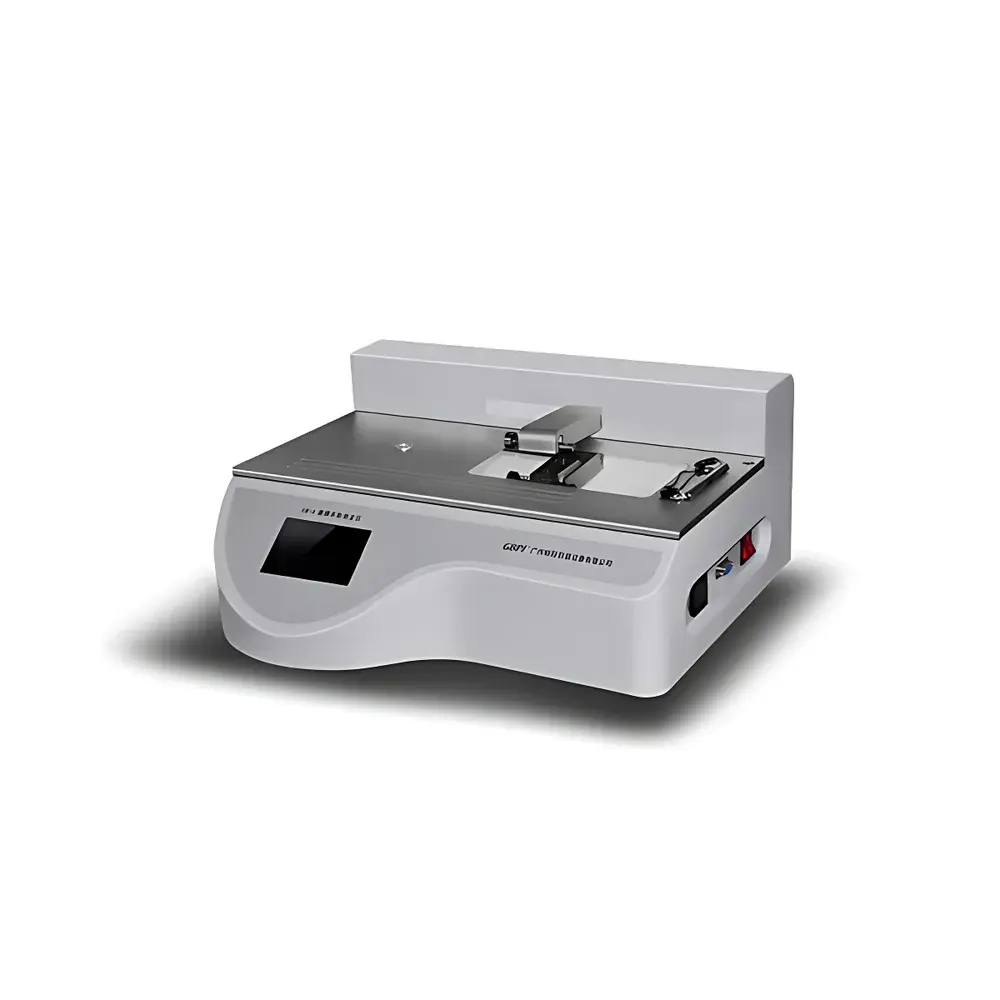
GBPI GM-5D Coefficient of Friction Tester for Plastic Films and Packaging Materials
| Brand | GBPI |
|---|---|
| Origin | Guangdong, China |
| Manufacturer | GBPI Packaging Instruments Co., Ltd. |
| Model | GM-5D |
| Compliance | GB/T 10006–1988, ASTM D1894–2014, ISO 8295–2004, TAPPI T816 |
| CoF Range | 0.01–0.999 |
| Measurement Accuracy | ±2% |
| Force Range | 0–10 N |
| Slider Mass | 200 ± 2 g |
| Slider Dimensions | 63 × 63 mm |
| Standard Test Speed | 100 mm/min (infinitely variable) |
| Temperature Control Option | RT–75 °C |
| Specimen Thickness Limit | ≤2 mm |
| Test Platform | 200 × 470 mm |
| Overall Dimensions | 470 × 330 × 210 mm |
| Weight | 37 kg |
| Power | 100 W, AC 220 ± 10 V, 50 Hz |
Overview
The GBPI GM-5D Coefficient of Friction Tester is a precision-engineered instrument designed to quantify static and kinetic coefficients of friction (CoF) between flexible packaging materials—including plastic films, laminates, foils, and paper-based substrates—under controlled mechanical and environmental conditions. Based on the horizontal plane method per ASTM D1894 and ISO 8295, the system employs a calibrated slider assembly that traverses a stationary test specimen at defined velocity and normal load. Frictional force is measured via a high-stability load cell; static CoF is determined at the point of initial motion onset, while kinetic CoF is calculated from the average force during steady-state sliding. The instrument supports both self-mating (film-on-film) and hetero-mating (e.g., film-on-steel, film-on-cardboard) configurations, enabling evaluation of interfacial behavior critical to packaging integrity, high-speed filling line performance, and stack stability in logistics.
Key Features
- High-reproducibility measurement architecture with ±2% accuracy across the full CoF range (0.01–0.999), validated against traceable standard reference blocks.
- Integrated 10 N capacity load cell featuring automatic over-range protection to prevent sensor saturation and ensure long-term calibration stability.
- Motor-driven, infinitely variable speed control (10–500 mm/min), with default 100 mm/min compliant with major international standards.
- Onboard LCD interface displaying real-time static/kinetic CoF values, test speed, elapsed time, and force profile—enabling fully standalone operation without external computing hardware.
- Modular mechanical design with tool-free access to drive train, sensor mount, and slider guide rails—reducing mean time to repair (MTTR) and supporting field-level maintenance.
- Optional temperature-controlled test chamber (RT–75 °C) for evaluating thermal dependence of surface adhesion and slip behavior in heat-seal or sterilization applications.
Sample Compatibility & Compliance
The GM-5D accommodates specimens up to 2 mm thick and 200 × 470 mm in planar dimension, making it suitable for single-layer PE, BOPP, PET, CPP, aluminum foil, metallized films, coated papers, and multilayer laminates used in pharmaceutical blister packaging, food pouches, and medical device wraps. All test protocols align with regulatory and quality frameworks including ISO 9001, ISO 13485, and FDA 21 CFR Part 11 when paired with GBPI’s optional audit-trail-enabled software. Data outputs meet GLP/GMP documentation requirements for QC laboratories performing routine release testing or stability studies under ICH Q5E guidelines.
Software & Data Management
The optional GBPI CoF Analysis Suite (v3.2+) provides full traceability: user authentication, electronic signatures, version-controlled method templates, and automated generation of PDF reports compliant with ASTM E2500 and USP . Real-time force–displacement curves are captured at ≥100 Hz sampling rate; zoomable plots support manual verification of peak static force and plateau kinetic force regions. Raw data exports to CSV and Excel formats include timestamps, operator ID, instrument serial number, calibration certificate expiry, and environmental metadata (if temperature option installed). Audit logs record all parameter modifications, test starts/stops, and report generations—supporting inspection readiness for MHRA, ANVISA, or PMDA audits.
Applications
- Quality assurance of roll-to-roll extruded films prior to slitting and converting.
- Evaluation of anti-block additive efficacy in polyolefin films.
- Validation of corona treatment uniformity and aging effects on surface energy.
- Assessment of lubricant migration in heat-seal layers affecting vertical form-fill-seal (VFFS) machine performance.
- Comparative analysis of slip agents (e.g., erucamide vs. oleamide) in pharmaceutical blister lidding foils.
- Regulatory submission support for packaging compatibility dossiers under EU Annex 1 and FDA Guidance for Industry: Container Closure Systems for Packaging Human Drugs and Biologics.
FAQ
What standards does the GM-5D comply with for friction testing?
The instrument meets the mechanical and procedural requirements of GB/T 10006–1988, ASTM D1894–2014, ISO 8295–2004, and TAPPI T816 for coefficient of friction determination.
Can the GM-5D operate without a computer?
Yes—the built-in LCD interface enables complete test execution, calculation, and result display independently of external hardware.
Is calibration traceable to national metrology institutes?
All force sensors ship with a factory calibration certificate referencing NIM (China National Institute of Metrology); optional UKAS-accredited recalibration services are available through GBPI’s global service network.
What maintenance intervals are recommended?
Load cell zero-point verification every 30 days; full mechanical alignment and slider rail lubrication every 6 months; annual full-system calibration recommended for regulated environments.
Does the GM-5D support custom test protocols beyond standard methods?
Yes—software-defined test sequences allow user-defined speed ramps, dwell times, multi-cycle repetition, and conditional stop triggers based on force thresholds or displacement limits.



