
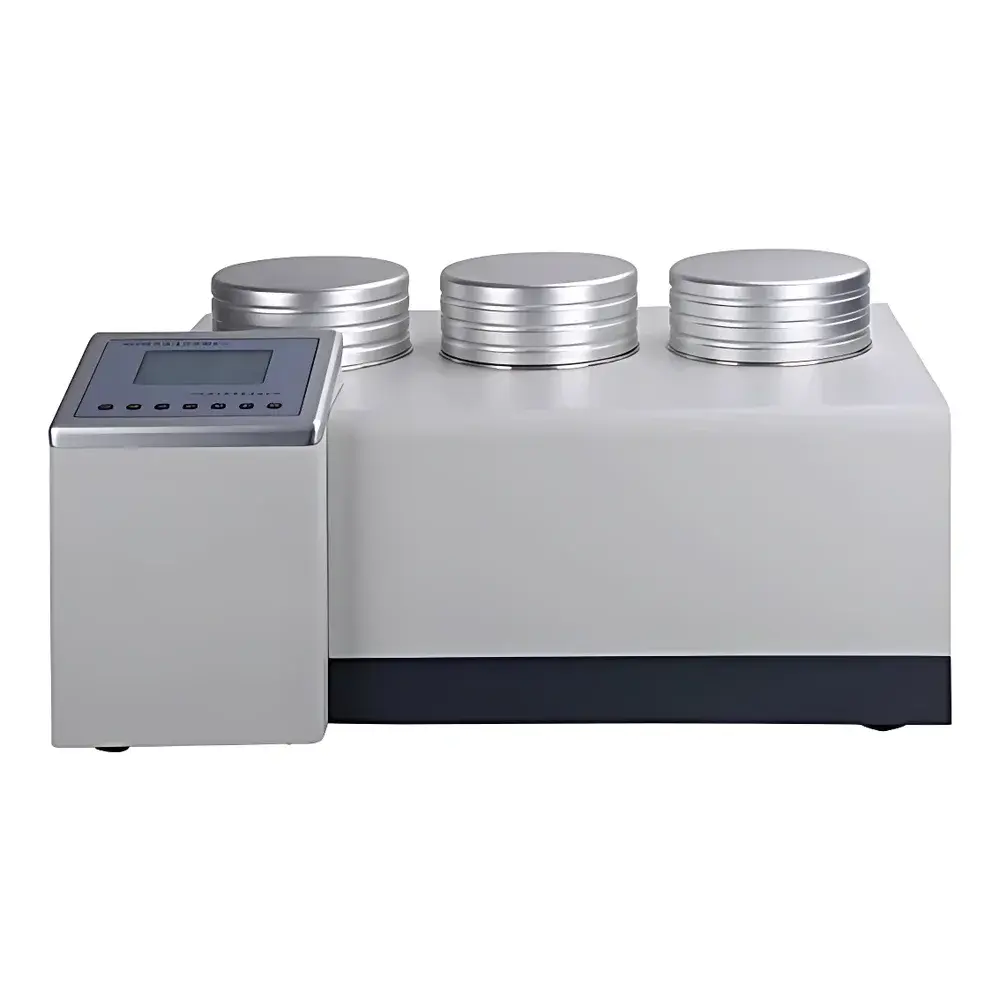
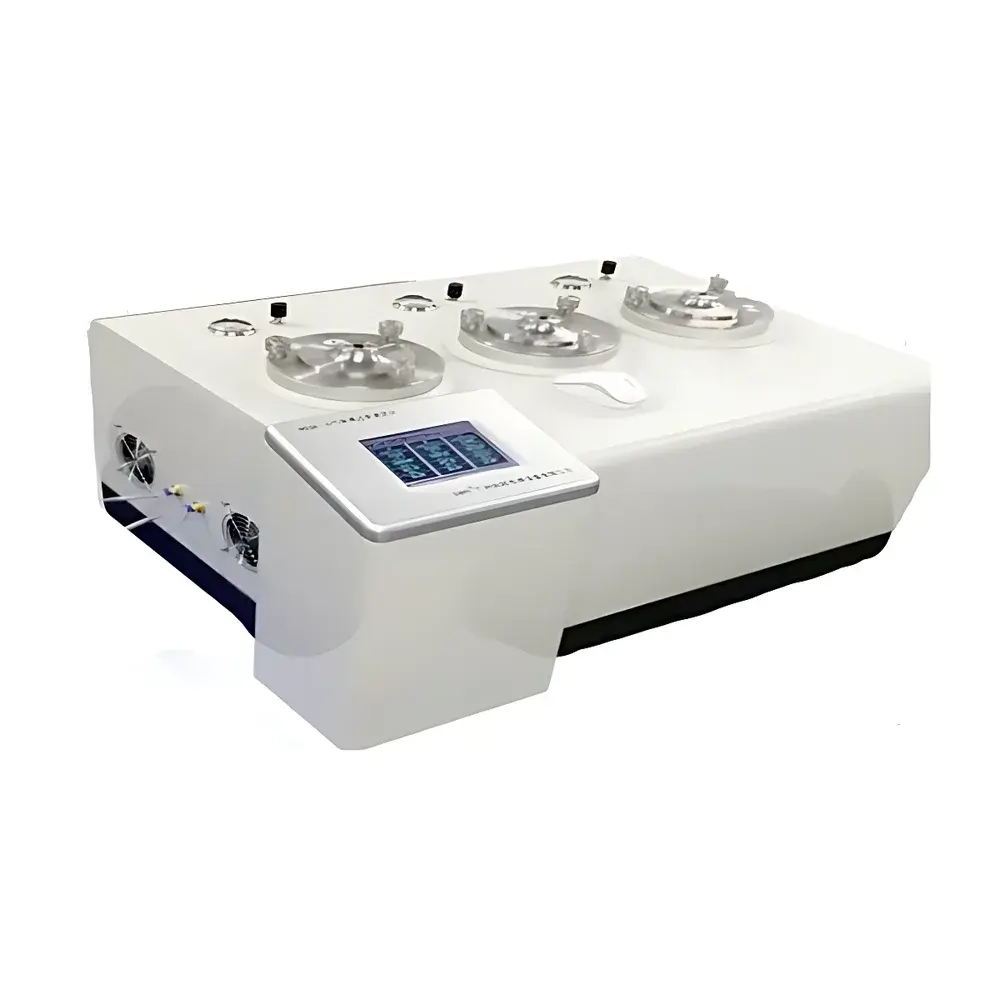
GBPI N530G Gas Permeability Tester
| Brand | GBPI |
|---|---|
| Origin | Guangdong, China |
| Manufacturer Type | OEM/ODM Manufacturer |
| Country of Origin | China |
| Model | N530G |
| Price Range | USD 14,000 – 70,000 |
| Measurement Principle | Differential Pressure (Manometric) Method |
| Gas Types | O₂, CO₂, N₂, Air, He |
| Measurement Range | 0.02–50,000 cm³/(m²·24h·0.1 MPa) [expandable to 600,000 cm³/(m²·24h·0.1 MPa)] |
| Accuracy | ±0.01 cm³/(m²·24h·0.1 MPa) |
| Temperature Control Range | 5–50 °C (optional 5–95 °C) |
| Temp. Stability | ±0.01 °C |
| Humidity Control | 0 %RH (optional 30–90 %RH, ±2 %RH accuracy) |
| Vacuum Resolution | 0.1 Pa |
| Test Chamber Vacuum Level | <10 Pa |
| Test Pressure Range | −0.1 to +0.1 MPa |
| Max. Sample Thickness | ≤2 mm |
| Sample Diameter | Φ97 mm |
| Effective Test Area | 38.48 cm² |
| Concurrent Test Stations | 3 (expandable) |
| Sensors | 3 independent high-stability pressure transducers |
| Power Supply | 220 V AC, 50 Hz |
| Power Consumption | 1000 W |
| Dimensions (W×D×H) | 800 × 560 × 400 mm |
| Weight | 100 kg |
| Interface | RS232/USB |
| Compliance Standards | GB/T 1038, ISO 2556, ISO 15105-1, ASTM D1434, JIS K7126-A, YBB00082003-2015 |
Overview
The GBPI N530G Gas Permeability Tester is a precision differential pressure (manometric) instrument engineered for quantitative determination of gas transmission rates—specifically oxygen (O₂), nitrogen (N₂), carbon dioxide (CO₂), air, and helium (He)—through polymeric films, laminates, foils, and rigid packaging materials. It operates on the fundamental principle of Fick’s first law of diffusion under controlled pressure gradient conditions: a pre-conditioned specimen is sealed between two isolated test chambers; a stable differential pressure is established across the sample (typically high-pressure gas on one side, vacuum or low-pressure inert gas on the other); and the time-dependent pressure rise in the low-pressure chamber is measured via ultra-stable piezoresistive transducers. This real-time manometric response enables direct calculation of gas permeability (P), permeance (GTR), diffusion coefficient (D), and solubility coefficient (S), all traceable to SI units and internationally recognized calibration protocols.
Key Features
- Triple-sensor architecture with three independent, temperature-compensated pressure transducers ensures redundancy, long-term baseline stability, and enhanced signal-to-noise ratio during low-flux measurements.
- Embedded electromagnetic stepwise temperature control system delivers ±0.01 °C thermal stability over 5–50 °C (optionally extended to 95 °C), with programmable ramp rates and active thermal shielding to minimize ambient drift.
- Patented auto-pressure-balance function maintains constant ΔP across the specimen throughout the test cycle—critical for compliance with ISO 15105-1 Annex A and ASTM D1434 dynamic equilibrium requirements.
- Test chamber sealing integrity validated to <10 Pa base vacuum, enabling reliable measurement of ultra-high-barrier substrates—including ceramic thin films, metallized PET, SiOₓ-coated PP, and fluoropolymer composites—where conventional instruments fail.
- Modular multi-station configuration supports up to three simultaneous tests (standard) with optional expansion to six stations, significantly improving throughput for QC laboratories performing batch validation per ISO 22000 or ICH Q5C.
- Real-time graphical display of GTR, chamber pressure, ΔP, and temperature on integrated 7-inch TFT LCD; full parameter logging at user-defined intervals (1 s to 600 s).
- Self-diagnostic firmware with automatic leak detection, overpressure cutoff (±0.1 MPa limit), and vacuum pump interlock safeguards operator safety and data integrity.
Sample Compatibility & Compliance
The N530G accommodates planar specimens up to 2 mm thick and 97 mm in diameter (38.48 cm² effective area), including monolayer and multilayer flexible packaging (e.g., PE/EVOH/PE coextrusions), rigid thermoplastics (PP, PVC, PVDC sheets), coated papers (foil-laminated cigarette packaging), aerospace-grade elastomers (helium-barrier blimp envelopes), biodegradable matrices (starch-PCL blends), and inorganic substrates (alumina ceramics, glass microsheets). Its design conforms rigorously to regulatory testing frameworks: GB/T 1038 (China), ISO 2556 (gas transmission rate of plastics), ISO 15105-1 (differential pressure method), ASTM D1434 (O₂ permeability of plastic film), JIS K7126-A (manometric method), and YBB00082003-2015 (pharmaceutical packaging). All hardware and software support audit-ready electronic records compliant with FDA 21 CFR Part 11 when paired with validated LIMS integration.
Software & Data Management
The proprietary GBPI PermeaSoft v4.2 platform provides fully automated test sequencing, real-time curve fitting (zero-order, linear, and asymptotic models), and ISO-compliant report generation—including GTR, P, D, and S values with expanded uncertainty budgets per GUM (JCGM 100:2008). Raw sensor data is stored in .CSV and .XML formats with embedded metadata (operator ID, calibration timestamp, environmental logs). The software supports GLP/GMP workflows via user role-based access control, electronic signatures, and immutable audit trails. Calibration verification includes certified reference films (e.g., SRM 1477 from NIST-equivalent providers) and pressure transducer zero/span checks traceable to national metrology institutes.
Applications
The N530G serves as a primary characterization tool across regulated and industrial sectors. In pharmaceutical packaging, it validates O₂ transmission through blister lidding foils and cold-forming aluminum composites per USP . In food packaging R&D, it quantifies CO₂ loss from modified-atmosphere coffee pouches and N₂ ingress into snack bags. Electronics manufacturers use it to assess moisture vapor transmission in OLED encapsulation barriers. Automotive suppliers characterize tire innerliner butyl rubber permeability to He and O₂. Renewable energy labs evaluate gas barrier performance of backsheet films for photovoltaic modules per IEC 61215. Additionally, it supports academic research in polymer physics—enabling Arrhenius analysis of activation energies across −273 °C to +200 °C via extrapolated temperature modeling.
FAQ
What gases can be tested with the N530G?
O₂, N₂, CO₂, air, and He are standard; other non-corrosive gases may be qualified upon consultation with GBPI technical support.
Is vacuum pump included in the standard configuration?
No—the N530G requires an external dual-stage oil-sealed or dry scroll vacuum pump (minimum 2 m³/h, ultimate vacuum ≤5 Pa) supplied by the user.
Can the instrument perform tests at elevated humidity?
Yes—optional RH module enables controlled humidification (30–90 %RH, ±2 %RH accuracy) for water vapor-coupled gas permeation studies, critical for hydrophilic polymers.
How is calibration verified?
Using certified reference membranes (e.g., GBPI RM-O2-01) and NIST-traceable pressure calibrators; annual recalibration recommended per ISO/IEC 17025.
Does the system comply with 21 CFR Part 11?
Yes—when deployed with PermeaSoft v4.2 in validated network environments, including electronic signature enforcement, audit trail retention (>10 years), and role-based permissions.
Related Products





