
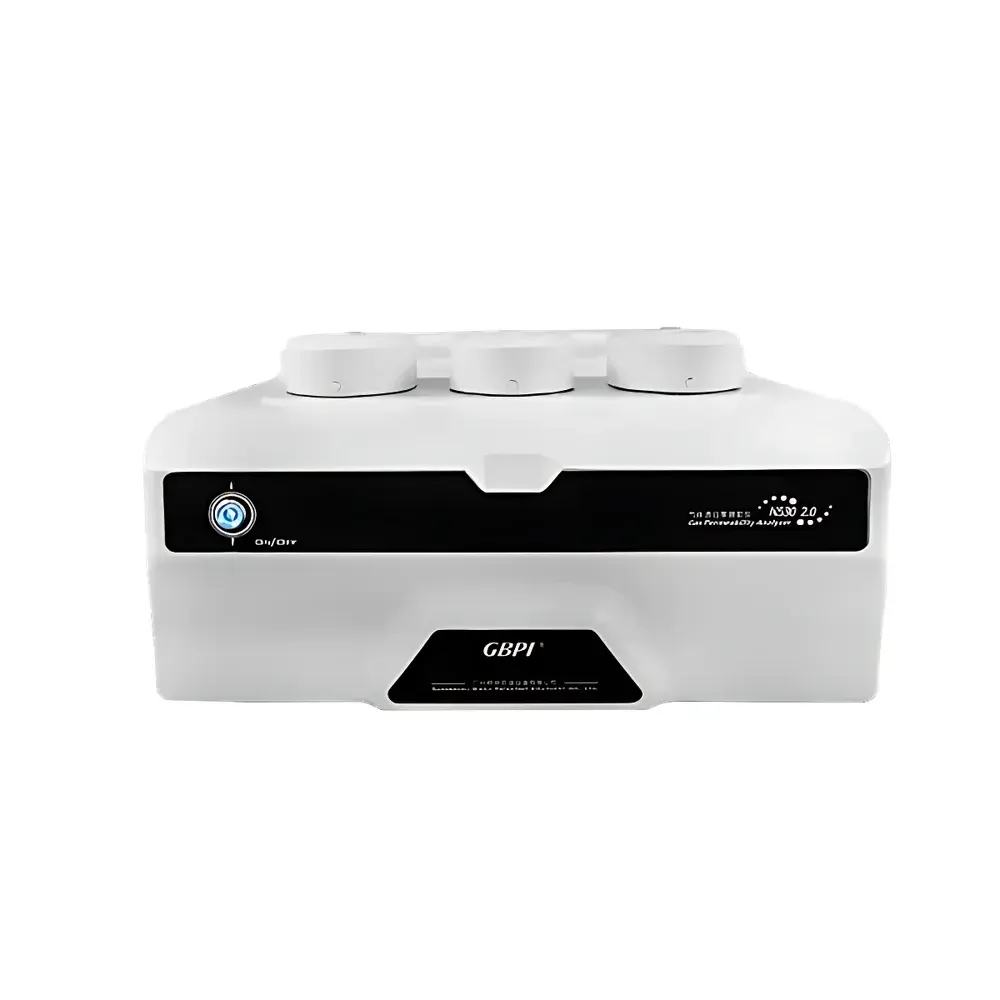
GBPI N530 2.0A Gas Permeability Tester (Differential Pressure Method)
| Brand | GBPI |
|---|---|
| Origin | Guangdong, China |
| Manufacturer Type | Direct Manufacturer |
| Region of Origin | Domestic (China) |
| Model | GBPI N530 2.0A |
| Quotation | Upon Request |
| Test Principle | Differential Pressure Method (ASTM D1434 / ISO 2556 / GB/T 1038 compliant) |
| Measurement Range | 0.01–50000 cm³/(m²·24 h·0.1 MPa), expandable to 600000 cm³/(m²·24 h·0.1 MPa) |
| Resolution | 0.0001 cm³/(m²·24 h·0.1 MPa) |
| Temperature Control Range | 15–60 °C |
| Temperature Stability | ±0.1 °C |
| Vacuum Level | <10 Pa |
| Vacuum Resolution | 0.01 Pa |
| Test Pressure | 0.1 MPa |
| Permeation Area | 50.24 cm² |
| Specimen Diameter | Φ110 mm |
| Max Specimen Thickness | ≤2 mm |
| Specimen Capacity | 3 independent test chambers |
| Power Supply | AC 220 V, 50 Hz |
| Power Consumption | 750 W |
| Dimensions | 690 × 620 × 390 mm |
| Weight | 55 kg |
| Compatible Gases | O₂, CO₂, N₂, air, He |
| Sample Types | Films, sheets, papers, foils, pouches, bottles, cups, trays, tubes, and laminated packaging structures |
Overview
The GBPI N530 2.0A Gas Permeability Tester is an engineered differential pressure method instrument designed for precise, traceable, and repeatable measurement of gas transmission rates (GTR) through packaging and barrier materials. It operates on the fundamental principle of Fick’s first law of diffusion under a controlled transmembrane pressure gradient: a defined test gas (e.g., O₂, CO₂, or N₂) is introduced into the high-pressure upper chamber while the lower chamber is maintained under vacuum; the resulting gas flux across the specimen is quantified via high-resolution pressure transduction in the low-pressure chamber. This methodology ensures thermodynamic equilibrium compliance and direct correlation with internationally recognized mass transport models. The system conforms strictly to ASTM D1434, ISO 2556, ISO 15105-1, JIS K7126-1, YBB 00082003, and GB/T 1038 — making it suitable for regulatory submissions in pharmaceutical, medical device, food, and electronics packaging sectors where barrier integrity directly impacts shelf life, sterility assurance, and product safety.
Key Features
- Triple independent test chambers enable concurrent evaluation of three identical or heterogeneous specimens — each with fully isolated pressure control, real-time data acquisition, and autonomous termination logic.
- Patented auto-pressure-difference maintenance system dynamically regulates and sustains the prescribed 0.1 MPa differential across the specimen surface, eliminating manual intervention and drift-induced error.
- Ultra-high-resolution pressure sensing (0.01 Pa resolution) combined with active thermal stabilization (±0.1 °C over 15–60 °C range) ensures metrological consistency across low-, medium-, and high-barrier materials — from ultra-high阻隔 AlOx-coated PET to microporous nonwovens.
- Integrated dual-direction semiconductor temperature control eliminates mechanical refrigerant loops, reducing maintenance intervals and acoustic noise (<55 dB(A)) during extended-duration tests.
- Pneumatic clamping mechanism with self-aligning sealing gaskets achieves >99.99% leak-tightness at 0.1 MPa differential — validated per ISO 15105-1 Annex B leakage protocols.
- Modular gas manifold supports rapid reconfiguration for O₂, CO₂, N₂, air, or He without hardware modification — all calibrated against NIST-traceable reference standards.
Sample Compatibility & Compliance
The N530 2.0A accommodates planar and 3D specimens per ISO 15105-1 Annex C and ASTM F1307 adaptations. Planar formats include monolayer and multilayer films (e.g., BOPP, PET, PE, PLA, PBAT), metallized foils, paperboard laminates, pharmaceutical blister foils (PVC/PP/PTP), and functional barrier coatings. For non-planar packaging, optional fixtures enable testing of rigid and semi-rigid containers — including PET bottles, aluminum cans, thermoformed trays, stand-up pouches, and laminated tubes — using volumetric expansion compensation algorithms. All test procedures comply with GLP and GMP requirements: audit trails record user ID, timestamp, parameter changes, calibration events, and raw sensor outputs. System validation documentation aligns with FDA 21 CFR Part 11 and EU Annex 11 expectations for computerized systems used in regulated environments.
Software & Data Management
The embedded GBPI SmartOS v4.2 platform features role-based access control (RBAC) with three-tiered user permissions (Operator, Supervisor, Administrator), electronic signature capability per 21 CFR Part 11 §11.200, and immutable audit logs covering all critical actions. Test methods are stored as reusable templates with configurable ramp profiles, dwell times, and pass/fail criteria. Real-time visualization includes five synchronized time-series plots: permeation rate vs. time, chamber temperature vs. time, upper/lower chamber pressure vs. time, and differential pressure drift vs. time — all exportable as CSV, PDF, or XML. Reports adhere to ISO/IEC 17025 formatting conventions and support automated integration with LIMS via OPC UA or RESTful API. Calibration history, certificate traceability (GBW(E)130541/130542), and uncertainty budgets are embedded within each report metadata layer.
Applications
This instrument serves as a primary metrology tool in R&D laboratories evaluating polymer structure–property relationships (e.g., crystallinity effects on O₂ permeability), QC labs validating incoming film lots against specification limits (e.g., ≤5 cm³/m²·24h·0.1MPa for pharmaceutical cold-form blisters), and regulatory affairs teams generating stability dossier data for FDA IND/NDA submissions. Key application domains include: oxygen-sensitive pharmaceutical packaging (lyophilized biologics, oral solid dosage forms); modified atmosphere packaging (MAP) for fresh produce and meat; moisture-sensitive electronics encapsulation (e.g., OLED display barriers); photovoltaic backsheet durability assessment; and compostable film development for sustainable packaging mandates (EN 13432, ASTM D6400). Its ability to quantify CO₂ transmission is critical for carbonated beverage container qualification per ISO 11607-1.
FAQ
What international standards does the N530 2.0A validate against?
It is fully compliant with ASTM D1434, ISO 2556, ISO 15105-1, GB/T 1038, JIS K7126-1, and YBB 00082003 — with documented verification reports available upon request.
Can the system be used for package-level testing (e.g., bottles or pouches)?
Yes — optional accessories enable ASTM F2338-compliant package testing with volumetric compensation for headspace expansion and seal integrity verification.
Is third-party calibration and certification supported?
GBPI holds CNAS accreditation (L8185) and provides ISO/IEC 17025-compliant calibration services using GBW(E)130541/130542 certified reference materials traceable to NIM (National Institute of Metrology, China).
How is data integrity ensured for regulated environments?
The system implements full 21 CFR Part 11 compliance: electronic signatures, audit trail encryption, user authentication, and immutable raw data storage — validated per GAMP5 Category 4 requirements.
What maintenance is required for long-term operational reliability?
Annual vacuum pump oil replacement and biannual pressure sensor zero calibration are recommended; GBPI offers remote diagnostics, firmware updates, and on-site service contracts with SLA-backed response times.






