
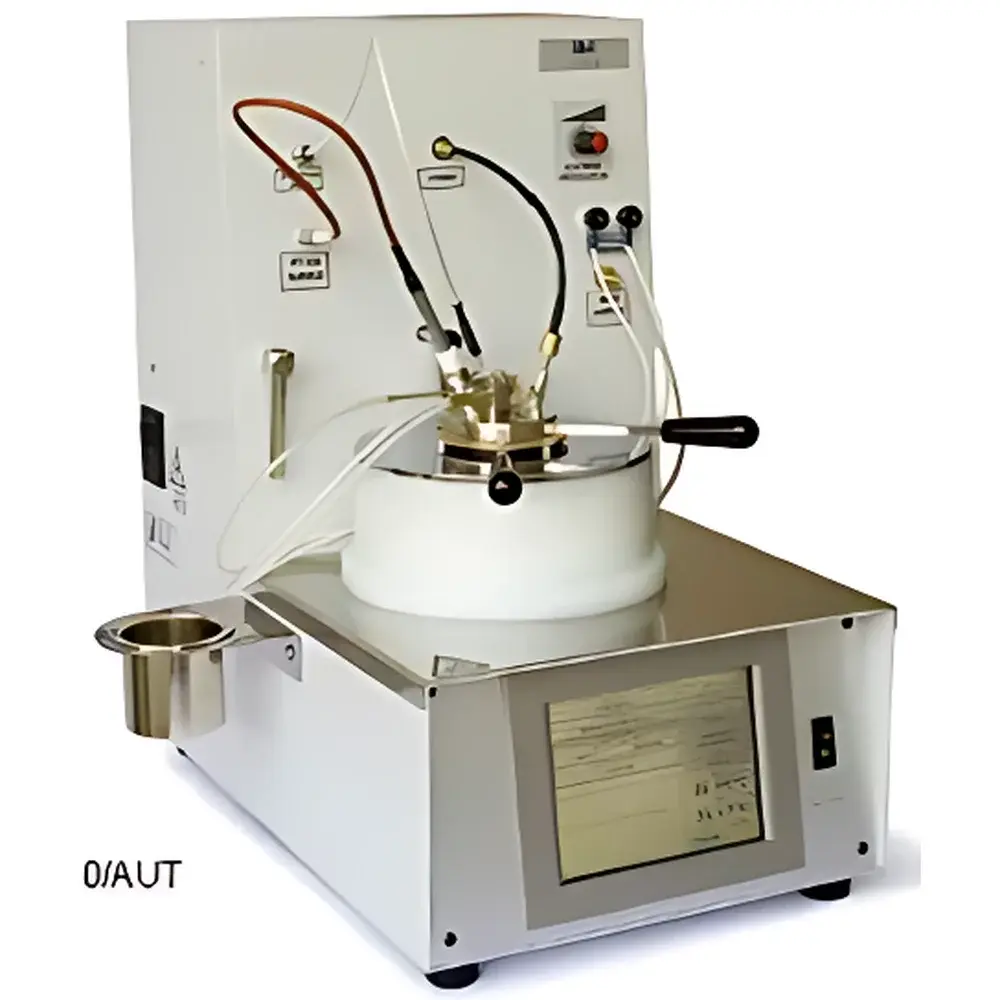
SDM 820AUT Abel Closed-Cup Flash Point Tester
| Brand | SDM |
|---|---|
| Origin | Italy |
| Model | 820AUT |
| Test Method | Abel Closed-Cup |
| Temperature Range | –30 °C to +70 °C (with external chiller) |
| Temperature Accuracy | ±0.1 °C |
| Display | 800×480 Touchscreen |
| Power Supply | 220 V, 50 Hz |
| Power Consumption | 300 W |
| Dimensions | 33 × 46 × 57 cm |
| Weight | 28 kg |
| Compliance | IP 170, IP 491, IP 492, ISO 1516, ISO 3679, ISO 13736 |
Overview
The SDM 820AUT Abel Closed-Cup Flash Point Tester is a precision-engineered instrument designed for the accurate and repeatable determination of flash point in petroleum products, solvents, lubricants, and other volatile liquids according to the standardized Abel closed-cup method. It operates on the fundamental principle of controlled heating under sealed conditions, where vapour concentration above the sample surface is incrementally increased until the lowest temperature at which an ignitable vapour–air mixture forms—i.e., the flash point—is detected via ionization sensing. Unlike open-cup methods, the Abel procedure employs a tightly sealed brass test cup with integrated ignition and vapor containment, ensuring high reproducibility and alignment with regulatory requirements for safety-critical classification (e.g., UN GHS, CLP, OSHA HCS). The instrument is fully compliant with internationally recognized standards including IP 170, IP 491, IP 492, ISO 1516, ISO 3679, and ISO 13736—making it suitable for use in quality control laboratories, refinery QC departments, and third-party testing facilities operating under ISO/IEC 17025 accreditation frameworks.
Key Features
- Abel-specific closed-cup configuration with calibrated brass test cup and acid-resistant epoxy-coated chassis for long-term chemical resistance and mechanical stability
- Dual-mode ignition system: selectable electric spark or pilot flame ignition, both automatically triggered at user-defined temperature intervals per standard protocol
- Precise electronic PID temperature control with ±0.1 °C accuracy across the full operational range (–30 °C to +70 °C when coupled with external chiller)
- Integrated air- and water-bath thermal environment, featuring chrome-plated copper heating block and internal cooling coil with external coolant interface
- Motor-driven magnetic stirrer ensures homogeneous sample temperature distribution during ramping and holding phases
- Ionization-based flash detection system with real-time signal processing, eliminating subjective visual interpretation and minimizing operator bias
- 800×480 high-contrast touchscreen interface with intuitive navigation, multilingual support (English, Italian, Spanish, German), and context-sensitive help
Sample Compatibility & Compliance
The 820AUT accommodates samples with low to moderate volatility, including kerosene, diesel fuel, heating oils, biodiesel blends, white spirit, and industrial solvents. Its closed-cup design prevents premature vapor loss and enables reliable measurement of flash points below 60 °C—critical for hazard classification under EU REACH Annex XVII and transport regulations (ADR/RID/IMDG Code). All hardware and firmware components are validated against the repeatability and reproducibility criteria specified in ISO 4256 and ASTM D93 Annex A1. The system supports GLP-compliant operation through audit-trail-enabled software logging, user access levels, and electronic signature capability—fully compatible with FDA 21 CFR Part 11 requirements when deployed with appropriate IT infrastructure controls.
Software & Data Management
The embedded Windows-compatible application (tested on Windows 2000 through Windows Vista) provides comprehensive method development, calibration management, and result documentation. Core modules include: Analysis (method selection, parameter definition, real-time curve visualization), Diagnostics (system self-test, sensor validation, error code reporting), Calibration (multi-point temperature verification using certified reference standards), and Data Processing (export to CSV, PDF report generation with customizable templates, trend analysis, and statistical summary). All test records—including raw temperature/time data, ignition events, pass/fail status, and operator ID—are time-stamped and stored with immutable timestamps. Data export functions support integration into LIMS environments via ODBC or direct file transfer protocols.
Applications
- Flash point verification for incoming crude oil and refined product batches prior to storage or blending
- Regulatory compliance testing for SDS preparation and GHS classification (Category 1–4 flammability)
- In-process monitoring during solvent recovery and distillation unit operation
- Research and development of low-flash biofuels and reformulated gasoline components
- Third-party certification testing for ISO 8217 marine fuels and ASTM D396 heating oils
- Contract laboratory services requiring traceable, auditable flash point data under ISO/IEC 17025
FAQ
What standards does the 820AUT comply with?
It meets IP 170, IP 491, IP 492, ISO 1516, ISO 3679, and ISO 13736 for Abel closed-cup flash point determination.
Can the instrument operate below ambient temperature?
Yes—when connected to an external recirculating chiller, the operational range extends to –30 °C.
Is the ionization detector replaceable or field-calibratable?
The detector is factory-aligned and includes built-in diagnostics; recalibration is performed using NIST-traceable reference fluids during scheduled maintenance.
Does the software support electronic signatures for regulated environments?
Yes—user authentication, role-based permissions, and audit-trail logging are enabled to satisfy 21 CFR Part 11 and EU Annex 11 requirements.
What maintenance is required for long-term reliability?
Routine cleaning of the brass cup and lid, periodic verification of stirrer speed and ignition timing, and annual temperature sensor calibration using certified reference thermometers.





