GBPI GBB-F Five-Point Heat Sealing Tester
| Brand | GBPI |
|---|---|
| Origin | Guangdong, China |
| Manufacturer Type | Direct Manufacturer |
| Country of Origin | China |
| Model | GBB-F-aa |
| Price Range | USD 4,200 – 7,000 |
| Temperature Range | Ambient to 300 °C |
| Temperature Control Accuracy | ±1 °C |
| Sealing Time | 0.1–999.9 s |
| Sealing Pressure | 0.05–0.8 MPa |
| Sealing Surface Dimensions (Upper/Lower Jaw) | 300 × 5.5 mm (smooth) |
| Heating Mode | Dual (Automatic & Manual) |
| Pneumatic Source | Compressed Air |
| Overall Dimensions | 700 × 400 × 540 mm |
| Weight | 55 kg |
| Power Rating | 2000 W |
| Electrical Supply | AC 220 V, 50 Hz |
Overview
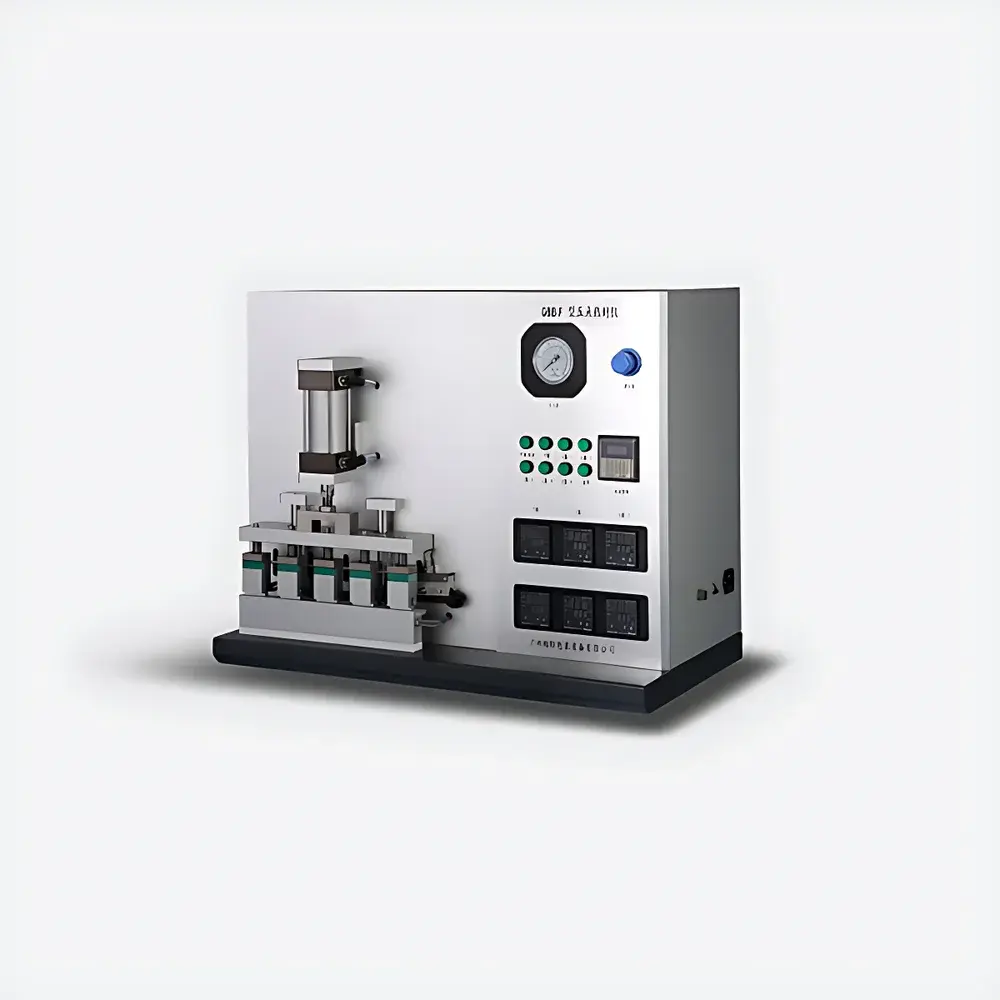
The GBPI GBB-F Five-Point Heat Sealing Tester is an engineered solution for precise, repeatable evaluation of heat seal integrity in flexible packaging materials. Designed in accordance with fundamental thermomechanical sealing principles—where polymer chain mobility, interfacial diffusion, and pressure-induced molecular entanglement govern seal formation—the instrument enables systematic determination of the critical process parameters: sealing temperature, dwell time, and applied pressure. Unlike single-point testers, the GBB-F integrates five independently controlled heating zones across its upper sealing jaw, allowing concurrent assessment of thermal sensitivity gradients across a single specimen or parallel optimization of multiple material configurations. This architecture supports both R&D-driven parameter mapping and QC validation under standardized test conditions aligned with international packaging performance requirements.
Key Features
- Five-zone independent temperature control: Each of the five upper sealing elements operates at a user-defined setpoint (ambient to 300 °C), enabling multi-temperature profiling across one sample strip or simultaneous testing of five distinct material batches.
- Dual-mode operation: Fully automated pneumatic cycling (programmable via front-panel interface) and manual foot-switch activation for rapid prototyping or operator-guided seal trials.
- Precision pneumatic actuation: Compressed-air-driven sealing force delivery ensures consistent pressure application (0.05–0.8 MPa) with minimal mechanical hysteresis and high repeatability between cycles.
- Modular sealing interface: Standard 300 × 5.5 mm smooth stainless-steel upper jaws paired with a silicone-padded lower bar; custom geometries (e.g., rounded edges, stepped profiles, textured surfaces) available upon request to replicate production-grade tooling.
- Thermal calibration accessibility: Integrated Pt100 sensors are field-serviceable and traceably calibratable using standard reference thermometers—supporting GLP-compliant documentation and internal audit readiness.
- Robust industrial construction: 55 kg cast-aluminum frame with reinforced thermal insulation, rated for continuous 2000 W operation under AC 220 V / 50 Hz supply.
Sample Compatibility & Compliance
The GBB-F accommodates a broad spectrum of thermoplastic packaging substrates—including LDPE, HDPE, PP, PET, CPP, aluminum-laminates, and coextruded structures—commonly used in pharmaceutical blister lidding, food pouches, medical device sterile barriers, and cosmetic sachets. Its operational envelope satisfies the physical test requirements of key regulatory and industry standards: QB/T 2358–1998 (Chinese national standard for plastic film heat seal strength), ASTM F2029–2016 (Standard Test Method for Making Heat-Sealed Packages for Use in Integrity Testing), and YBB 00122003–2015 (Chinese Pharmacopoeia packaging container standard for heat-seal integrity). While the instrument itself does not carry FDA 510(k) clearance, its output data—when generated under documented SOPs—supports submissions requiring evidence of seal process validation per FDA Guidance for Industry: Container Closure Systems for Packaging Human Drugs and Biologics (2022) and EU Annex 1 (2022) sterility assurance frameworks.
Software & Data Management
The GBB-F operates via an embedded microcontroller-based interface with non-volatile parameter storage (up to 99 test protocols). All critical parameters—temperature setpoints per zone, pressure, dwell time, cycle count, and timestamp—are logged internally and exportable via USB to CSV format. While no proprietary PC software is bundled, the structured log files integrate seamlessly with LIMS platforms (e.g., LabWare, Thermo Fisher SampleManager) and statistical process control tools (e.g., Minitab, JMP) for trend analysis, SPC charting, and CAPA documentation. Audit trail functionality complies with ALCOA+ principles when paired with institutional electronic record policies; full 21 CFR Part 11 compliance requires integration with validated third-party electronic lab notebook (ELN) or quality management system (QMS) infrastructure.
Applications
- Optimization of heat seal initiation temperature (HIT) and hot tack onset for new film formulations.
- Validation of sealing parameter windows during packaging line qualification (IQ/OQ/PQ).
- Comparative analysis of seal strength vs. aging (post-seal dwell time) in accelerated stability studies.
- Root-cause investigation of delamination, channel leaks, or weak seals in complaint investigations.
- Supporting ISO 11607–1:2019 Annex D risk assessments for sterile barrier systems.
- Teaching laboratory use in polymer science and packaging engineering curricula.
FAQ
Does the GBB-F support real-time temperature monitoring during sealing?
Yes—each of the five upper sealing zones incorporates a dedicated Pt100 sensor with continuous readout displayed on the front panel during active heating and sealing phases.
Can the sealing pressure be calibrated traceably?
Pressure transducer calibration is performed at factory level against NIST-traceable deadweight testers; users may verify linearity using certified pressure gauges connected to the pneumatic manifold test port.
Is firmware upgrade capability available?
Firmware updates are distributed annually via secure download from GBPI’s technical support portal and installed via USB drive—no external service engineer required.
What maintenance intervals are recommended for long-term accuracy?
Biannual verification of thermal uniformity (per ASTM E220) and annual pneumatic system leak check (per ISO 8573–1 Class 4) are advised; GBPI provides certified calibration kits and service bulletins.
Are replacement sealing jaws available with anti-adhesion coatings?
Yes—optional DLC (diamond-like carbon) or ceramic-coated upper jaws reduce residue buildup on high-additive films and extend maintenance intervals without compromising thermal conductivity.
Related Products