
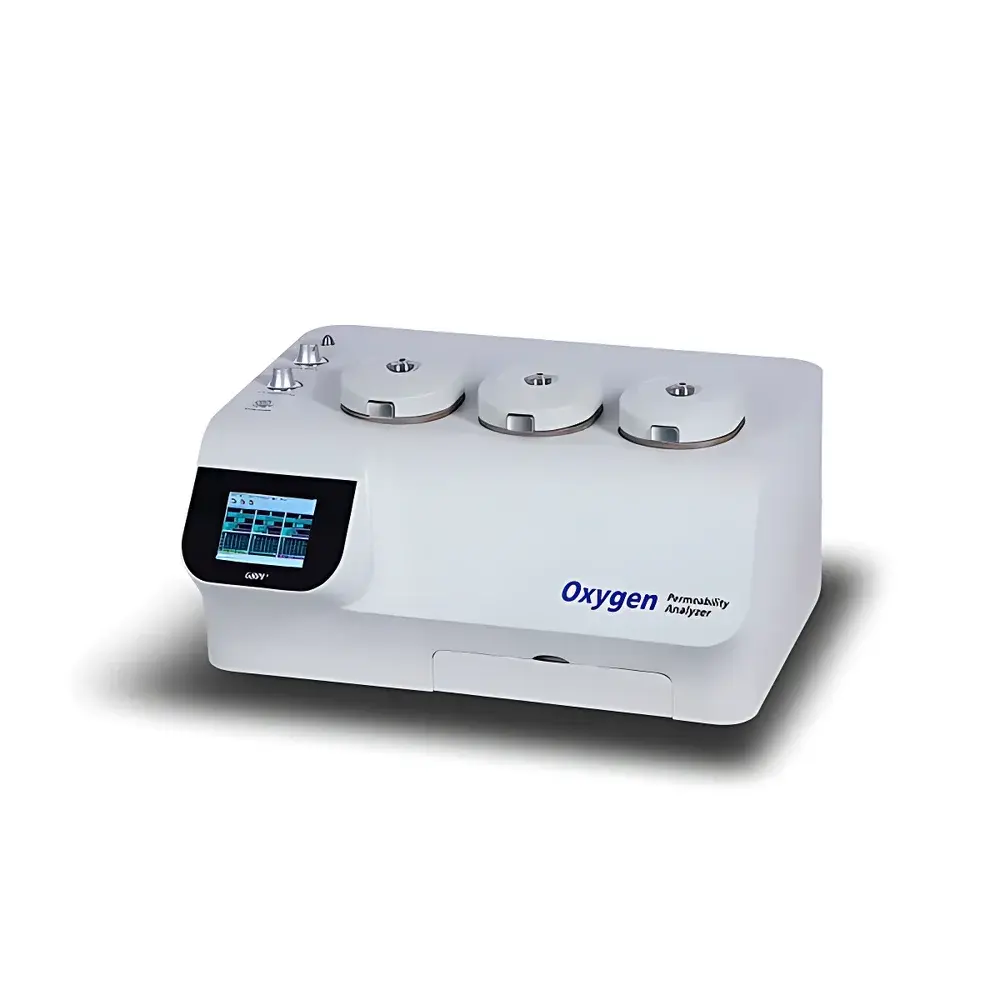
GBPI Y310-2 Isostatic Pressure Oxygen Transmission Rate (OTR) Analyzer
| Brand | GBPI |
|---|---|
| Origin | Guangdong, China |
| Manufacturer Type | OEM Manufacturer |
| Region Classification | Domestic (China) |
| Model | Y310-2 |
| Price Range | USD 14,000 – 70,000 |
| Test Range | 0.02–16,500 cm³/(m²·24h) (film) |
| O₂ Resolution | 0.001 cm³/(m²·24h) |
| Temperature Control | 15–45 °C (optional 5–50 °C) |
| Temp Accuracy | ±0.1 °C |
| Humidity Range | 0%, 30–90%, or 100% RH |
| Humidity Accuracy | ±1% RH |
| Test Area | 50.24 cm² |
| Specimen Size | Φ100 mm |
| Max Thickness | ≤3 mm |
| Sample Capacity | 1–3 specimens per test cycle |
| Carrier Gas Pressure | 0.1–0.2 MPa |
| Gas Inlet | 1/8″ stainless steel tubing |
| Dimensions | 700 × 560 × 370 mm |
| Weight | 100 kg |
| Power | 750 W, AC 220 V, 50 Hz |
Overview
The GBPI Y310-2 Isostatic Pressure Oxygen Transmission Rate (OTR) Analyzer is a gravimetrically referenced, coulometric sensor-based instrument engineered for precise and repeatable measurement of oxygen permeation through polymeric films, laminates, rigid sheets, and packaged containers. It operates on the principle of isostatic pressure differential—maintaining equal upstream and downstream partial pressures of oxygen while quantifying its diffusion across a sealed specimen under controlled temperature and humidity conditions. This method ensures minimal boundary-layer interference and high fidelity for both low-barrier (e.g., PET, PE) and ultra-high-barrier materials (e.g., Al-coated films, SiOx-coated substrates, pharmaceutical blister foils). Designed for compliance-driven laboratories, the Y310-2 delivers traceable, metrologically validated OTR data aligned with international regulatory expectations for packaging integrity assessment in pharmaceutical, food, medical device, and electronics sectors.
Key Features
- Triple-test chamber architecture enabling independent, concurrent OTR measurements on up to three specimens—each with autonomous start/stop, real-time monitoring, and discrete report generation.
- High-resolution coulometric oxygen sensor (detection limit: 0.001 cm³/(m²·24h)) with auto-range extension via optional OTR mask—extending upper detection limit to 260,000 cm³/(m²·24h) for porous or non-barrier materials.
- Electromagnetic programmable temperature control (±0.1 °C accuracy) and dual-stream humidity regulation (dry/wet gas blending; ±1% RH stability at 30–90% RH, plus dry and saturated modes).
- ARM-based embedded control system allowing standalone operation—no host PC required for routine testing, calibration, or diagnostics.
- Full GMP-aligned software architecture compliant with FDA 21 CFR Part 11 and EU Annex 11 requirements: role-based user access (Administrator, Operator, Reviewer), electronic signatures, and comprehensive audit trails covering system events, method changes, and raw data modifications.
- Integrated calibration workflow supporting dual-reference traceability: certified standard reference films (e.g., 125 µm polyethylene) and NIST-traceable O₂/N₂ gas mixtures—both validated against GBPI’s national standard substance certificates (GBW(E)130497/8).
Sample Compatibility & Compliance
The Y310-2 accommodates flat specimens up to 3 mm thick and 100 mm in diameter—including monolayer polymers, metallized composites, ceramic-coated substrates, rubber gaskets, and rigid thermoplastics. With optional container adapters, it quantifies OTR for bottles (PET, HDPE), pouches (stand-up, retort), trays, and blister cavities using standardized headspace equilibration protocols. All test methodologies adhere to ISO 15105-2, ASTM D3985 (electrochemical sensor), ASTM F1927 (moisture-corrected OTR), ASTM F1307 (container testing), ASTM F2622 (high-resolution film testing), GB/T 19789-2005, YBB00082003-2015 (Chinese pharmaceutical packaging standards), DIN 53380-3, and JIS K-7126-B. Instrument validation documentation supports GLP and GMP audit readiness.
Software & Data Management
The GBPI OTR Studio v4.x software provides a Windows-native interface with intuitive workflow configuration, real-time multi-parameter visualization (OTR, O₂ concentration, temperature, RH), and dynamic curve zoom/pan functionality. All raw sensor outputs, environmental logs, and calculation metadata are stored in an encrypted local SQLite database with automatic backup and versioned export (CSV, PDF, Office-compatible reports). Audit trail records include timestamped entries for user login/logout, method parameter edits, calibration execution, and result approval—fully searchable and exportable for regulatory submission. Data integrity is reinforced by write-protected archival mode and tamper-evident digital signatures.
Applications
- Pharmaceutical packaging: barrier validation of blister lidding foils, sachets, and cold-forming films per USP and ICH Q5C stability guidance.
- Food packaging R&D: shelf-life modeling of vacuum-sealed trays, modified-atmosphere packaging (MAP), and active packaging systems.
- Medical device packaging: ISO 11607-1 compliance verification for sterile barrier systems (SBS) used in Class II/III devices.
- Flexible electronics: OTR screening of encapsulation films for OLED displays, photovoltaic backsheets, and flexible batteries.
- Regulatory submissions: generation of technically defensible OTR datasets for FDA 510(k), CE marking technical files, and PMDA dossier support.
FAQ
What calibration standards are supported?
The Y310-2 accepts both certified reference films (e.g., GBPI-supplied 125 µm PE standard) and NIST-traceable O₂/N₂ gas mixtures. Calibration is performed via automated software-guided procedures requiring no external instrumentation.
Is container testing possible without custom fixtures?
Yes—the base system includes universal bottle/pouch adapters compatible with common pharmaceutical and food-grade containers. Custom fixtures are available upon request for non-standard geometries.
Does the instrument meet 21 CFR Part 11 requirements?
Yes. The embedded software implements full electronic signature enforcement, role-based permissions, and immutable audit trails meeting FDA requirements for computerized systems in regulated environments.
Can humidity be controlled at 0% RH and 100% RH simultaneously across chambers?
Each chamber operates independently; users may configure distinct RH setpoints per chamber—including dry (0% RH), saturated (100% RH), or intermediate (30–90% RH) conditions—within a single test run.
What maintenance is required for the oxygen sensor?
The coulometric sensor requires no routine consumables. GBPI recommends annual performance verification using standard films and biennial sensor recalibration by authorized service centers. Built-in over-range protection prevents sensor damage during accidental exposure to high-O₂ environments.






