
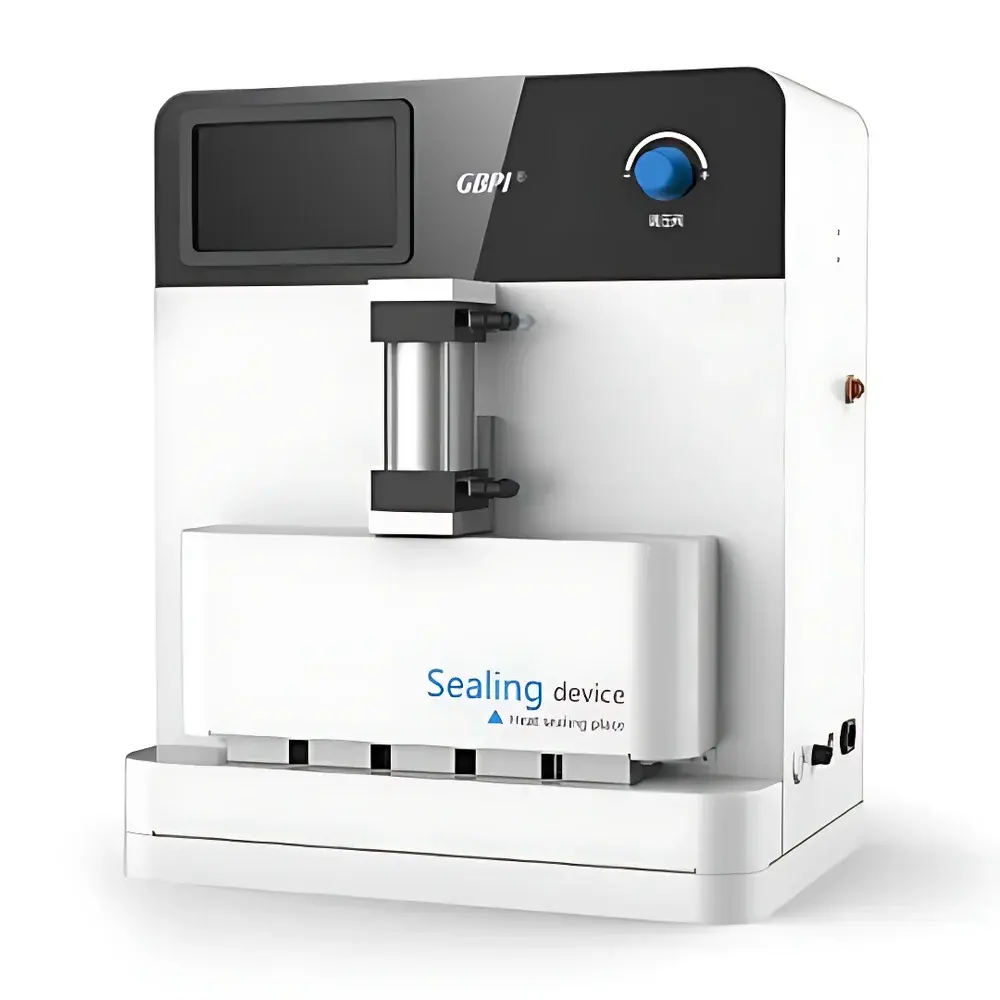
GBPI GBB-F1X Heat Sealing Tester
| Brand | GBPI |
|---|---|
| Origin | Guangdong, China |
| Manufacturer Type | Direct Manufacturer |
| Model | GBB-F1X |
| Temperature Range | Ambient to 250 °C |
| Temperature Control Accuracy | ±0.1 °C |
| Sealing Time Range | 0.1 s to 99 h 59 min 59.9 s |
| Sealing Pressure Range | 0.1–0.8 MPa |
| Sealing Surface | Five independent upper sealing bars (35 × 10 mm each) + heated lower sealing bar with silicone pad |
| Heating Method | Dual-zone resistive heating |
| Drive System | Pneumatic, dual-cylinder synchronized actuation |
| Control Interface | 7-inch color TFT touchscreen with embedded controller |
| Operating Modes | Automatic, Manual, and Foot-pedal triggered |
| Compliance Standards | QB/T 2358–1998, ASTM F2029, YBB00122003–2015 |
Overview
The GBPI GBB-F1X Heat Sealing Tester is an engineered solution for quantitative evaluation of heat seal integrity in flexible packaging materials. It operates on the principle of controlled thermal compression—applying precisely regulated temperature, pressure, and dwell time to induce molecular interdiffusion at polymer interfaces. This process replicates industrial sealing conditions used in vertical form-fill-seal (VFFS), horizontal form-fill-seal (HFFS), and pouch-making equipment. The instrument is designed for laboratories requiring repeatable, traceable, and standards-compliant seal optimization—particularly where regulatory documentation, material qualification, or process validation is mandated (e.g., pharmaceutical blister lidding, sterile barrier systems, food-grade laminates).
Key Features
- Five-point independent thermal control: Five upper sealing bars and one lower sealing bar operate with fully decoupled PID temperature regulation—enabling multi-zone thermal profiling across a single sample or parallel evaluation of five distinct seal parameters.
- High-fidelity thermal management: Equipped with calibrated platinum RTD sensors and digital PID controllers delivering ±0.1 °C stability over the full 25–250 °C range; sensor calibration verification is accessible via on-device diagnostics.
- Pneumatic actuation architecture: Dual externally mounted cylinders ensure uniform force distribution and mechanical repeatability; integrated pressure transducer provides real-time feedback and closed-loop pressure regulation from 0.1 to 0.8 MPa.
- Human-centered operational interface: 7-inch capacitive touchscreen displays live values for all critical parameters (temperature per zone, applied pressure, elapsed time, cycle status); supports both touch-initiated and foot-switch operation for hands-free workflow integration.
- Configurable sealing geometry: Standard sealing surfaces are 35 × 10 mm per upper bar; custom tooling—including contoured, grooved, or anti-adhesion coated dies—is available upon request to accommodate specialized substrates (e.g., metallized PET, peelable medical films, high-barrier foils).
Sample Compatibility & Compliance
The GBB-F1X accommodates a broad spectrum of thermoplastic-based packaging structures: mono- and co-extruded polyolefin films (LDPE, LLDPE, PP), polyester-laminates (PET/AL/PE), aluminum foils with polymer coatings, paper-plastic composites, and medical-grade Tyvek®-polyethylene laminates. Seal performance assessment aligns with internationally recognized test methodologies—including QB/T 2358–1998 (Chinese national standard for plastic film heat seal strength), ASTM F2029–22 (Standard Test Method for Making Heat-Sealed Packages for Testing), and YBB00122003–2015 (Chinese Pharmacopoeia standard for pharmaceutical packaging). When configured with optional audit-trail software, the system meets GLP/GMP data integrity requirements per FDA 21 CFR Part 11, supporting electronic signatures, user role-based access control, and immutable event logging.
Software & Data Management
An optional PC-based application enables method creation, parameter scheduling, batch reporting, and statistical analysis (mean, SD, CV%, trend charts). All test records include metadata: operator ID, timestamp, environmental conditions (if external sensor linked), instrument firmware version, and calibration history. Audit trail functionality captures every action—user login/logout, parameter modification, result export, and report generation—with timestamps and initiating user attribution. Role-based permissions allow administrators to assign granular access rights (e.g., “Operator” may run tests but not modify calibration; “Observer” views historical data only). Data exports comply with ISO/IEC 17025 documentation requirements and support CSV, PDF, and XML formats for LIMS integration.
Applications
- Optimization of sealing parameters for new film formulations or converted packaging structures
- Validation of heat seal process windows prior to production line commissioning
- Comparative analysis of seal strength across different sealant layers (e.g., EVA vs. ionomer vs. Surlyn®)
- Accelerated aging studies correlating seal integrity with storage conditions (humidity, temperature)
- Root cause analysis of package failures—leakage, delamination, or seal creep under stress
- Regulatory submission support for FDA 510(k), EU MDR Class IIa/b dossiers, or PMDA packaging validation packages
FAQ
What standards does the GBB-F1X directly support?
It natively implements test protocols defined in QB/T 2358–1998, ASTM F2029–22, and YBB00122003–2015. Optional software modules extend compliance to ISO 11607–2 and ISTA 3A for medical device packaging validation.
Is external compressed air required?
Yes—a clean, dry, oil-free air supply (minimum 0.8 MPa, 2.5 HP compressor recommended) must be connected via 6 mm PU tubing with inline filtration (particulate, moisture, and oil removal).
Can the instrument be integrated into an automated lab environment?
Via optional RS-232 or USB CDC serial interface, the GBB-F1X supports SCPI-like command sets for remote triggering, parameter upload, and result polling—compatible with LabVIEW, Python pySerial, or MES orchestration platforms.
What maintenance is required for long-term accuracy?
Annual verification of temperature uniformity (per ASTM E220), pressure transducer calibration, and seal bar flatness inspection using optical interferometry or precision gauge blocks is recommended. GBPI provides certified calibration certificates traceable to NIM (China National Institute of Metrology).
Is technical support available outside mainland China?
Yes—GBPI maintains authorized service partners in Southeast Asia, the Middle East, and Latin America; firmware updates and remote diagnostics are delivered via secure cloud portal with TLS 1.3 encryption.





