
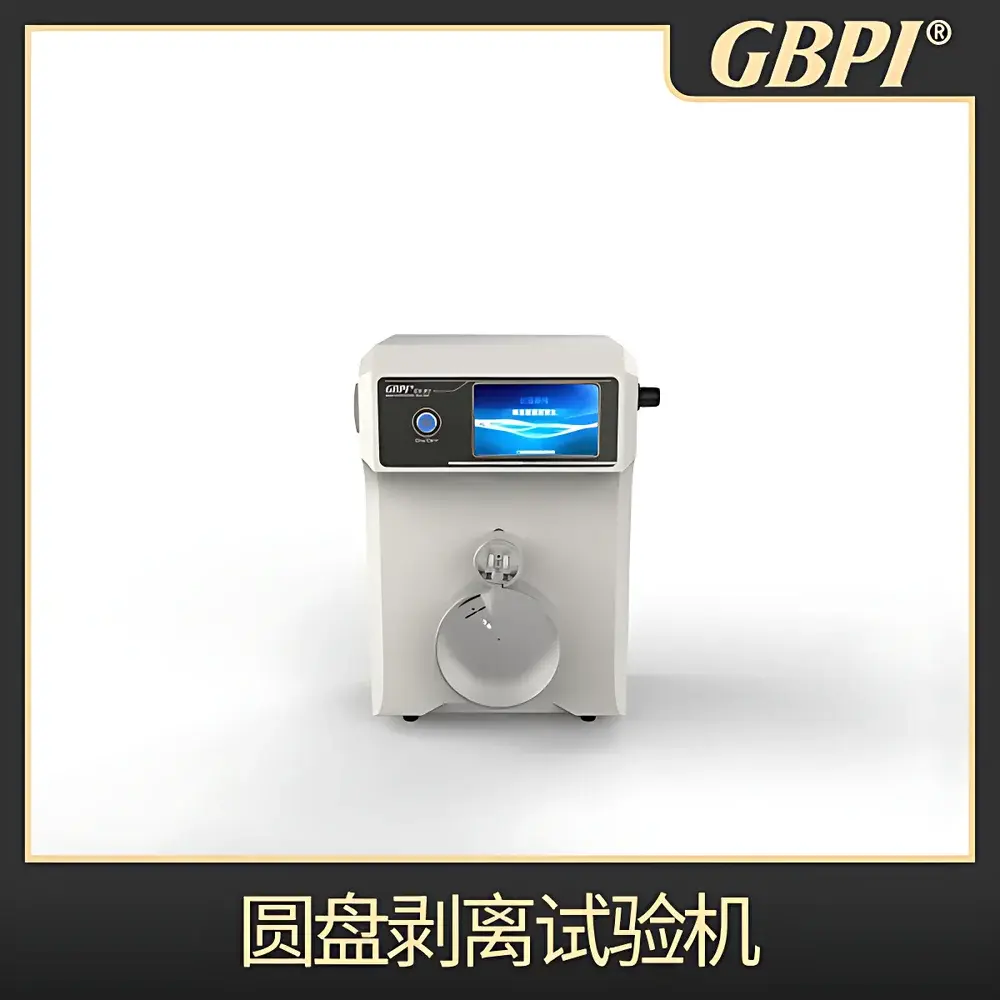
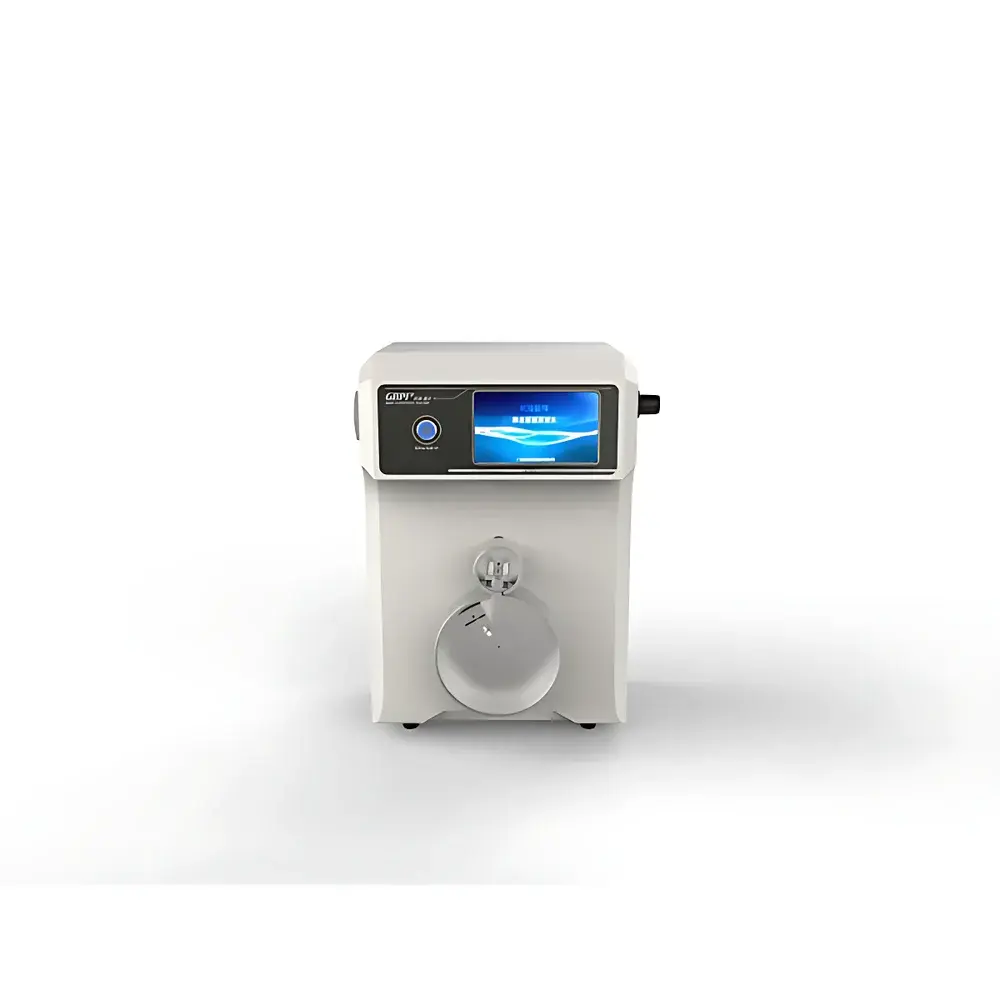
GBPI GX-B3 Disc Peel Adhesion Tester
| Brand | GBPI |
|---|---|
| Model | GX-B3 |
| Type | Disc-type Peel Adhesion Testing Machine |
| Origin | Guangdong, China |
| Manufacturer | GBPI Packaging Instruments Co., Ltd. |
| Compliance Standards | GB/T 7707, JIS C2107, JIS Z0237 |
| Disc Pressure | 100 N |
| Peel Speed Range | 0–1 m/s |
| Disc A Diameter | 170 mm |
| Disc A Width | 55 mm |
| Disc B Diameter | 65 mm |
| Disc B Width | 55 mm |
| Dimensions (L×W×H) | 546 × 360 × 300 mm |
| Power Consumption | 150 W |
| Supply | AC 220 V, 50 Hz |
Overview
The GBPI GX-B3 Disc Peel Adhesion Tester is a precision-engineered physical property testing instrument designed for quantitative evaluation of interfacial adhesion strength between printed ink layers and substrate surfaces—primarily in gravure-printed plastic films, cellophane, laminated composites, vacuum-metallized films, and surface-coated packaging materials. It operates on the standardized disc peel principle: two rotating cylindrical discs (Disc A and Disc B) apply controlled compressive load and uniform rolling contact to bond a standardized pressure-sensitive tape (e.g., glassine or specified test tape) to the printed surface; after defined dwell time, the bonded assembly is subjected to a regulated peel separation at a fixed angle (180° or 90° per standard protocol) and constant speed. The resulting delamination pattern—including ink transfer ratio, edge lifting, cohesive failure, or interfacial separation—is assessed visually and/or quantitatively to determine adhesion performance. This method reflects real-world mechanical stress conditions encountered during flexing, unwinding, or lamination processes in high-speed packaging lines.
Key Features
- Compliance-driven mechanical architecture: Disc geometry (A: Ø170 mm × 55 mm; B: Ø65 mm × 55 mm) and loading mechanism strictly conform to GB/T 7707 and JIS Z0237 dimensional tolerances, ensuring cross-laboratory data comparability.
- Adjustable disc pressure (factory-set at 100 N, with optional calibration range) enables method adaptation for low-surface-energy substrates or high-tack coatings without hardware modification.
- Programmable peel speed (0–1 m/s, ±0.02 m/s repeatability) and travel distance support both standard-compliant tests and internal R&D protocols requiring variable strain-rate analysis.
- Integrated 7-inch capacitive touchscreen interface with embedded firmware allows intuitive parameter setup, real-time status monitoring, and one-touch report generation.
- High-stability dual-disc drive system—featuring imported precision bearings and servo-controlled torque transmission—minimizes vibration-induced measurement noise and ensures long-term mechanical reproducibility (>50,000 cycles).
- Built-in thermal printer outputs traceable test reports containing date/time stamp, operator ID (if configured), test parameters, and pass/fail annotation per selected standard criteria.
- Energy-efficient design: 150 W nominal power draw with automatic idle-mode shutdown after 10 minutes of inactivity.
Sample Compatibility & Compliance
The GX-B3 accommodates flat, flexible sheet specimens up to 200 mm wide and 0.012–0.3 mm thick—including BOPP, PET, PE, CPP, aluminum foil laminates, metallized polyester, and UV-cured acrylic coatings. Specimen conditioning follows ISO 291 and ASTM D618 requirements (23 ± 2 °C, 50 ± 5 % RH, ≥4 h equilibration). All test procedures align with internationally recognized adhesion assessment frameworks: GB/T 7707 (China national standard for gravure ink adhesion), JIS C2107 (Japanese standard for electrical insulating tapes), and JIS Z0237 (general-purpose pressure-sensitive adhesive tape testing). While not intrinsically 21 CFR Part 11 compliant, audit-ready operation is achievable when integrated into validated QC workflows with documented change control, user access logs, and electronic signature protocols.
Software & Data Management
The GX-B3 operates via embedded real-time OS with non-volatile parameter storage (≥100 test profiles). All test executions generate timestamped metadata (start/stop time, applied pressure, speed, distance, ambient temperature/humidity if externally logged). Export functionality supports USB-stick-based CSV file transfer for downstream statistical process control (SPC) analysis in Minitab, JMP, or LIMS platforms. Optional PC connectivity (RS-232 or Ethernet module, sold separately) enables remote monitoring, centralized data archiving, and integration with enterprise quality management systems (QMS) supporting ISO 9001:2015 clause 8.5.2 (Identification and traceability).
Applications
- Quality assurance of gravure and flexographic ink adhesion on food-grade flexible packaging films.
- Validation of primer efficacy prior to metallization or coating application on polyolefin substrates.
- Comparative evaluation of UV-curable vs. solvent-based ink systems under accelerated aging conditions.
- Root-cause analysis of delamination failures in multi-layer laminates used in medical device pouches.
- Supplier qualification testing for pressure-sensitive label stocks and release liners.
- R&D screening of novel nanocomposite coatings for enhanced interfacial bonding energy.
FAQ
What tape specifications are required for GB/T 7707-compliant testing?
Standardized glassine tape (e.g., GB/T 7707 Annex A reference tape) with nominal 180° peel adhesion of 6.0 ± 1.0 N/25 mm and thickness 0.08–0.12 mm must be used; lot-specific certification is recommended.
Is compressed air mandatory for operation?
Yes—pneumatic actuation of the disc clamping mechanism requires clean, dry, oil-free air at 0.6–0.8 MPa (6–8 bar); an inline coalescing filter (ISO 8573-1 Class 2:2:2) is mandatory to prevent valve contamination.
Can the GX-B3 perform 90° peel tests?
No—the mechanical configuration is optimized for 180° peel geometry per GB/T 7707; alternative peel angles require dedicated fixtures not supported by this model.
Does the instrument include metrological traceability documentation?
A factory calibration certificate (traceable to CNAS-accredited standards) is available as a chargeable option (Order Code: CAL-GX-B3-01); annual recalibration is recommended per ISO/IEC 17025 guidelines.
What maintenance intervals are advised for sustained accuracy?
Lubrication of disc shafts every 6 months; visual inspection of pneumatic seals and tape feed path before each shift; annual verification of load cell linearity and speed encoder resolution by authorized service technician.



