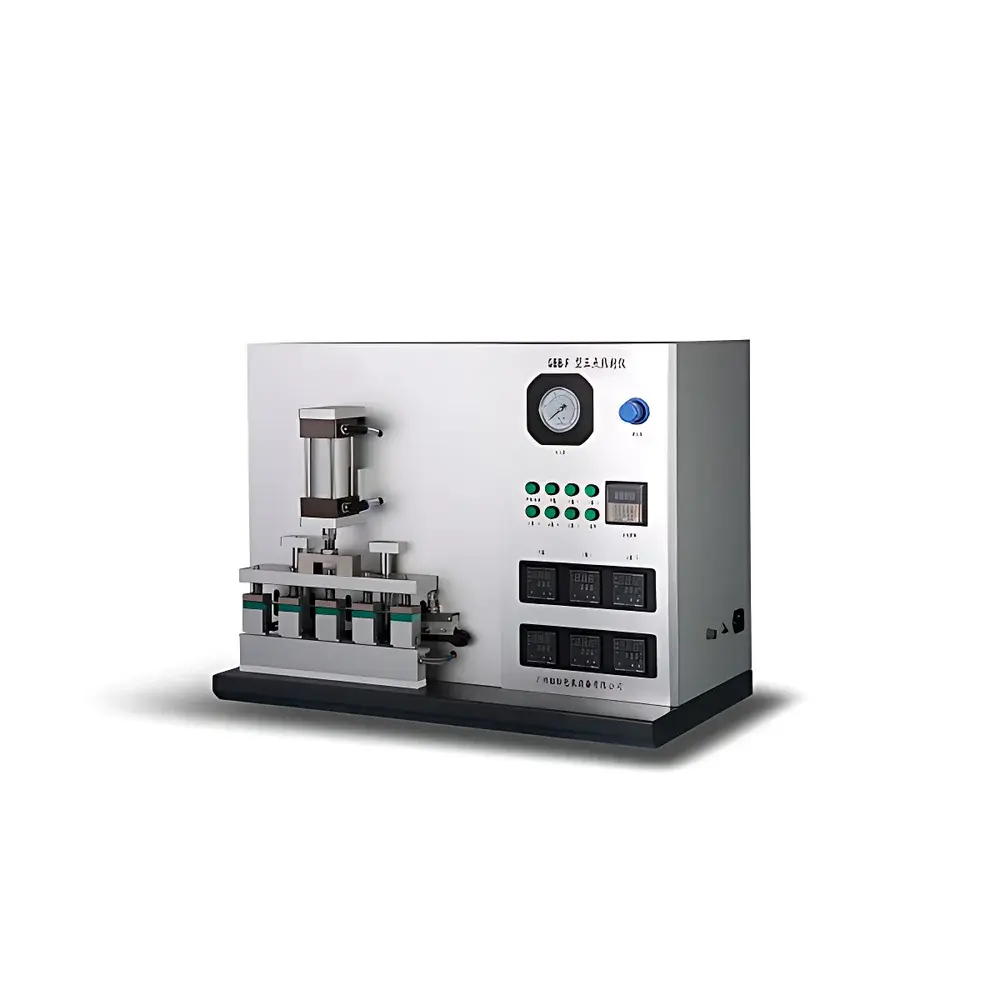
GBPI GBB-F12 Five-Point Heat Sealing Tester
| Brand | GBPI |
|---|---|
| Origin | Guangdong, China |
| Manufacturer | GBPI Packaging Instruments Co., Ltd. |
| Model | GBB-F12 |
| Temperature Range | Ambient to 300 °C |
| Temperature Control Accuracy | ±1 °C |
| Sealing Time | 0.1–999.9 s |
| Sealing Pressure | 0.05–0.8 MPa |
| Sealing Surface | Five independent 35 mm × 10 mm upper sealing blades (heated) + silicone-padded lower sealing bar |
| Heating Method | Electric resistance heating with pneumatic actuation |
| Control Mode | Automatic and manual (foot-switch operated) |
| Power Supply | AC 220 V, 50 Hz |
| Rated Power | 2000 W |
| Dimensions (W×D×H) | 700 × 400 × 540 mm |
| Weight | 55 kg |
| Compressed Air Requirement | Required (typical supply: ≥0.8 MPa, clean, dry, oil-free) |
Overview
The GBPI GBB-F12 Five-Point Heat Sealing Tester is an engineered laboratory instrument designed for precise, repeatable evaluation of heat seal integrity in flexible packaging materials. It operates on the principle of controlled thermal energy transfer under defined pressure and dwell time—mimicking industrial heat sealing processes used in pharmaceutical blister packaging, food pouch lamination, medical device pouching, and sterile barrier systems. Unlike single-point testers, the GBB-F12 integrates five independently controlled heating zones across its upper sealing assembly, enabling simultaneous assessment of seal performance across a gradient of temperatures within a single test cycle. This capability supports rapid optimization of sealing parameters (temperature, pressure, time) per ASTM F2029-2016 and QB/T 2358-1998, and facilitates compliance-driven validation protocols required under ISO 11607-2 and FDA guidance for packaging process qualification.
Key Features
- Five-zone independent temperature control: Each of the five 35 mm × 10 mm upper sealing blades is equipped with a dedicated thermocouple and PID controller, allowing discrete setpoints across the sealing surface—critical for mapping thermal transition behavior in multilayer coextruded films or laminates with varying melting points.
- Pneumatically actuated sealing mechanism: Driven by clean, dry compressed air (0.05–0.8 MPa), ensuring consistent force application and eliminating mechanical hysteresis associated with spring-loaded or hydraulic systems.
- Dual operation modes: Fully programmable automatic mode for standardized testing sequences; foot-switch–activated manual mode for real-time operator intervention during method development or troubleshooting.
- Configurable sealing interface: Lower sealing bar features replaceable silicone elastomer padding (Shore A 50–60) to minimize cold flow and ensure uniform pressure distribution. Upper blade geometry, surface finish (e.g., polished, matte, or PTFE-coated), and dimensions are available as factory-customized options.
- Traceable thermal calibration: Integrated Type K thermocouples are accessible via standardized calibration ports; sensor offset verification can be performed without disassembly using NIST-traceable reference probes.
- Robust industrial architecture: Stainless steel frame, reinforced aluminum housing, and EMI-shielded power electronics support continuous operation in QC laboratories compliant with GLP environments.
Sample Compatibility & Compliance
The GBB-F12 accommodates a broad range of thermoplastic packaging substrates—including polyethylene (LDPE, LLDPE), polypropylene (CPP, OPP), polyester (PET), aluminum foil laminates, and peelable medical-grade Tyvek®/polyethylene composites. Its five-point configuration enables detection of marginal seal zones in wide-web films and identification of interlayer delamination thresholds in retort-stable structures. The instrument conforms to key regulatory test standards: ASTM F2029-2016 (Standard Test Method for Making Heat-Sealed Packages for Use in Determining the Heat Seal Strength of Thermoplastic Films and Laminates), QB/T 2358-1998 (Plastic Film Heat Seal Strength Test Method), and YBB 00122003-2015 (National Medicine Packaging Standard for Heat Seal Strength of Pharmaceutical Plastic Films). Data acquisition supports 21 CFR Part 11–compliant audit trails when integrated with validated third-party software platforms.
Software & Data Management
The GBB-F12 operates via an embedded microcontroller with local parameter storage (up to 99 user-defined methods). While the base unit does not include proprietary PC software, all operational parameters—including timestamped seal temperature profiles, applied pressure, dwell duration, and actuation status—are logged internally and exportable via RS-232 serial interface. Integration with laboratory information management systems (LIMS) or electronic lab notebooks (ELN) is supported through ASCII-based ASCII protocol or Modbus RTU. For full traceability, users may pair the tester with external data acquisition systems that record real-time thermocouple feedback at ≥1 Hz sampling rate, enabling post-test analysis of thermal ramp rates and peak hold stability—essential for IQ/OQ/PQ documentation in GMP-regulated facilities.
Applications
- Optimization of heat seal parameters for form-fill-seal (FFS) lines in food and pharmaceutical manufacturing
- Comparative evaluation of seal strength vs. temperature gradients in multilayer barrier films
- Validation of sterilization pouch integrity after ethylene oxide (EtO) or steam autoclave processing
- Root cause analysis of seal failures (leak paths, channeling, scorching) in production audits
- Material supplier qualification per ISO 15378 requirements for primary packaging components
- Development of peelable vs. tear-open seal specifications for patient-ready drug delivery systems
FAQ
Is compressed air supply mandatory?
Yes—the pneumatic actuation system requires a clean, dry, oil-free air source delivering minimum 0.8 MPa (8 bar) pressure. An inline coalescing filter (5 µm particulate, 0.01 ppm oil aerosol, dew point ≤3 °C) is strongly recommended to prevent valve clogging and ensure long-term actuator reliability.
Can the GBB-F12 be used for hot tack testing?
No—it is not configured for dynamic hot tack measurement (i.e., tensile separation during cooling phase). It is strictly a static heat seal integrity tester per ASTM F2029 methodology.
What calibration documentation is provided?
Factory calibration certificate (as-delivered) includes verification of temperature accuracy (±1 °C at 100 °C, 150 °C, and 200 °C) and pressure transducer linearity. Optional UKAS-accredited calibration certificates are available upon request.
Is the instrument compatible with automated test reporting workflows?
Yes—via RS-232 output, it supports integration with custom Python/LabVIEW scripts or commercial QC software (e.g., Minitab Workspace, JMP Connect) for automated report generation, SPC charting, and deviation flagging against predefined acceptance limits.