
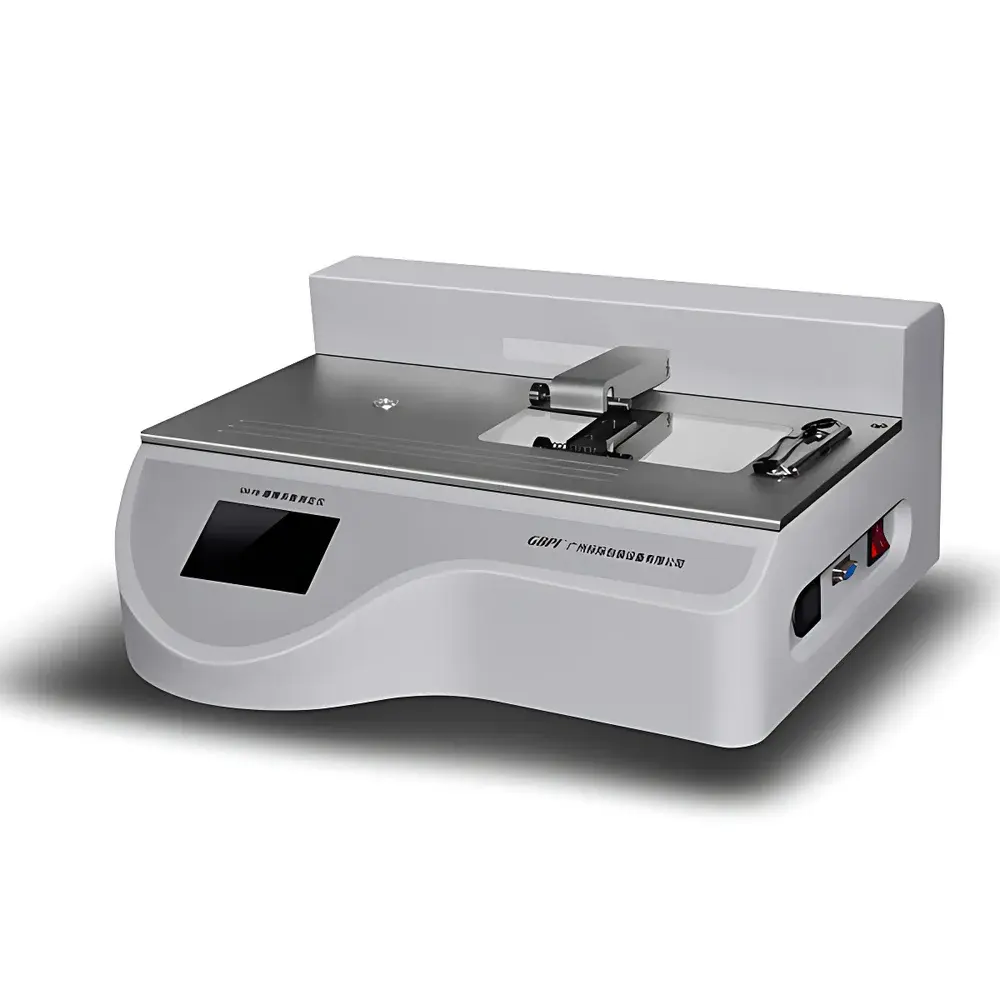
GBPI GB-FB1 Coefficient of Friction and Peel Strength Tester
| Brand | GBPI |
|---|---|
| Origin | Guangdong, China |
| Manufacturer Type | Manufacturer |
| Country of Origin | China |
| Model | GB-FB1 |
| Pricing | Upon Request |
| Test Standards | GB 10006, ISO 8295, ASTM D1894, TAPPI T816 |
| Friction Coefficient Range | 0.001–0.999 |
| Resolution | 0.1 |
| Force Measurement Range | 0–9.8 N |
| Slider Velocity | 0–500 mm/min (infinitely variable |
| standard test speeds | 100 ±10 mm/min and 150 ±10 mm/min) |
| Stroke Length | 100 ±5 mm |
| Max Sample Thickness | ≤2 mm |
| Slider Dimensions | 63 mm × 63 mm |
| Slider Mass | 200 g ±2 g |
| Test Platform Size | 200 mm × 470 mm |
| Display | LCD screen |
| Overall Dimensions | 470 mm × 340 mm × 220 mm |
| Power Consumption | 100 W |
| Electrical Supply | AC 220 V ±10 V, 50 Hz |
| Net Weight | 13.6 kg |
Overview
The GBPI GB-FB1 Coefficient of Friction and Peel Strength Tester is a dual-function precision instrument engineered for quantitative evaluation of interfacial resistance in packaging and flexible material systems. It operates on the fundamental principle of horizontal sliding friction measurement—based on ASTM D1894 and ISO 8295 methodologies—where a standardized slider (200 g ±2 g) is drawn across a fixed sample surface at controlled velocity and normal load. The system simultaneously captures static friction force (peak resistance prior to motion onset) and kinetic friction force (sustained resistance during steady-state sliding), enabling calculation of both static (μs) and dynamic (μk) coefficients of friction with resolution down to 0.1 and range spanning 0.001–0.999. In peel mode, the instrument reconfigures the fixture geometry to apply tensile separation force perpendicular to the interface, quantifying peel strength in accordance with ASTM D903 and ISO 8510-2. This dual-capability architecture supports rigorous process validation, raw material qualification, and QC release testing across regulated and non-regulated manufacturing environments.
Key Features
- Dual-mode operation: seamlessly switches between COF (static/dynamic) and peel strength testing via mechanical fixture reconfiguration—no tool change required.
- Infinitely variable motor-driven carriage: precise speed control from 0 to 500 mm/min, with factory-calibrated default settings at 100 ±10 mm/min and 150 ±10 mm/min per ISO/ASTM protocols.
- High-fidelity load cell: 0–9.8 N capacity with integrated signal conditioning, auto-ranging amplification, and overload protection to prevent sensor damage.
- Modular software architecture compliant with FDA 21 CFR Part 11 and Annex 11 requirements: includes role-based user access control, electronic signatures, full audit trail (test execution log, parameter modification history, calibration events), and immutable data archiving.
- Real-time graphical display: 4.3-inch LCD panel shows live force vs. time curve, instantaneous μs/μk values, and pass/fail status against configurable limits.
- Standardized slider assembly: 63 mm × 63 mm anodized aluminum block with certified mass tolerance (±2 g), traceable to national metrology standards.
- USB 2.0 interface for bidirectional communication: enables automated report generation, multi-curve overlay analysis, statistical summary (mean, SD, CV%), and export to CSV, PDF, or XML formats.
Sample Compatibility & Compliance
The GB-FB1 accommodates flat, flexible specimens up to 2 mm in thickness—including polymer films (LDPE, PET, BOPP), metallized foils, laminated structures, paperboard, nonwovens, coated textiles, and medical adhesive patches. Its test platform (200 mm × 470 mm) supports both strip- and sheet-form samples per GB 10006 and TAPPI T816 geometries. All operational parameters—including dwell time, preload application sequence, and velocity ramp profiles—are programmable to align with method-specific clauses in ISO 8295 Clause 7 (conditioning), ASTM D1894 Section 8 (specimen preparation), and USP Annex 3 (peel integrity for sterile barrier systems). The instrument’s firmware and software are validated under GLP/GMP-compliant IQ/OQ protocols and support full traceability to ISO/IEC 17025-accredited calibration laboratories.
Software & Data Management
The embedded GBPI TestSuite v3.2 software provides full lifecycle data governance. It features modular test templates preconfigured for each standard (e.g., “ISO 8295-COF”, “ASTM D903-Peel”), eliminating manual parameter entry errors. Raw force-time datasets are stored with metadata (operator ID, timestamp, environmental conditions, calibration certificate ID). Statistical functions include batch-wise coefficient of variation (CV%) calculation, outlier detection via Grubbs’ test, and trend analysis across sequential lots. Integration with enterprise LIMS is supported via HL7 or RESTful API; optional cloud-hosted IoT platform enables remote instrument monitoring, centralized report repository, predictive maintenance alerts, and digital spare parts ordering—all accessible via secure SSO authentication.
Applications
- Packaging R&D: optimization of slip agent concentration in extruded films by correlating μk reduction with additive dosage.
- QC release testing: verification of COF consistency across production rolls of pharmaceutical blister lidding foil per USP guidance.
- Medical device manufacturing: peel strength validation of pressure-sensitive adhesives used in transdermal patches under accelerated aging conditions.
- Printing & converting: assessment of ink-to-substrate adhesion stability after solvent exposure or thermal treatment.
- Automotive interior materials: evaluation of textile-to-leather friction behavior for seat cover assembly ergonomics.
- Academic research: tribological characterization of biodegradable polymer blends under controlled RH/T environments.
FAQ
What standards does the GB-FB1 fully comply with for COF testing?
It meets the mechanical, procedural, and reporting requirements of GB 10006, ISO 8295, ASTM D1894, and TAPPI T816—including slider mass tolerance, velocity accuracy, and data sampling frequency specifications.
Can the instrument differentiate between static and kinetic friction in real time?
Yes—its high-speed analog-to-digital converter (≥1 kHz sampling) captures the exact inflection point where static friction transitions to kinetic friction, enabling automatic μs and μk extraction without post-processing.
Is calibration traceable to national metrology institutes?
Yes—each unit ships with a NIST-traceable calibration certificate for the load cell and velocity encoder, with recalibration intervals defined per ISO/IEC 17025 Clause 6.6.
Does the software support 21 CFR Part 11 compliance out of the box?
Yes—the audit trail module records all user actions, parameter changes, and result modifications with tamper-proof timestamps and digital signatures; electronic records meet ALCOA+ principles.
What is the maximum allowable sample width for peel testing?
Peel fixtures accept specimens up to 150 mm wide, with clamping force independently adjustable to prevent slippage during high-strength delamination events.





