
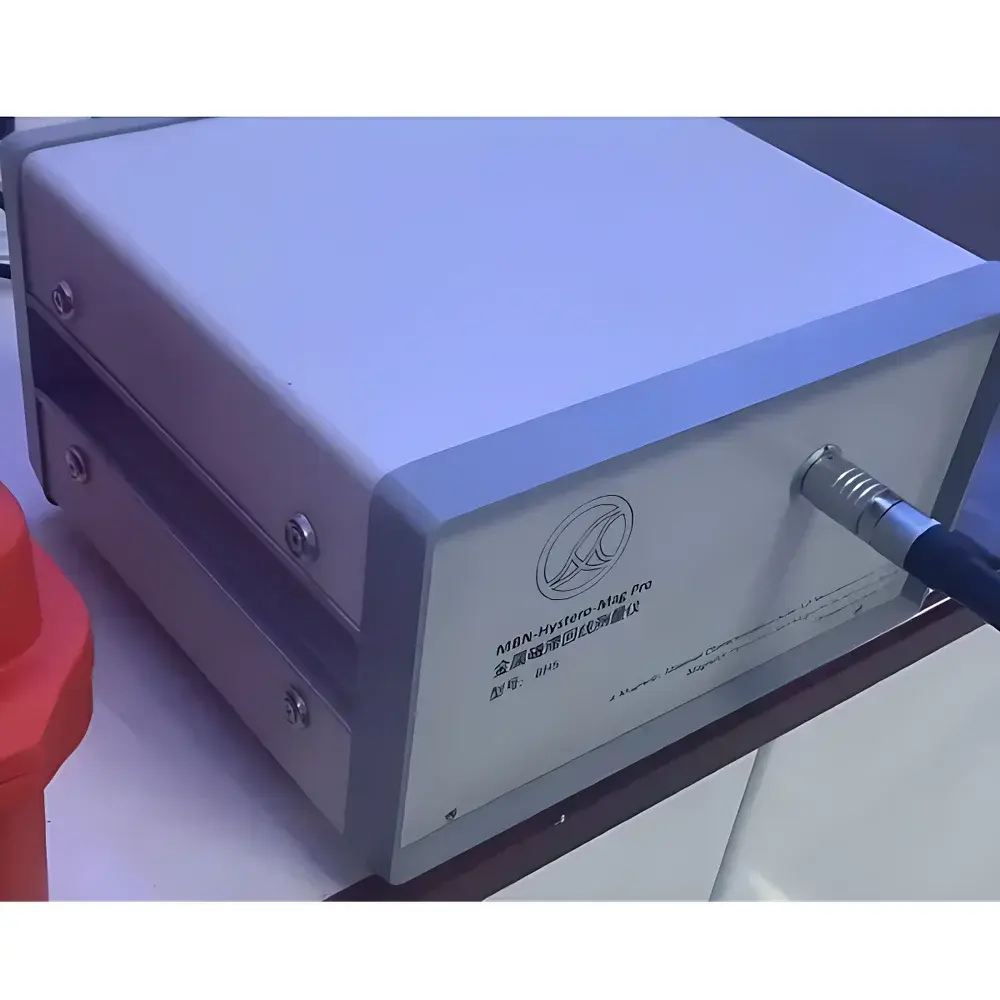
MAIERIC BH Hysteresis Loop & Barkhausen Noise Analyzer
| Brand | MAIERIC |
|---|---|
| Origin | Anhui, China |
| Model | MAIERIC |
| Measurement Principle | Combined DC-biased hysteresis loop tracing + high-frequency Barkhausen noise detection |
| Signal Acquisition | Dual-channel synchronized B–H and MBN waveform capture |
| Excitation Frequency Range | 0.1–100 Hz (programmable) |
| MBN Bandwidth | 20 kHz–1 MHz (programmable bandpass filter) |
| Data Output Format | .db (binary database with timestamped MBN, B, H waveforms) |
| Interface | Wi-Fi-enabled real-time PC control |
| Compliance | Designed for ASTM E1444/E2884-compliant magnetic testing workflows |
| Software Features | Real-time x–y scalable plotting of B(H), H(t), and MBN(t) |
Overview
The MAIERIC BH Hysteresis Loop & Barkhausen Noise Analyzer is a dual-mode electromagnetic characterization system engineered for non-destructive evaluation of ferromagnetic materials in manufacturing quality control and failure analysis environments. It integrates two complementary magnetic measurement techniques—quasi-static B–H loop tracing and high-frequency Barkhausen noise (MBN) emission analysis—within a single hardware platform. The system operates on the physical principle that microstructural changes induced by grinding-induced thermal damage (e.g., untempered martensite, residual tensile stress, or surface phase transformation) alter both the macroscopic hysteresis behavior (coercivity Hc, remanence Br, permeability μ) and the stochastic domain wall dynamics responsible for MBN signal amplitude, count rate, and spectral distribution. By co-acquiring time-synchronized B(t), H(t), and MBN(t) waveforms under controlled excitation, the instrument enables correlative interpretation of bulk magnetic properties and near-surface microstructural integrity—critical for detecting grinding burns in bearing races, gear teeth, camshafts, and other case-hardened components.
Key Features
- U-core electromagnetic probe with integrated dual-function windings: primary excitation coils on both arms, secondary B-sensing coil on the yoke base, and Hall-effect H-sensor positioned across the air gap for direct field measurement
- Dedicated miniature MBN pickup coil centered precisely between pole faces, optimized for high signal-to-noise ratio at 20 kHz–1 MHz bandwidth
- Fully programmable excitation: adjustable frequency (0.1–100 Hz), amplitude (0–10 Vpp), and waveform shape (sinusoidal, triangular, or DC-biased)
- Digitally tunable MBN bandpass filtering and programmable preamplification gain (20–80 dB), enabling adaptive noise suppression for varying material thicknesses and surface conditions
- Wi-Fi–enabled remote operation with low-latency (<50 ms) real-time data streaming to Windows-based control software
- Simultaneous display of three synchronized plots: B vs. H (hysteresis loop), H vs. t (field evolution), and MBN RMS vs. t (noise envelope)—all with independent x–y scaling and cursor-assisted measurement
Sample Compatibility & Compliance
The analyzer supports flat, curved, or contoured ferromagnetic surfaces with minimum radius of curvature ≥15 mm and surface roughness Ra ≤6.3 µm. Probe lift-off tolerance is ±0.1 mm; optimal coupling requires consistent contact pressure (0.5–2 N) maintained via spring-loaded probe housing. The system is designed for use in accordance with ASTM E1444 (Standard Practice for Magnetic Particle Testing) and ASTM E2884 (Standard Guide for Magnetic Barkhausen Emission Testing). Raw data files (.db) embed operator ID, calibration certificate traceability, ambient temperature, and probe serial number—supporting audit readiness for ISO 9001, IATF 16949, and internal GLP/GMP documentation requirements. While not FDA 21 CFR Part 11–certified out-of-the-box, the software architecture supports optional digital signature and electronic record locking modules for regulated production environments.
Software & Data Management
The proprietary MAIERIC Control Suite runs natively on Windows 10/11 (64-bit) and provides full instrument configuration, acquisition control, and post-processing capability. All raw waveforms—B(t), H(t), and MBN(t)—are acquired at 1 MS/s per channel and stored in a structured binary .db container format, preserving bit-true fidelity without compression. Built-in analysis tools include automatic hysteresis parameter extraction (Hc, Br, μmax, area loss), MBN peak amplitude histogramming, cumulative pulse counting, and FFT-based spectral centroid tracking. Export options include CSV (for MATLAB/Python integration), PNG/SVG vector graphics, and PDF reports with embedded metadata. Database management supports folder-based project organization, keyword tagging, and batch comparison of up to 32 reference and test samples.
Applications
- Detection of grinding-induced thermal damage in hardened steel components, including white layer formation, untempered martensite, and tensile residual stress gradients within the first 50–200 µm below the surface
- Correlation of MBN signal amplitude decay and spectral broadening with Rockwell C-scale hardness variations (HRC 55–65) in case-carburized or induction-hardened parts
- Process validation of grinding parameters (wheel speed, feed rate, coolant flow) via quantitative MBN response mapping across part batches
- Early-stage fatigue precursor identification in rotating machinery components where microcrack initiation alters local domain wall pinning density
- Material sorting and heat treatment verification based on comparative hysteresis loop shape analysis (e.g., distinguishing normalized vs. quenched-and-tempered microstructures)
FAQ
What is the minimum detectable grinding burn depth using this system?
Detection sensitivity depends on material composition and probe coupling, but typical resolution for subsurface thermal damage is 30–80 µm under optimal contact conditions.
Can the system distinguish between residual stress and hardness effects in MBN signals?
Yes—by combining multi-frequency MBN excitation with concurrent B–H loop analysis, stress-dominated and hardness-dominated contributions can be decoupled using established empirical models (e.g., MBN amplitude vs. Hc correlation trends).
Is probe calibration traceable to national standards?
Each probe ships with a factory calibration certificate referencing NIST-traceable magnetic field standards; annual recalibration services are available through authorized MAIERIC service centers.
Does the software support automated pass/fail decision logic for production line deployment?
Custom rule-based thresholds (e.g., Hc > 12.4 kA/m AND MBN RMS < 8.7 mV) can be defined and deployed as inspection templates with configurable alarm outputs (visual, audible, or PLC-triggered).
Are third-party data analysis tools compatible with the .db file format?
Yes—the binary structure is documented in the SDK manual; Python and MATLAB API wrappers are provided for direct memory-mapped reading of time-series arrays and metadata headers.
Related Products



