
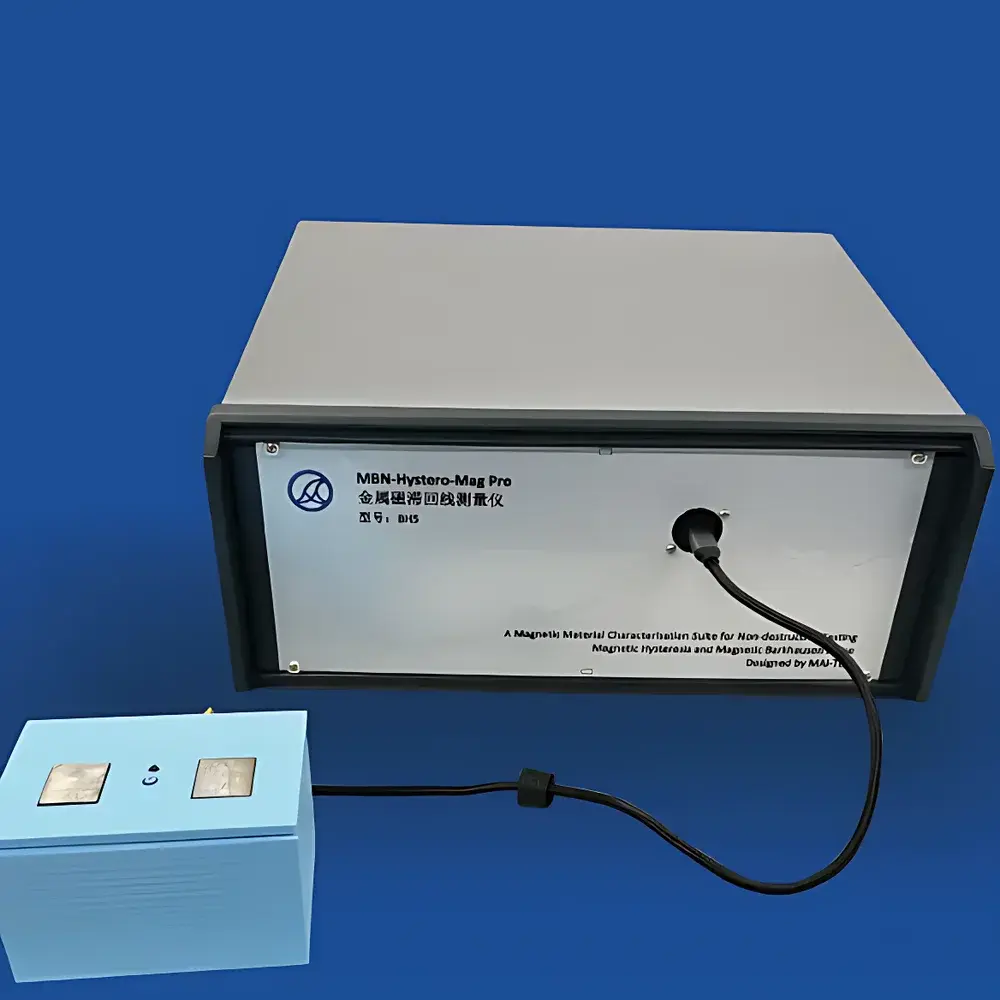
MAIERIC BH Hysteresis Loop & Barkhausen Noise Analyzer
| Brand | MAIERIC |
|---|---|
| Origin | Anhui, China |
| Model | BH Hysteresis Loop & Barkhausen Noise Analyzer |
| Measurement Principle | Dual-mode electromagnetic induction + Hall-effect field sensing + high-frequency MBN detection |
| Excitation Frequency Range | 1 Hz – 1 kHz (programmable) |
| Signal Acquisition | Simultaneous B (flux density), H (magnetic field strength), and MBN (Barkhausen noise) waveforms |
| Data Output Format | .db (binary database with timestamped raw channels) |
| Real-time Display | Adjustable XY scaling for B–H loop, H(t), MBN envelope, and time-domain MBN burst trains |
| Connectivity | Wi-Fi 802.11n (IEEE 802.11 compliant), USB 2.0 backup |
| Filtering | Programmable bandpass filter (10 kHz – 1 MHz, 3rd-order IIR) for MBN |
| Amplification | Programmable preamplifier gain (20 dB – 60 dB, 10 dB steps) |
| Compliance | Designed per IEC 60404-4 (magnetic materials — methods of measurement of DC magnetic properties) and ASTM A341/A341M (standard test method for direct-current magnetic properties of materials) |
Overview
The MAIERIC BH Hysteresis Loop & Barkhausen Noise Analyzer is a dual-function electromagnetic characterization system engineered for quantitative, non-destructive evaluation of soft and semi-hard ferromagnetic materials. It operates on the fundamental principles of controlled quasi-static magnetization (for B–H loop acquisition) and dynamic domain-wall jump detection (for Barkhausen Noise analysis). The instrument employs a U-shaped laminated magnetic yoke as its core transducer, integrating dual excitation windings on the limbs, a flux-sensing pickup coil at the yoke base, a calibrated Hall-effect sensor positioned in the air gap between poles, and a miniature high-bandwidth search coil centered directly above the sample surface—optimized for MBN signal capture. This architecture enables synchronized acquisition of three orthogonal physical quantities: magnetic flux density (B), magnetic field intensity (H), and stochastic MBN emission bursts—each sampled at independent, user-defined rates up to 10 MS/s for MBN and 10 kS/s for B/H. The system is designed for laboratory-based material qualification, process monitoring in heat treatment and grinding operations, and fundamental research into domain dynamics under applied fields.
Key Features
- Dual-channel real-time acquisition: Simultaneous digitization of B (via induced voltage integration), H (via Hall sensor output), and MBN (via high-gain RF coil) with hardware-triggered synchronization.
- Programmable excitation control: Adjustable sinusoidal or triangular waveform output (1 Hz – 1 kHz), amplitude range ±0.1 V to ±10 V (rms), with phase-lock capability for harmonic analysis.
- Configurable signal conditioning: User-selectable bandpass filtering (10 kHz – 1 MHz, center frequency and bandwidth independently tunable), programmable preamplifier gain (20–60 dB), and anti-aliasing low-pass filters.
- Wi-Fi-enabled remote operation: IEEE 802.11n wireless interface supports secure TCP/IP communication; compatible with Windows-based host PC running proprietary acquisition and analysis software (no cloud dependency).
- Real-time visualization suite: Overlaid B–H hysteresis loops, time-resolved H(t) and MBN envelope traces, and adjustable XY scaling for quantitative loop parameter extraction (e.g., coercivity Hc, remanence Br, permeability μ).
- Traceable data storage: Raw multichannel time-series data saved in proprietary .db binary format—including timestamps, calibration metadata, and hardware configuration snapshots—for post-acquisition spectral, statistical, or machine learning analysis.
Sample Compatibility & Compliance
The analyzer accommodates flat or gently curved ferromagnetic specimens up to 150 mm × 100 mm × 50 mm (L × W × H), with minimum thickness ≥0.3 mm. Surface roughness should not exceed Ra 6.3 µm to ensure consistent probe–sample coupling. It is validated for use with electrical steels (non-oriented and grain-oriented), ferritic stainless steels, nickel–iron alloys (e.g., Permalloy), and sintered soft magnetic composites. All measurement protocols align with IEC 60404-4 for DC magnetic property determination and support traceable reporting per ASTM A341/A341M Annex A2 (coercivity and remanence calculation methods). The system architecture supports GLP-compliant audit trails when used with version-locked software builds and calibrated Hall sensor certificates (NIST-traceable upon request).
Software & Data Management
The included Windows application provides full instrument control, real-time plotting, and offline analysis tools. Key modules include loop fitting (linear interpolation for Hc/Br), MBN burst counting and amplitude distribution histograms, RMS/peak MBN power vs. H plots, and comparative overlay of multiple acquisitions. Data export supports CSV (for B, H, MBN time series), PNG/SVG (vector graphics), and MATLAB-compatible .mat files. The software implements local user authentication, session logging, and file integrity checksums (SHA-256) to satisfy basic data integrity requirements under ISO/IEC 17025 clause 7.5.2. No internet connection is required for operation or data processing.
Applications
- Quantitative assessment of coercivity (Hc) and remanent flux density (Br) in transformer cores and motor laminations.
- Residual stress mapping in case-hardened or ground components via MBN amplitude and peak frequency shifts (correlated to near-surface compressive/tensile states).
- In-process monitoring of grinding burn: Detection of thermally induced microstructural changes (e.g., untempered martensite) through abrupt MBN signal suppression and hysteresis loop broadening.
- Hardness estimation in ferrous alloys using empirical MBN–HV correlations established per DIN 50150.
- Fundamental studies of domain wall pinning behavior under cyclic magnetization, including minor loop analysis and Preisach modeling input generation.
FAQ
What standards does this instrument comply with for magnetic property measurement?
It conforms to IEC 60404-4 for DC hysteresis loop acquisition and supports methodology alignment with ASTM A341/A341M for coercivity and permeability reporting.
Can the system distinguish between residual stress and hardness effects in MBN signals?
Yes—through multi-parameter analysis: stress primarily affects MBN peak frequency and envelope symmetry, while hardness correlates more strongly with RMS MBN amplitude and burst count density.
Is calibration of the Hall sensor traceable to national standards?
NIST-traceable calibration certificates are available as an optional add-on; factory calibration uses reference magnets certified to ISO/IEC 17025 accredited procedures.
Does the software support automated pass/fail decision logic for production inspection?
User-defined thresholds for Hc, Br, and MBN RMS can be configured to generate binary pass/fail flags per acquisition, with configurable report templates (PDF/Excel).
What is the typical measurement repeatability for coercivity on standardized electrical steel samples?
Under controlled temperature (23 ± 1 °C) and fixed probe pressure (2.5 N ± 0.2 N), repeatability for Hc is ≤ ±1.2% (k = 2) across five consecutive measurements on CRNO M150-35A.



