
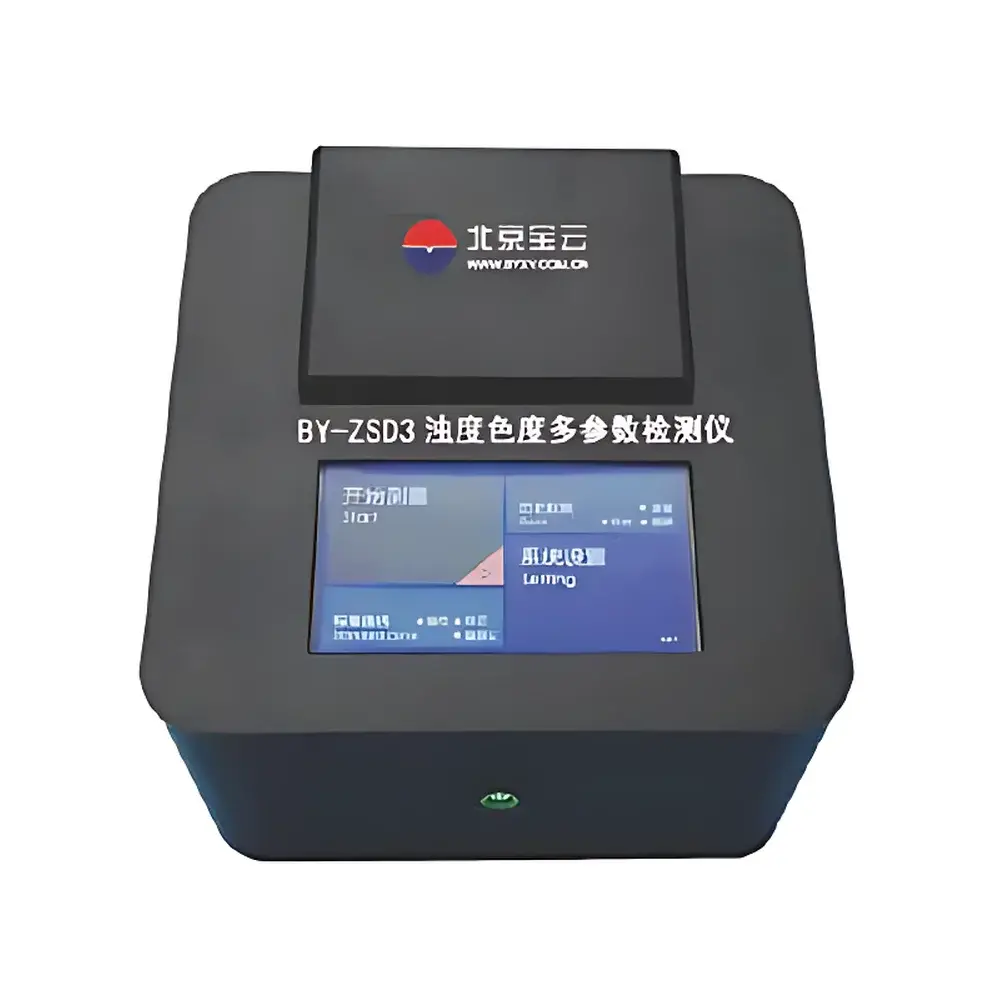
BJBY BY-ZSD3 Portable Multi-Parameter Water Quality Analyzer
| Brand | BJBY |
|---|---|
| Origin | Beijing, China |
| Model | BY-ZSD3 |
| Instrument Type | Portable / Handheld Water Quality Analyzer |
| Detection Parameters | Turbidity, Color, Free Chlorine, Combined Chlorine, pH, Cyanuric Acid, Urea, Ozone, Hydrogen Peroxide |
| Measurement Principles | Nephelometry (Turbidity), Spectrophotometry (Color, Chlorine, Ammonia-N, etc.) |
| Detection Range | Turbidity 0.000–2000 NTU |
| Other Parameters | Compliant with GB/T 5750 and HJ Standards |
| Resolution | Turbidity — 0.001 NTU (0.000–9.999), 0.1 NTU (10.0–99.9), 1 NTU (100–2000) |
| Wavelengths | 380, 430, 460, 530, 610, 850 nm (automatically selected) |
| Data Storage | 2000 measurement records |
| Display | 5.0-inch HD LCD touchscreen |
| Power Supply | 17000 mAh rechargeable Li-polymer battery, USB power input, AC adapter, or external power bank |
| Operating Environment | 0–50 °C, 0–90% RH (non-condensing) |
| Certifications | Designed per GB/T 5750.4–2023 (turbidity), GB/T 5750.11–2023 (chlorine), HJ 535–2009 (ammonia nitrogen) |
Overview
The BJBY BY-ZSD3 Portable Multi-Parameter Water Quality Analyzer is an integrated field-deployable instrument engineered for rapid, standardized assessment of critical physical and chemical water quality indicators in real time. It combines nephelometric turbidity measurement—based on 90° light scattering at defined incident wavelengths—with high-selectivity spectrophotometric analysis across six programmable optical channels (380 nm to 850 nm). This dual-principle architecture enables simultaneous quantification of turbidity, color, free and combined chlorine, ammonia nitrogen, pH (via indicator-based photometric assay), cyanuric acid, urea, ozone, and hydrogen peroxide—all within a single handheld platform. Designed explicitly for compliance with Chinese national standards—including GB/T 5750.4–2023 (turbidity), GB/T 5750.11–2023 (residual chlorine), and HJ 535–2009 (ammonia nitrogen)—the BY-ZSD3 delivers metrologically traceable results suitable for regulatory reporting, routine pool/spa surveillance, drinking water distribution monitoring, and emergency response scenarios.
Key Features
- Tri-step operational workflow: sample blanking → reagent addition → automated measurement—enabling full analysis in under 60 seconds per parameter
- Premier optical design with thermally stabilized LED sources and precision interference filters ensuring wavelength accuracy ±1 nm and photometric repeatability <±0.5% RSD
- Pre-calibrated, factory-loaded standard curves for all supported parameters, aligned with GB method validation protocols and certified reference material traceability
- 5.0-inch capacitive touchscreen interface with intuitive icon-driven navigation, multilingual UI support (English, Spanish, French, Arabic), and real-time graphical trend display
- Integrated thermal printer (optional) with direct label printing capability—supporting GLP-compliant documentation including timestamp, operator ID, calibration status, and QC flags
- Robust mechanical housing rated IP67 for dust/water ingress protection; ergonomic grip and shock-absorbing silicone bumper for field durability
Sample Compatibility & Compliance
The BY-ZSD3 accommodates standard 10 mm and 25 mm square cuvettes (supplied) as well as disposable test vials for chlorine and ammonia nitrogen assays. All reagents are supplied in vacuum-sealed, light-protected powder format with ≥24-month shelf life at ambient storage conditions (25 °C). The analyzer meets the functional requirements of ISO/IEC 17025:2017 for in-field testing laboratories and supports audit-ready data integrity through embedded electronic signatures and tamper-evident logging. While not FDA 21 CFR Part 11–certified out-of-the-box, its firmware architecture permits configuration for GMP/GLP environments via optional audit trail activation and role-based access control modules.
Software & Data Management
Data acquisition, storage, and export are managed through the embedded BY-Link™ firmware v3.2, which maintains a secure SQLite database with automatic timestamping, GPS tagging (when paired with Bluetooth-enabled GNSS module), and configurable auto-backup intervals. Up to 2000 measurement records—including raw absorbance values, calculated concentrations, calibration history, and environmental metadata—are stored locally and exportable via USB-C or Bluetooth 5.0 to Windows/macOS/Linux hosts. CSV and PDF report generation is supported, with customizable templates compliant with municipal health department submission formats. Firmware updates are delivered via signed OTA packages with SHA-256 verification.
Applications
- Public swimming pool and spa facility operators performing daily regulatory checks per GB 37488–2019
- Municipal water utilities conducting field verification of disinfection residual and turbidity at distribution endpoints
- Environmental health inspectors executing rapid-response assessments during waterborne outbreak investigations
- Construction site wastewater monitoring per local discharge permit requirements
- Educational laboratories requiring student-safe, low-maintenance instrumentation for water chemistry curricula
- NGO-led community water safety programs in off-grid or resource-constrained regions
FAQ
Does the BY-ZSD3 support calibration verification using NIST-traceable standards?
Yes—calibration verification is performed using certified turbidity standards (Formazin or AMCO AEPA equivalents) and photometric reference solutions traceable to NIM (National Institute of Metrology, China). Certificate of Calibration is provided with each unit.
Can the instrument be used for wastewater effluent testing?
It is validated for use with clarified secondary effluent and disinfected reclaimed water per HJ/T 91–2019; however, undiluted raw sewage or high-suspended-solids samples require pre-filtration per method guidance.
Is remote data synchronization available without manual USB transfer?
Optional LTE-M module (BY-Connect Pro) enables encrypted cloud upload to private AWS-hosted instances or on-premise servers with TLS 1.3 encryption and configurable retention policies.
What is the recalibration interval recommendation under continuous field use?
Daily optical zero check is advised; full multi-point calibration every 72 operating hours or after 50 measurements—whichever occurs first—as documented in the built-in maintenance log.
Are reagents compatible with international standards such as APHA 2130B or ISO 7027?
Turbidity measurement conforms to ISO 7027–1:2016 principles; chlorine and ammonia nitrogen assays align functionally with APHA 4500-Cl G and 4500-NH3 F methods, though formal cross-validation reports are available upon request.
Related Products







