
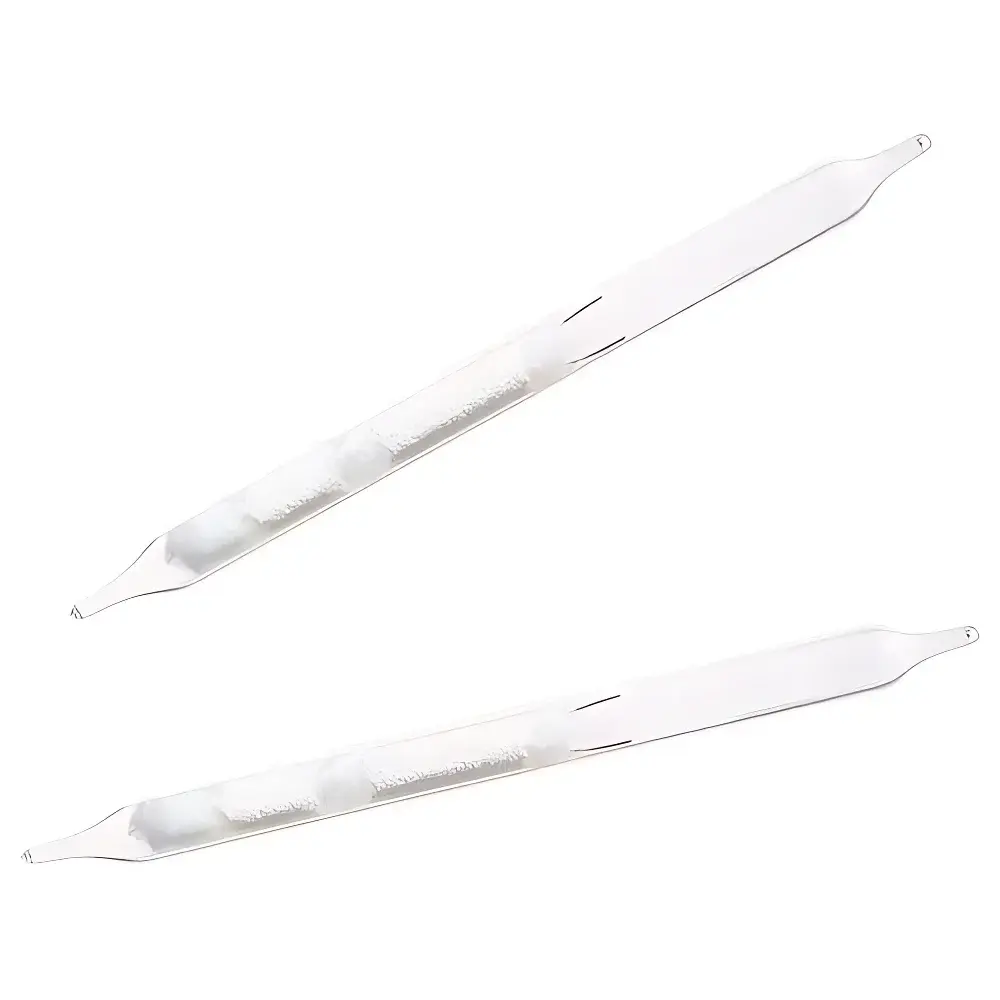
SKC DNPH-Silica Carbonyl Sampling Tube
| Brand | SKC |
|---|---|
| Origin | USA |
| Model | DNPH-Silica |
| Dimensions (ID × Length) | 6 mm × 100 mm or 8 mm × 115 mm |
| Sorbent Mass | 300/150 mg (6×100 mm) or 1500/300/150 mg (8×115 mm) |
| Sorbent | High-Purity Silica Coated with DNPH |
| Compliance | HJ 683–2014, HJ/T 400–2007, GB/T 39897–2021, GB/T 27630–2011, NIOSH 2016, EPA TO-11A, MDHS 102, ASTM D5197/D6196 |
Overview
The SKC DNPH-Silica Carbonyl Sampling Tube is a precision-engineered passive and active air sampling device designed for the quantitative collection and stabilization of airborne aldehydes and ketones—including formaldehyde, acetaldehyde, acetone, propionaldehyde, and hexanal—prior to high-performance liquid chromatography (HPLC) analysis with UV or diode-array detection. The tube operates on the principle of derivatization-based sorption: carbonyl compounds in sampled air react covalently with 2,4-dinitrophenylhydrazine (DNPH) chemically immobilized onto high-purity silica gel. This irreversible hydrazone formation yields stable, chromophoric derivatives that resist hydrolysis and thermal degradation during storage and transport, ensuring analytical integrity from field collection through laboratory quantification.
Key Features
- High-purity silica substrate with uniform DNPH coating ensures consistent derivatization efficiency and minimal inter-batch variability.
- Integrated ozone scrubber cartridge (pre-packed carbon-based or potassium iodide-coated sorbent) eliminates ozone interference, preventing oxidative degradation of carbonyl-DNPH hydrazones and suppressing artifact formation.
- Validated low blank background (<0.05 ng/formaldehyde equivalent per tube), certified via rigorous pre-release testing under ISO/IEC 17025-accredited conditions.
- Engineered uniform backpressure profile across production lots enables reproducible flow rates when used with calibrated sampling pumps (e.g., SKC AirCheck TOUCH or Gilian GilAir series), supporting compliance with ISO 16000-22 and EPA Method TO-11A flow tolerance requirements (±5%).
- Breakthrough indicators—based on empirically derived capacity limits—are provided for common sampling scenarios (e.g., 0.2 L/min for 8 h at 25°C, 50% RH) and are referenced in SKC Technical Bulletin TB-112.
- Two standardized configurations: 6 mm × 100 mm (300 mg front / 150 mg backup section) and 8 mm × 115 mm (1500 mg front / 300 mg intermediate / 150 mg backup), facilitating method flexibility for ambient, indoor, or vehicular air matrices.
Sample Compatibility & Compliance
The DNPH-Silica tube is validated for use in regulatory and standard-compliant monitoring programs across environmental, occupational, and product-emissions testing domains. It meets the technical specifications outlined in China’s HJ 683–2014 (ambient air), HJ/T 400–2007 (in-vehicle VOCs), GB/T 39897–2021 (non-metal automotive components), and GB/T 27630–2011 (passenger vehicle cabin air quality). Internationally, it aligns with U.S. EPA TO-11A for carbonyl compound measurement in indoor and outdoor air, NIOSH Method 2016 for workplace exposure assessment, UK MDHS 102 for formaldehyde and acetaldehyde, and ASTM standards D5197 (formaldehyde) and D6196 (carbonyls in indoor air). All tubes undergo lot-specific certification for derivatization yield (>92% for formaldehyde at 10 ppb·min), humidity resilience (tested up to 80% RH), and stability (derivatives remain quantifiable for ≥14 days at 4°C post-sampling).
Software & Data Management
While the DNPH-Silica tube itself is a consumable hardware component, its integration into compliant workflows requires traceable data handling. When paired with SKC’s AirCheck CONNECT software or third-party LIMS platforms (e.g., LabWare LIMS, Thermo Fisher SampleManager), users can digitally log batch numbers, sampling start/end times, flow rates, environmental parameters (T/RH), and chain-of-custody metadata. For GLP- and GMP-regulated laboratories, the tube supports 21 CFR Part 11 compliance when used within validated HPLC systems equipped with electronic audit trails, user access controls, and digital signature capabilities. SKC provides Certificate of Analysis (CoA) and Certificate of Conformance (CoC) for each production lot, including derivatization recovery data, blank values, and pressure-drop test reports.
Applications
- Ambient air quality monitoring networks measuring formaldehyde and C2–C6 carbonyls under national emission inventories.
- Indoor air quality (IAQ) assessments in offices, schools, hospitals, and residential buildings per ISO 16000-22 and EN 16343.
- In-vehicle emissions testing for automotive OEMs and Tier-1 suppliers validating cabin air quality against GB/T 27630–2011 and similar OEM specifications (e.g., VW TL 52258).
- Product emissions testing of furniture, flooring, insulation, and adhesives per ASTM D5116 and ISO 16000-9.
- Occupational hygiene surveys in chemical manufacturing, resin production, and wood-processing facilities where aldehyde exposure risks are elevated.
- Method development and validation studies requiring high-fidelity carbonyl capture with minimal artifact generation.
FAQ
What is the recommended sampling flow rate and duration for the 6 mm × 100 mm DNPH-Silica tube?
For formaldehyde and low-molecular-weight aldehydes, use 0.2–0.5 L/min for up to 8 hours; maximum recommended volume is 240 L to avoid breakthrough. Refer to SKC Technical Bulletin TB-112 for compound-specific capacity tables.
Can the tube be used without an integrated ozone scrubber?
No—the built-in ozone scrubber is essential for accurate carbonyl quantification in environments with measurable ozone (e.g., urban outdoor air, photolysis-rich indoor spaces). Omitting it risks >20% loss of formaldehyde-DNPH derivative signal due to ozonolysis.
How should DNPH-Silica tubes be stored before and after sampling?
Store unopened tubes at 2–8°C in sealed aluminum pouches; protect from light and ambient ozone. Post-sampling, cap both ends, refrigerate at 4°C, and analyze within 14 days. Freezing is not recommended due to potential condensation-induced hydrolysis.
Is the tube compatible with automated HPLC autosamplers?
Yes—standard 6 mm and 8 mm outer diameters comply with ANSI/SK standard vial dimensions. Tubes are designed for direct insertion into most HPLC autosampler trays following solvent extraction (typically 2 mL acetonitrile, 10 min sonication).
Does SKC provide method validation support for laboratory accreditation?
Yes—SKC offers application notes, recovery study templates, and collaborative method transfer support aligned with ISO/IEC 17025 requirements. Validation packages include spike recovery, matrix interference, and long-term stability data upon request.
Related Products







