
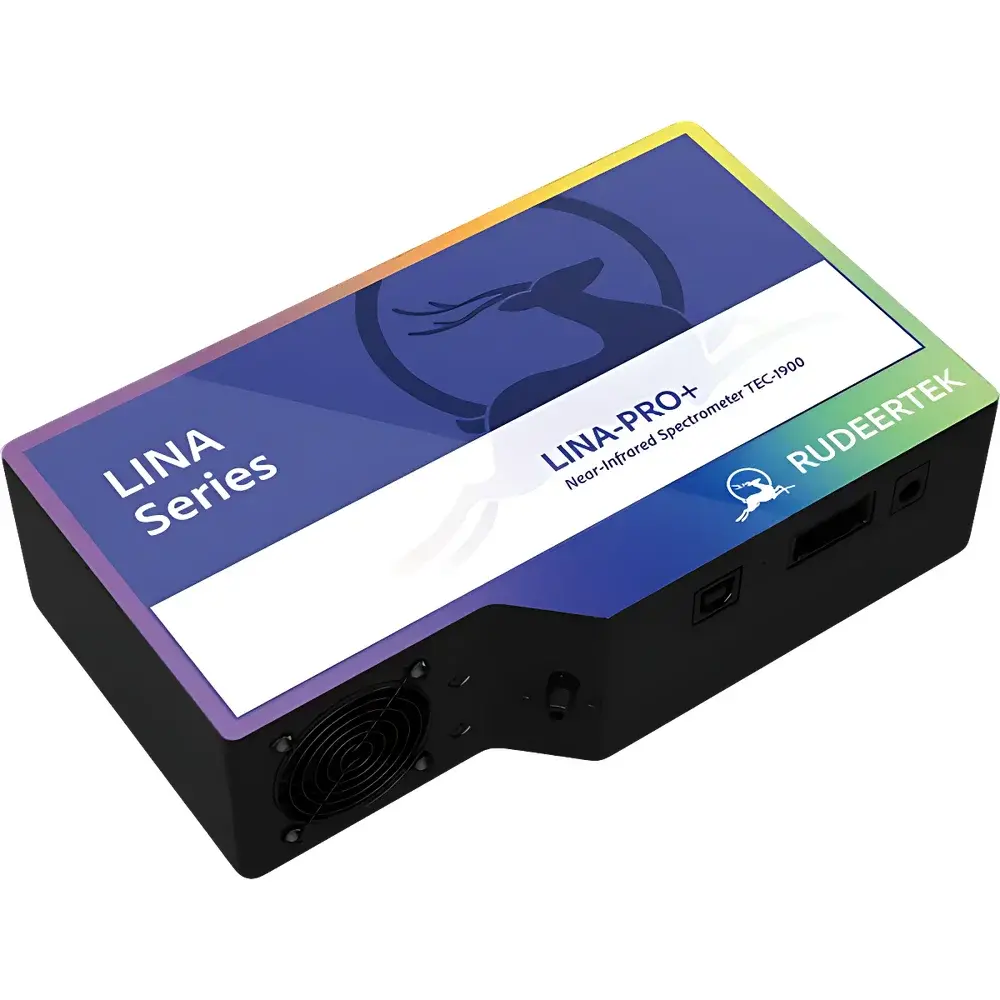
LINA-PRO+ TEC Dual-Stage Cooled Fiber Optic NIR Spectrometer
| Brand | LQ Tech |
|---|---|
| Origin | Anhui, China |
| Manufacturer Type | OEM Manufacturer |
| Regional Classification | Domestic (China) |
| Model | LINA-PRO+/Dual-Stage TEC Cooling |
| Price | Upon Request |
| Spectral Range | 900–1900 nm |
| Detector | InGaAs linear array (TEC dual-stage cooled) |
| Optical Resolution | ~4.3 nm (with 50 µm slit) |
| Signal-to-Noise Ratio | 5500:1 (full signal) |
| Dynamic Range | 8000:1 (single acquisition) |
| Stray Light | <1% |
| Pixel Count | 256 or 512 × 1 pixels |
| Pixel Size | 50/25 µm × 250 µm |
| Optical Design | Crossed Czerny-Turner |
| f-number | F/4 |
| Slit Options | 10/25/50/75/100 µm |
| Integration Time | 1 ms – 10 s |
| Linearity | ≥0.998 |
| A/D Resolution | 16-bit |
| Weight | 1.25 kg |
| Interface | USB 2.0 Type-B, Digital I/O, SMA905 fiber connector |
| OS Compatibility | 32/64-bit Windows 7/10/11 |
Overview
The LINA-PRO+ TEC Dual-Stage Cooled Fiber Optic NIR Spectrometer is a high-performance, laboratory- and industrial-grade near-infrared spectrometer engineered for precision spectral acquisition in the 900–1900 nm range. Built upon a crossed Czerny-Turner optical architecture with an F/4 beam path, it delivers consistent spectral fidelity across demanding application environments. Its core innovation lies in the integration of a thermoelectrically cooled (TEC) dual-stage InGaAs linear array detector — a design that actively suppresses dark current drift and thermal noise, enabling stable long-integration measurements without external chillers or liquid nitrogen. This architecture extends usable detection to 1900 nm while maintaining sub-5 nm optical resolution (typical at 50 µm slit width), making it suitable for quantitative analysis of organic functional groups (e.g., C–H, O–H, N–H overtones and combinations) in pharmaceuticals, agricultural feedstocks, polymer blends, and petrochemical intermediates.
Key Features
- Dual-stage TEC cooling system for InGaAs detector: achieves stable operating temperature ≤−20 °C, reducing dark current by >90% compared to single-stage variants and improving measurement reproducibility under ambient fluctuations.
- Extended spectral coverage from 900 nm to 1900 nm: supports full characterization of first and second overtones critical for moisture, fat, protein, and starch quantification per ASTM E1655 and ISO 12099 standards.
- Optimized optical platform: crossed Czerny-Turner design with F/4 throughput ensures high light efficiency and minimal astigmatism; interchangeable slits (10–100 µm) allow trade-off adjustment between resolution and sensitivity.
- High dynamic range (8000:1, single-scan) and SNR (5500:1 at full signal): enables reliable detection of weak absorption features alongside strong baseline signals — essential for reflectance and transmission measurements of heterogeneous samples.
- Rugged, compact form factor (1.25 kg) with SMA905 fiber interface: facilitates integration into OEM systems, inline process monitoring setups, and portable field-deployable analyzers.
Sample Compatibility & Compliance
The LINA-PRO+ accommodates diverse sampling modalities via standard 400 µm or 600 µm core optical fibers, supporting diffuse reflectance, transmittance, and fiber-coupled probe configurations. It is routinely deployed in GLP-compliant QC labs for raw material identification (USP ), blend uniformity assessment (FDA Process Analytical Technology guidance), and at-line fermentation monitoring. Stray light <1% meets ISO 17025 requirements for spectral purity in calibration-critical workflows. The device operates within IEC 61326-1 electromagnetic compatibility limits and conforms to RoHS 2 directives. Firmware supports timestamped metadata embedding, satisfying audit-trail prerequisites under FDA 21 CFR Part 11 when paired with compliant host software.
Software & Data Management
The spectrometer ships with SDKs for C/C++, Python (PyVISA, NumPy), and LabVIEW, enabling full control of integration time, trigger modes (hardware/software), and pixel binning. Raw spectra are acquired in IEEE 754-compliant 32-bit floating-point format. Optional SpectraSuite-compatible GUI provides real-time preview, dark/reference correction, peak integration, and export to CSV, HDF5, or JCAMP-DX — interoperable with chemometric platforms including Unscrambler X, MATLAB PLS Toolbox, and Python’s scikit-learn. All data files include embedded instrument metadata (wavelength calibration coefficients, slit ID, detector temperature, firmware version) to support ALCOA+ data integrity principles.
Applications
- Pharmaceutical solid dosage analysis: API concentration mapping, excipient compatibility screening, and coating thickness estimation via NIR reflectance.
- Agricultural quality grading: grain moisture, oil content, and protein prediction in wheat, soybean, and corn using PLS regression models trained on reference wet chemistry.
- Polymer identification and recycling sorting: differentiation of PET, PP, PE, and ABS based on characteristic C–H stretching harmonics between 1600–1850 nm.
- Fuel composition verification: ethanol/gasoline blend ratio determination and biodiesel oxidation stability monitoring through OH and CH band tracking.
- Process analytical technology (PAT): real-time monitoring of drying endpoints in fluidized bed dryers and granulation endpoints in high-shear mixers.
FAQ
What cooling performance does the dual-stage TEC achieve?
The detector stabilizes at ≤−20 °C with ±0.1 °C thermal regulation, independent of ambient conditions up to 40 °C.
Can the LINA-PRO+ be used with existing fiber-optic probes?
Yes — it accepts standard SMA905-terminated fibers with NA ≤0.22 and core diameters of 400 µm or 600 µm.
Is wavelength calibration traceable to NIST standards?
Factory calibration uses certified rare-earth oxide emission lines (e.g., Holmium Oxide); users may perform field recalibration using optional tungsten-halogen or mercury-argon sources.
Does the device support synchronized multi-channel acquisition?
Not natively — it operates as a single-channel spectrometer, but multiple units can be time-synchronized via external TTL triggers using the digital I/O port.
What is the typical warm-up time before photometric stability?
Detector thermal equilibrium is reached within 5 minutes of power-on; optimal spectral stability is achieved after 15 minutes of continuous operation.
Related Products





