
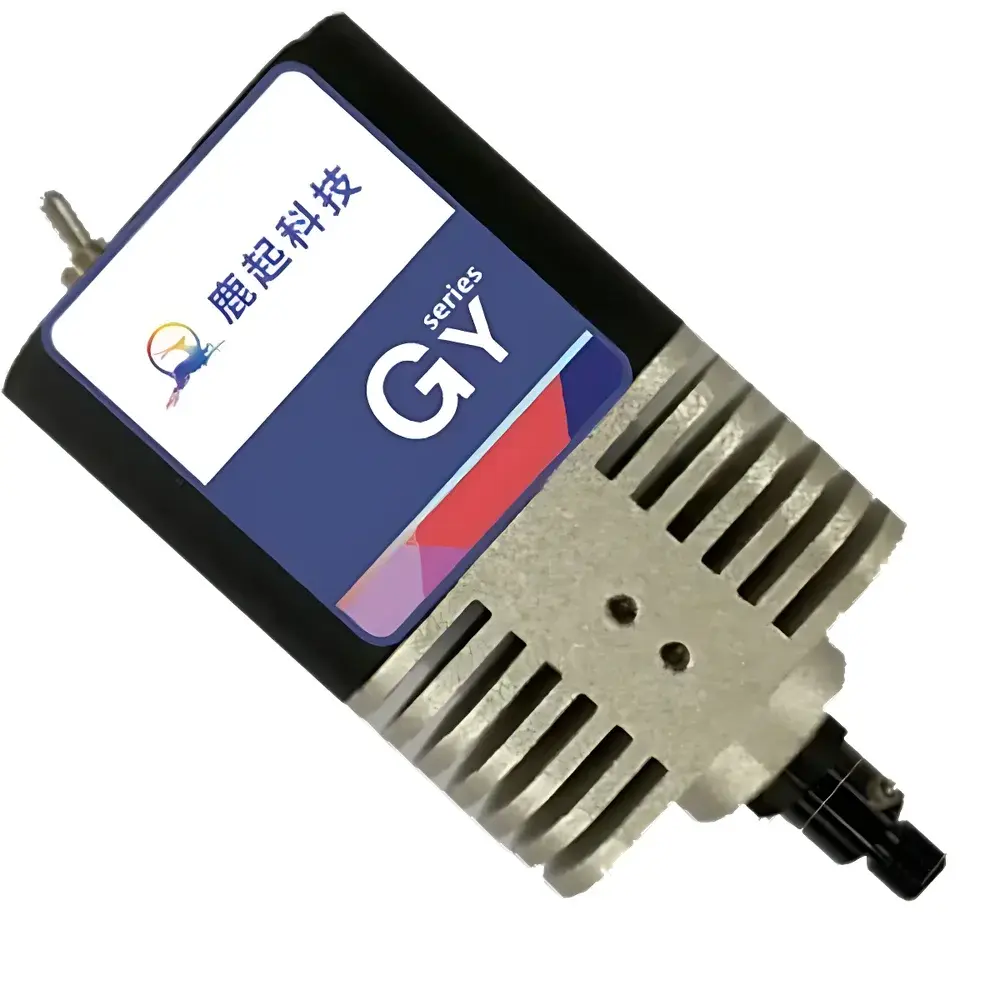
Luchu Technology GY-HL05 Compact Halogen Broadband Light Source
| Brand | Luchu Technology |
|---|---|
| Origin | Anhui, China |
| Manufacturer Type | OEM/ODM Manufacturer |
| Country of Origin | China |
| Model | GY-HL05 |
| Light Source Type | Tungsten-Halogen Lamp |
| Optical Output Power | 5 W |
| Fiber Coupling Interface | SMA 905 |
| Dimensions | Palm-Sized (≈65 × 45 × 32 mm) |
| Spectral Range | ~350–2500 nm (typical halogen continuum) |
| Operating Lifetime | ≥2000 h (at rated power, stable filament temperature) |
Overview
The Luchu Technology GY-HL05 is a compact, self-contained tungsten-halogen broadband light source engineered for stability, spectral continuity, and seamless integration into optical benchtop systems, fiber-coupled spectroscopy platforms, and calibration workflows. Based on a precisely regulated halogen lamp architecture, the GY-HL05 operates via incandescent emission from a quartz-encapsulated tungsten filament under halogen regenerative cycle—ensuring consistent radiance and minimized blackbody drift over time. Its spectral output spans the near-ultraviolet through visible to mid-infrared (approximately 350–2500 nm), delivering a smooth, featureless continuum ideal for spectrophotometric reference, hyperspectral system characterization, and white-light interferometry alignment. Unlike pulsed or line-emission sources (e.g., mercury or xenon arcs), the GY-HL05 provides inherently stable DC output with negligible temporal noise (<0.5% RMS intensity fluctuation over 1 h, under constant current drive), making it suitable for quantitative intensity-based measurements where shot-noise-limited performance is not required but repeatability is critical.
Key Features
- Palm-sized mechanical footprint (65 × 45 × 32 mm) enables direct mounting onto optical rails, breadboards, or inside instrument enclosures without thermal or spatial compromise.
- SMA 905-compatible fiber port ensures standardized coupling to 200–1000 µm core multimode fibers; integrated collimation optics minimize coupling loss and maximize NA-matched throughput.
- Thermally stabilized housing with passive aluminum heatsinking maintains filament temperature within ±2°C during continuous operation, supporting long-term radiometric consistency.
- Internally regulated constant-current driver eliminates external power supply dependency; accepts universal 100–240 VAC input with active PFC and low EMI signature.
- No moving parts, no consumable electrodes, and no warm-up stabilization delay—operational readiness achieved within <15 seconds after power-on.
- Compliant with IEC 61000-6-3 (EMC emission) and IEC 61000-6-2 (immunity) standards for laboratory-grade electronic equipment.
Sample Compatibility & Compliance
The GY-HL05 is compatible with standard optical components including monochromators, integrating spheres, photodiode arrays, CCD/CMOS spectrometers, and FTIR sampling accessories. Its broadband output supports reflectance, transmittance, and absorbance validation per ASTM E308 (computing CIE tristimulus values), ISO 13655 (spectral measurement of graphic arts substrates), and USP (photometric system qualification). While not certified for medical or Class 3B laser safety applications, the unit meets EN 62471 (Photobiological Safety of Lamps) as Risk Group 1 (Exempt) when operated behind enclosed fiber ports. No hazardous substances are used in construction; RoHS 3 and REACH-compliant materials are employed throughout.
Software & Data Management
The GY-HL05 operates as a standalone analog source and does not require proprietary firmware or host software for basic functionality. For automated intensity control or scheduled duty cycling, optional TTL-compatible trigger input (0–5 V logic) allows synchronization with data acquisition systems (e.g., National Instruments DAQ, Thorlabs Kinesis, or Python-controlled PyVISA scripts). Radiometric calibration reports—including spectral irradiance (W·nm⁻¹·sr⁻¹·m⁻²) at 1 m distance, referenced to NIST-traceable standards—are available upon request for GLP/GMP-aligned laboratories. Audit trails, user access logs, and electronic records are not embedded, consistent with its role as a passive illumination component rather than a regulated analytical instrument under FDA 21 CFR Part 11.
Applications
- Reference source for wavelength and photometric calibration of UV-Vis-NIR spectrophotometers and array detectors.
- Illumination engine for fluorescence excitation background subtraction and Raman baseline correction.
- Broadband seed source in OCT (optical coherence tomography) system development and dispersion compensation testing.
- Stable illumination in machine vision inspection systems requiring color constancy across varying ambient conditions.
- Teaching lab module for demonstrating blackbody radiation, Planck’s law, and spectral responsivity characterization.
- Integration into portable field-deployable sensors for soil reflectance, water quality index, or agricultural NDVI prototype validation.
FAQ
Is the GY-HL05 suitable for use with monochromators requiring high étendue?
Yes—the source’s effective emitting area (~0.8 mm²) and f/1.2 native output NA are optimized for efficient coupling into typical Czerny-Turner monochromator inputs.
Can the output intensity be modulated externally?
Yes—via the rear-panel TTL input (5 V CMOS compatible), enabling pulse-width or frequency modulation up to 10 kHz without affecting spectral shape.
Does the unit include a built-in shutter or intensity feedback loop?
No—intensity regulation is open-loop; closed-loop stabilization requires external photodiode monitoring and PID-controlled driver integration.
What is the recommended fiber core diameter for optimal coupling efficiency?
A 400 µm or 600 µm multimode fiber (0.22 or 0.39 NA) achieves >75% coupling efficiency; larger cores (>800 µm) introduce vignetting due to source étendue mismatch.
Is spectral calibration data provided with each unit?
A factory-measured relative spectral power distribution (rSPD) curve is included digitally; absolute NIST-traceable calibration is available as an optional service.




