
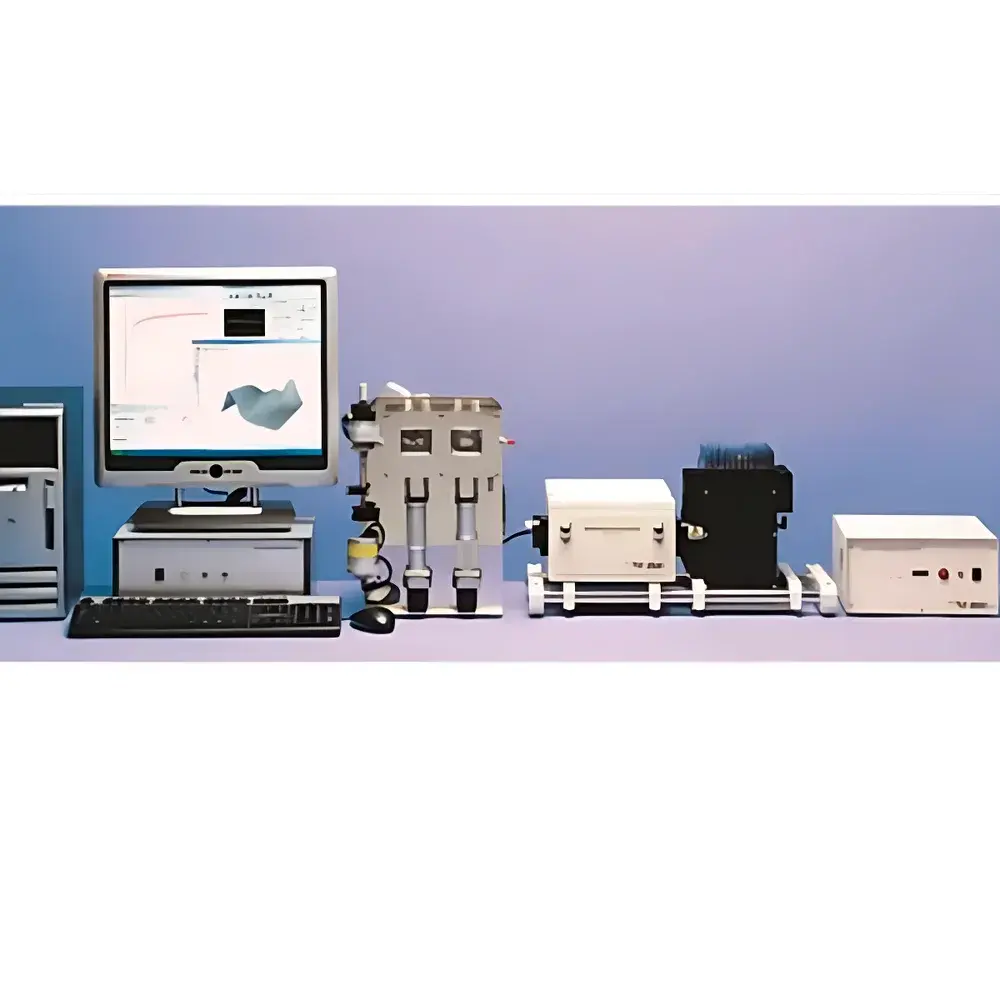
Applied Photophysics SX20 Stopped-Flow Spectrometer
| Brand | Applied Photophysics |
|---|---|
| Origin | United Kingdom |
| Model | SX20 |
| Instrument Type | Circular Dichroism (CD) Stopped-Flow Spectrometer |
| Application Domain | Transient Kinetics, Pre-Steady-State Reaction Analysis |
| Compliance Context | ASTM E259, ISO 17025 (for kinetic method validation), GLP/GMP-ready data audit trail support |
Overview
The Applied Photophysics SX20 Stopped-Flow Spectrometer is a high-precision, modular kinetic instrument engineered for the quantitative analysis of fast liquid-phase reactions occurring on millisecond timescales (1 ms to 100 ms). It operates on the fundamental principle of rapid mixing followed by immediate flow cessation—enabling optical detection (absorbance, fluorescence, circular dichroism, or polarization) at precisely defined time points after reaction initiation. Unlike conventional continuous-flow or quench-flow systems, the SX20’s stopped-flow architecture ensures reproducible dead-time minimization (~1.2 ms under optimal conditions), critical for resolving early transient intermediates in enzyme catalysis, protein folding, ligand binding, and photochemical processes. As the latest iteration in Applied Photophysics’ SX series—introduced over fifteen years ago and cited in >80% of peer-reviewed stopped-flow literature—the SX20 maintains backward compatibility with legacy accessories while incorporating enhanced fluidic control, thermal stabilization (±0.1 °C), and low-drift optical path design.
Key Features
- Modular optical detection platform supporting simultaneous or sequential acquisition across multiple channels: UV-Vis absorbance (190–750 nm), single- or dual-channel fluorescence (with excitation/emission wavelength selection), fluorescence anisotropy, and circular dichroism (CD) using a dedicated photoelastic modulator (PEM) and lock-in detection.
- Precision syringe-driven mixing system with programmable volume ratios (1:1 to 10:1), variable injection speed (0.1–50 mL/s), and temperature-controlled sample handling (4–40 °C).
- Integrated dead-time calibration capability using reference dyes (e.g., Co(III) EDTA complex) and real-time flow profile monitoring via pressure transducers.
- Robust mechanical architecture featuring vibration-damped optical bench, sealed purge chamber (N₂ or dry air), and motorized cuvette positioning for automated multi-sample runs.
- Compliance-ready firmware with full 21 CFR Part 11–compatible electronic signatures, audit trail logging, and user-access privilege tiers for regulated environments (e.g., pharmaceutical QC labs).
Sample Compatibility & Compliance
The SX20 accommodates aqueous and organic solvent-based reaction mixtures, including viscous glycerol/water buffers (up to 80% v/v) and detergent-solubilized membrane proteins. Sample volumes per experiment range from 20 µL to 200 µL, minimizing reagent consumption without compromising signal-to-noise ratio. All optical modules meet ISO 17025 requirements for kinetic method validation when operated within specified environmental controls (humidity <60%, ambient temperature stability ±1 °C/h). CD-specific configurations comply with ASTM E259 guidelines for chiroptical measurement traceability, including wavelength accuracy verification using holmium oxide filters and ellipticity linearity assessment via quartz wedge standards.
Software & Data Management
Acquisition and analysis are performed using Pro-Data v5.3 software—a Windows-based application supporting real-time visualization, global fitting of multi-wavelength datasets (e.g., singular value decomposition, target modeling), and export to industry-standard formats (CSV, ASCII, HDF5). Raw data files include embedded metadata: timestamp, syringe positions, temperature logs, PEM phase offset, and instrument configuration hash. Data integrity is enforced through SHA-256 checksums and optional encrypted storage. For enterprise integration, the software supports OPC UA connectivity and RESTful API endpoints for LIMS synchronization and automated report generation compliant with GLP documentation templates.
Applications
- Enzyme kinetics: Pre-steady-state burst analysis of serine proteases, ATPase turnover in motor proteins, and proton-coupled electron transfer in cytochrome c oxidase.
- Protein folding/unfolding: Millisecond-resolved secondary/tertiary structural changes monitored by CD or near-UV fluorescence.
- Nucleic acid interactions: DNA intercalation kinetics, RNA aptamer-ligand binding, and G-quadruplex formation pathways.
- Photobiological reactions: Flash-induced electron transfer in photosynthetic reaction centers and rhodopsin activation intermediates.
- Pharmaceutical development: Binding affinity determination (kon/koff) for biologics under physiologically relevant conditions (e.g., 37 °C, pH 7.4 buffer).
FAQ
What is the minimum measurable dead time for the SX20 system?
The practical dead time is instrument- and configuration-dependent; under optimized conditions (low-viscosity buffer, 1:1 mixing, 50 mL/s injection), it achieves ~1.2 ms. Actual values are empirically determined per setup using calibration reactions.
Can the SX20 perform CD measurements during stopped-flow experiments?
Yes—when equipped with the optional CD detection module, it delivers time-resolved ellipticity traces (θ) with sensitivity down to ±0.02 mdeg at 222 nm, enabling direct observation of secondary structural transitions during folding.
Is the system compatible with hazardous or oxygen-sensitive samples?
The fluidic manifold supports inert gas purging, and optional glove-box integration enables operation under O₂-free or anaerobic conditions (e.g., for Fe-S cluster studies).
How does the SX20 ensure data traceability in regulated laboratories?
It provides full ALCOA+ compliance: attributable, legible, contemporaneous, original, accurate records—including electronic signatures, immutable audit trails, and version-controlled method files—all validated per IQ/OQ protocols.
What maintenance is required for long-term operational stability?
Annual recalibration of syringe position encoders, PEM modulation frequency, and photomultiplier dark current is recommended; all procedures are documented in the manufacturer’s service manual and supported remotely by Applied Photophysics Field Service Engineers.
Related Products




