
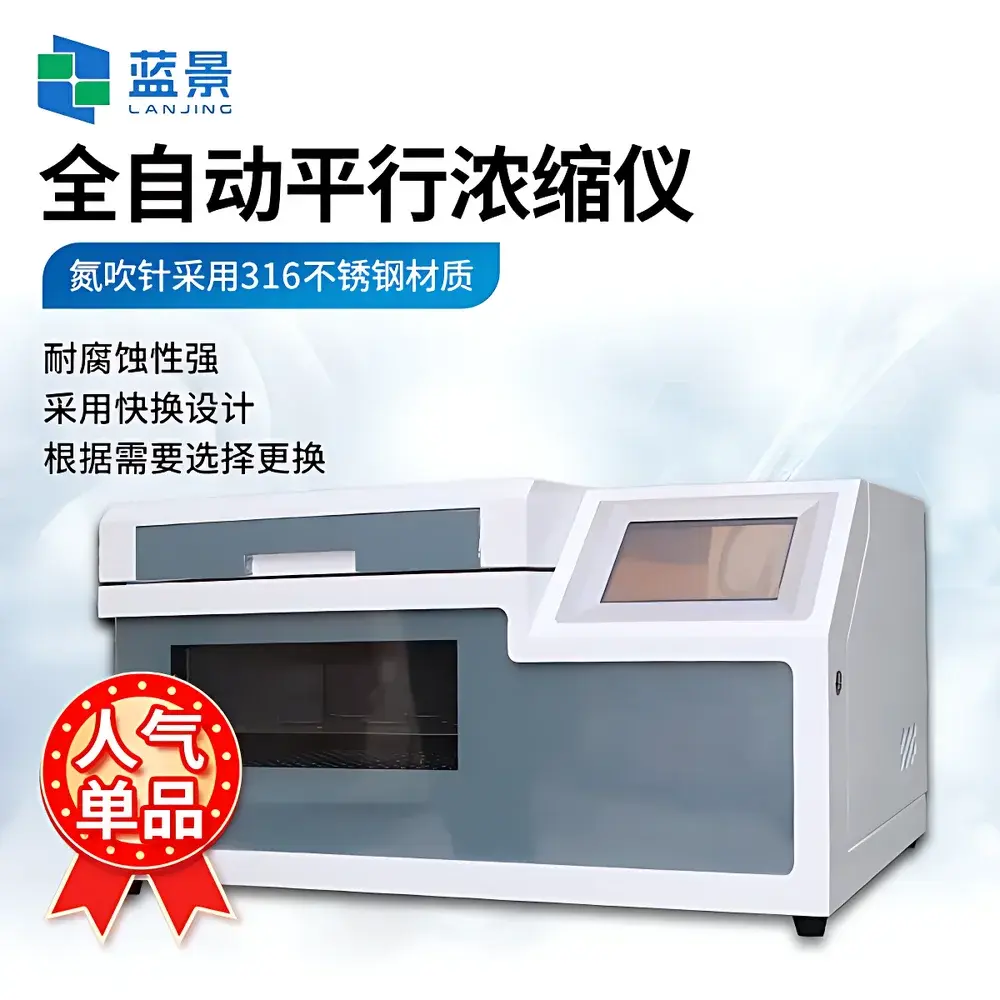
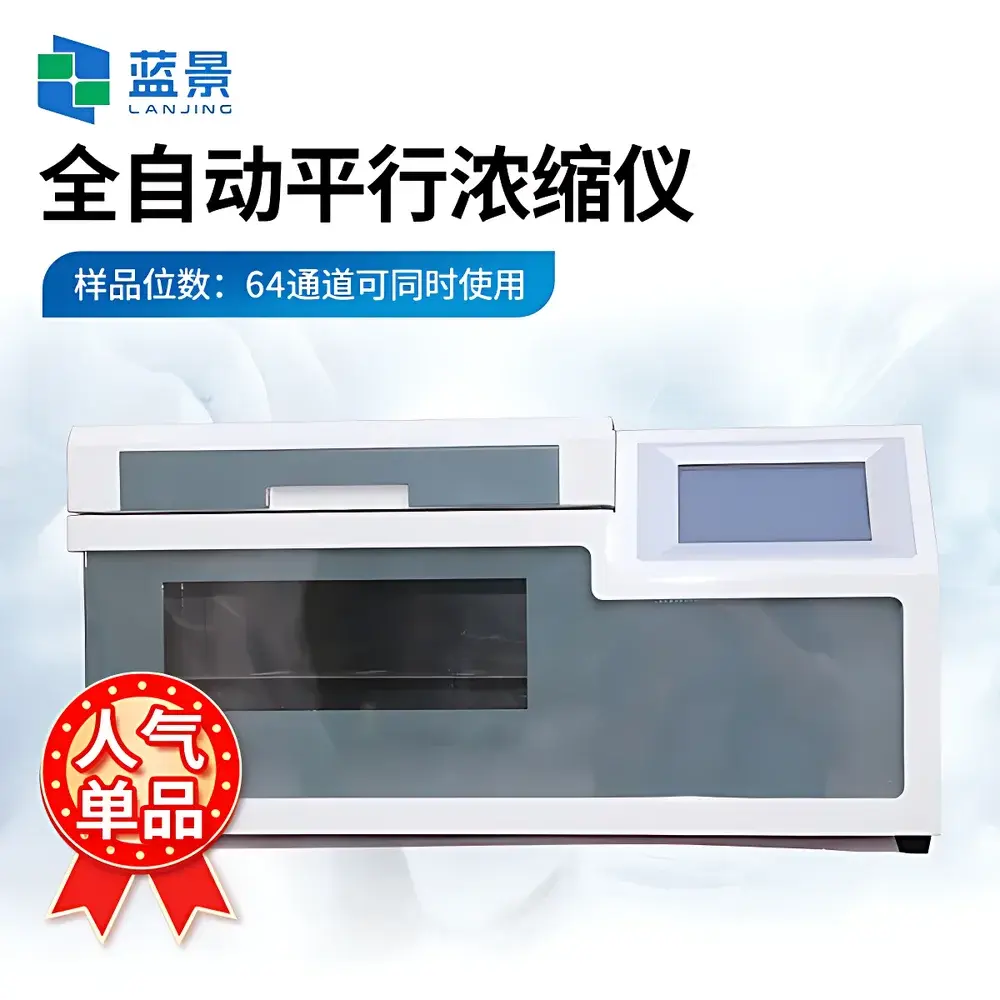
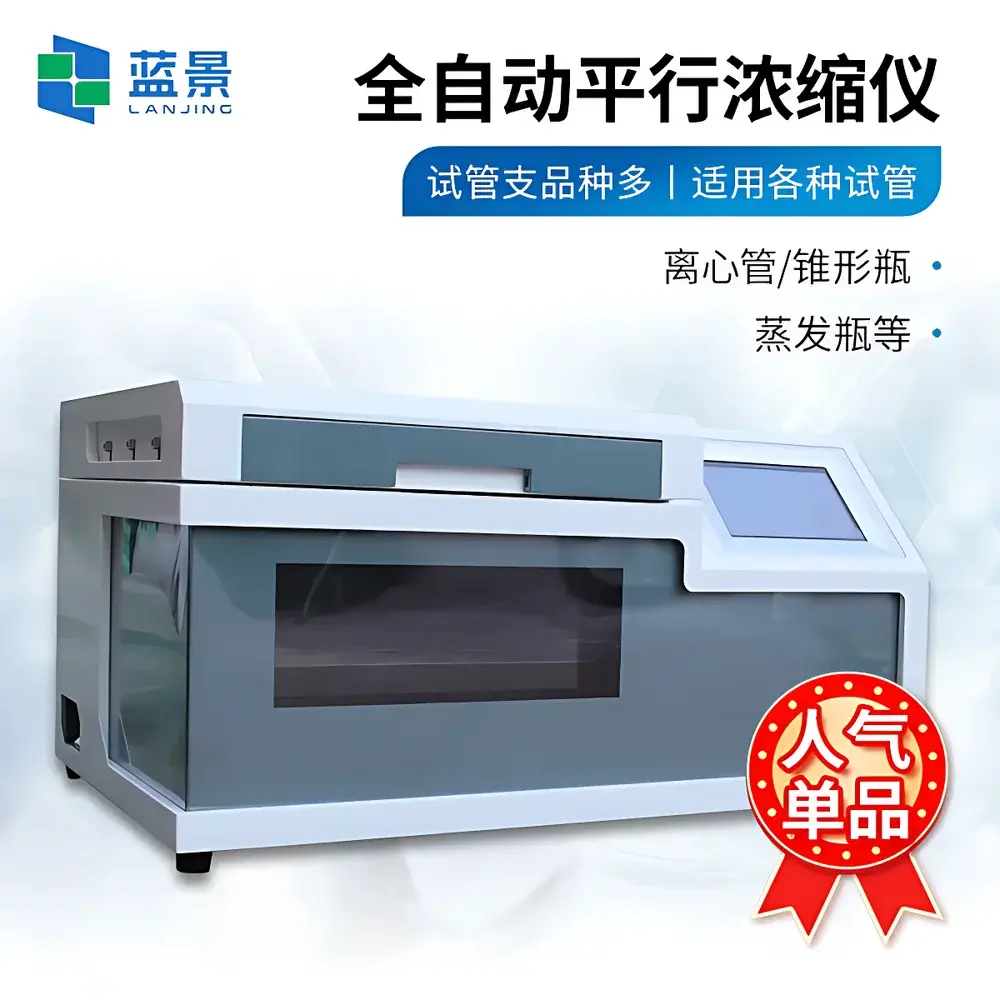
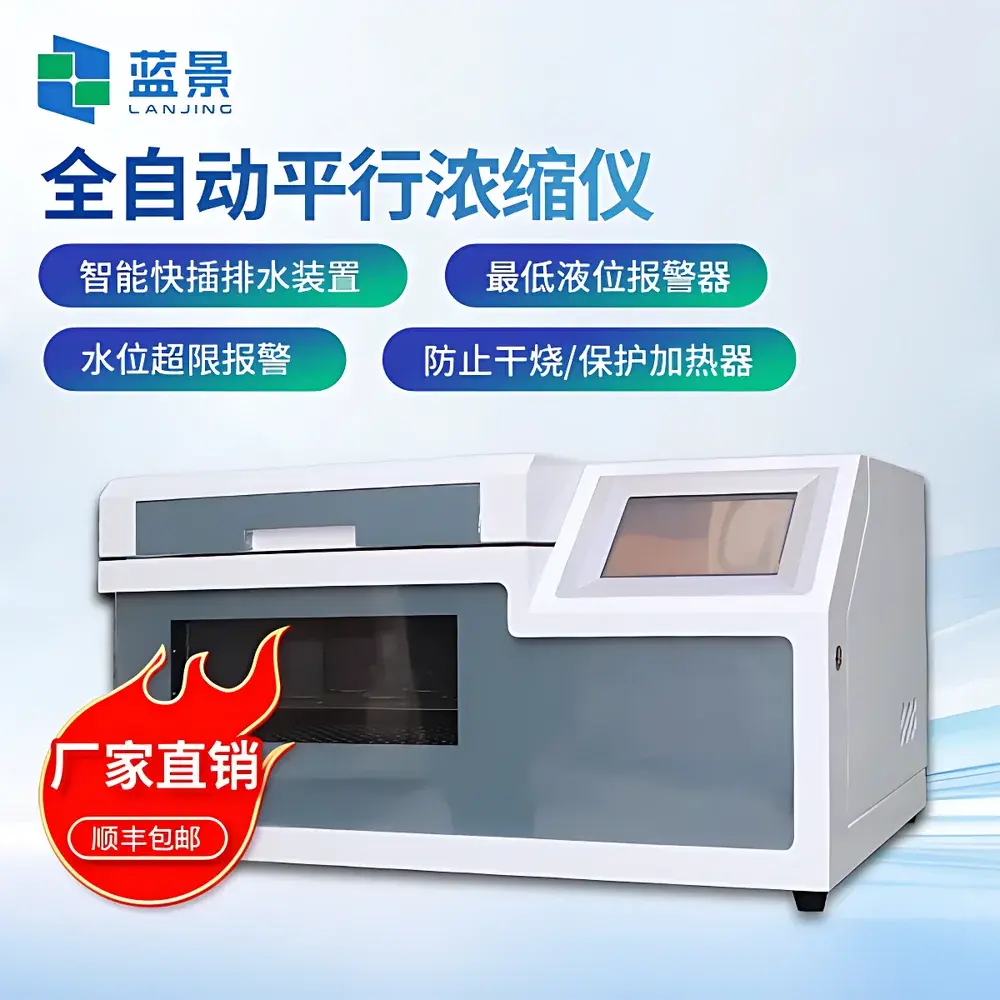
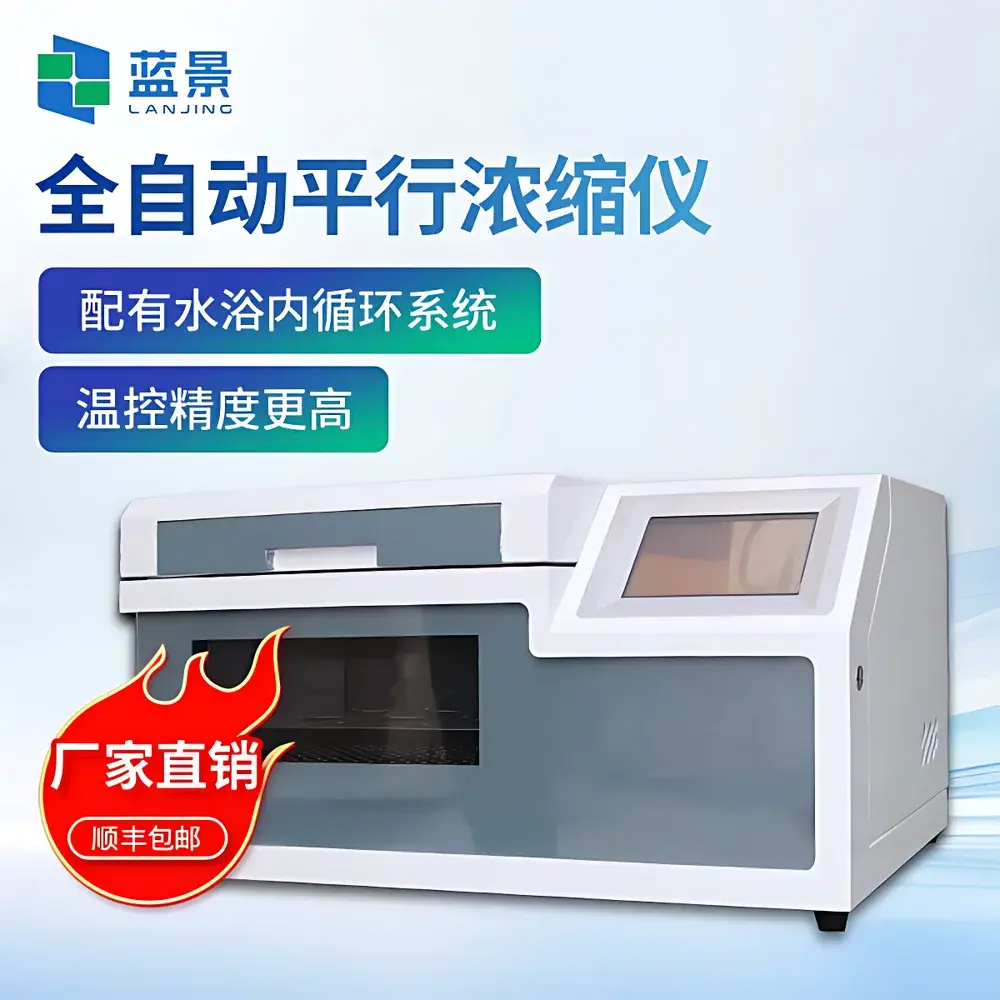
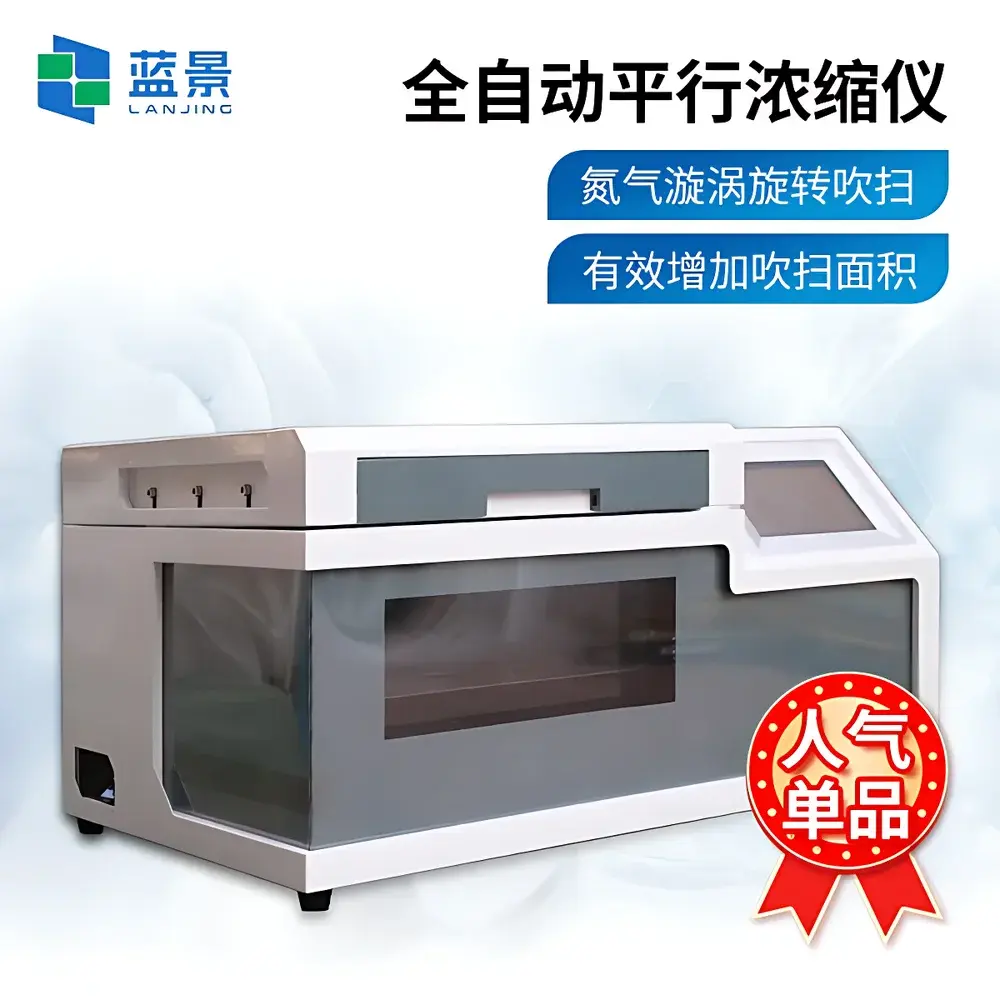
Lanjing LJ-QPN12 Automated Parallel Evaporator with Vacuum-Assisted Nitrogen Blow-Down and Optical Endpoint Detection
| Brand | Lanjing |
|---|---|
| Origin | Shandong, China |
| Manufacturer Type | Direct Manufacturer |
| Instrument Type | Vacuum-Assisted Parallel Nitrogen Concentrator |
| Temperature Range | 15–35 °C (ambient operating range) |
| Temperature Control Accuracy | ±0.5 °C |
| Sample Vial Capacity | 0.5 mL and 1 mL (optical endpoint detection) |
| Max Channel Count | 64 |
| Heating Method | PTC-heated water bath with internal circulation |
| Display | 8-inch HD touch screen (800×480 resolution) |
| Power Supply | 220 V / 110 V, 50 Hz |
| Rated Power | 2200 W |
| Nitrogen Input Pressure Range | 7–145 psi |
| Output Pressure Range | 0–72.5 psi |
| Gas Flow Control | Electromagnetically actuated per-channel valves with calibrated needle valves and real-time pressure display |
| Sensor Technology | Fiber-optic level detection for automatic endpoint termination at 0.5 mL or 1 mL |
| Compliance | Designed for GLP-compliant laboratories |
Overview
The Lanjing LJ-QPN12 Automated Parallel Evaporator is an engineered solution for high-throughput, reproducible sample concentration in analytical laboratories. It integrates vacuum-assisted nitrogen blow-down with precision water-bath heating and optical endpoint detection to automate the removal of volatile solvents from multiple samples simultaneously. Based on controlled convective evaporation under reduced pressure and directed inert gas flow, the system minimizes thermal degradation while ensuring consistent solvent removal kinetics across all channels. Unlike single-sample concentrators, the LJ-QPN12 employs a modular pneumatic architecture—featuring independently addressable electromagnetic valves and calibrated needle regulators—to maintain uniform nitrogen flow distribution across up to 64 positions. Its core application domain includes preparatory steps prior to GC, HPLC, LC-MS, and ICP-MS analysis, where quantitative recovery, minimal analyte loss, and strict volume repeatability are critical.
Key Features
- Optical endpoint detection using fiber-optic sensors enables precise automatic termination at user-defined residual volumes (0.5 mL or 1 mL), eliminating manual oversight and reducing inter-operator variability.
- PTC-heated water bath with integrated recirculation ensures thermal uniformity (±0.5 °C) across the entire heating surface, supporting stable evaporation kinetics even during extended runs.
- Modular gas control architecture: each channel features a dedicated electromagnetically actuated valve and a calibrated needle valve with engraved scale, enabling independent adjustment and real-time pressure monitoring.
- Vortex-rotating nitrogen delivery increases effective surface contact area while suppressing droplet splashing and cross-contamination between adjacent vials.
- Front-facing curved acrylic viewport with integrated LED illumination allows uninterrupted visual verification of sample status without interrupting active concentration cycles.
- Intelligent safety system includes dual-level water level sensing (low-water and overflow alarms), dry-run protection, and automatic heater shutdown upon endpoint detection or timeout.
- 8-inch capacitive touch interface supports bilingual operation (English/Chinese), displays live parameters (bath temperature, nitrogen pressure, elapsed time), and stores method profiles with timestamped execution logs.
Sample Compatibility & Compliance
The LJ-QPN12 accommodates a broad range of container formats—including 1–200 mL test tubes, centrifuge tubes, conical vials, and evaporation flasks—via interchangeable aluminum or stainless-steel rack inserts. All wetted parts contacting nitrogen gas (including 316 stainless-steel blow-down needles) comply with ASTM F899 standards for corrosion resistance. The instrument’s operational design aligns with common quality system requirements: it supports GLP documentation through embedded event logging (start/stop timestamps, parameter deviations, endpoint triggers), and its digital interface permits integration into networked lab environments for remote status monitoring. While not FDA 21 CFR Part 11 certified out-of-the-box, the system’s deterministic control logic, non-volatile parameter storage, and audit trail capability provide foundational readiness for regulated workflows requiring traceability and data integrity.
Software & Data Management
Control firmware runs on an embedded Linux-based platform with local storage for ≥10,000 method records and ≥50,000 event logs. Each log entry includes date/time stamp, setpoint values, actual measured parameters (temperature, pressure), and endpoint confirmation status. Remote monitoring is implemented via HTTP-based API endpoints compatible with standard lab informatics middleware (e.g., LabVantage, STARLIMS). Push notifications—configured per user or group—are delivered via SMTP or HTTPS webhook upon method completion, alarm activation, or system fault. No proprietary software installation is required on client workstations; configuration and monitoring occur through browser-accessible web UI or native mobile applications (iOS/Android).
Applications
- Preparative cleanup of environmental extracts (e.g., EPA Methods 508, 8082) prior to GC-ECD or GC-MS analysis.
- Concentration of biological matrices (plasma, urine, tissue homogenates) following protein precipitation or solid-phase extraction for LC-MS/MS quantitation.
- High-throughput reduction of combinatorial synthesis reaction mixtures in medicinal chemistry labs.
- Standardization of calibration stock solutions in reference material preparation workflows.
- Parallel evaporation of pesticide residue extracts in food safety testing labs compliant with ISO/IEC 17025 accreditation criteria.
FAQ
What volume endpoints does the optical sensor support?
The fiber-optic detection system is factory-calibrated for automatic termination at either 0.5 mL or 1 mL residual volume. Custom calibration for other endpoints is not supported.
Can the system operate under inert atmosphere conditions?
Yes—the nitrogen supply interface accepts input pressures from 7 to 145 psi, and the closed-loop gas path design allows purging with argon or other inert gases when configured with compatible regulators and fittings.
Is method transfer possible between different LJ-QPN12 units?
Method files (.lqm) exported from one unit are fully interoperable with others of the same firmware revision, ensuring consistency across multi-instrument laboratories.
Does the device meet CE or UL safety certification requirements?
The LJ-QPN12 complies with IEC 61010-1:2010 for laboratory electrical equipment. CE marking is applied for EU market deployment; UL listing is pending and available upon request for specific regional deployments.
How is maintenance access designed for long-term reliability?
All critical subsystems—including water bath heater assembly, gas manifold, and optical sensor module—are accessible via front-panel quick-release panels, minimizing service downtime and enabling field-replaceable unit (FRU) maintenance without full disassembly.



