
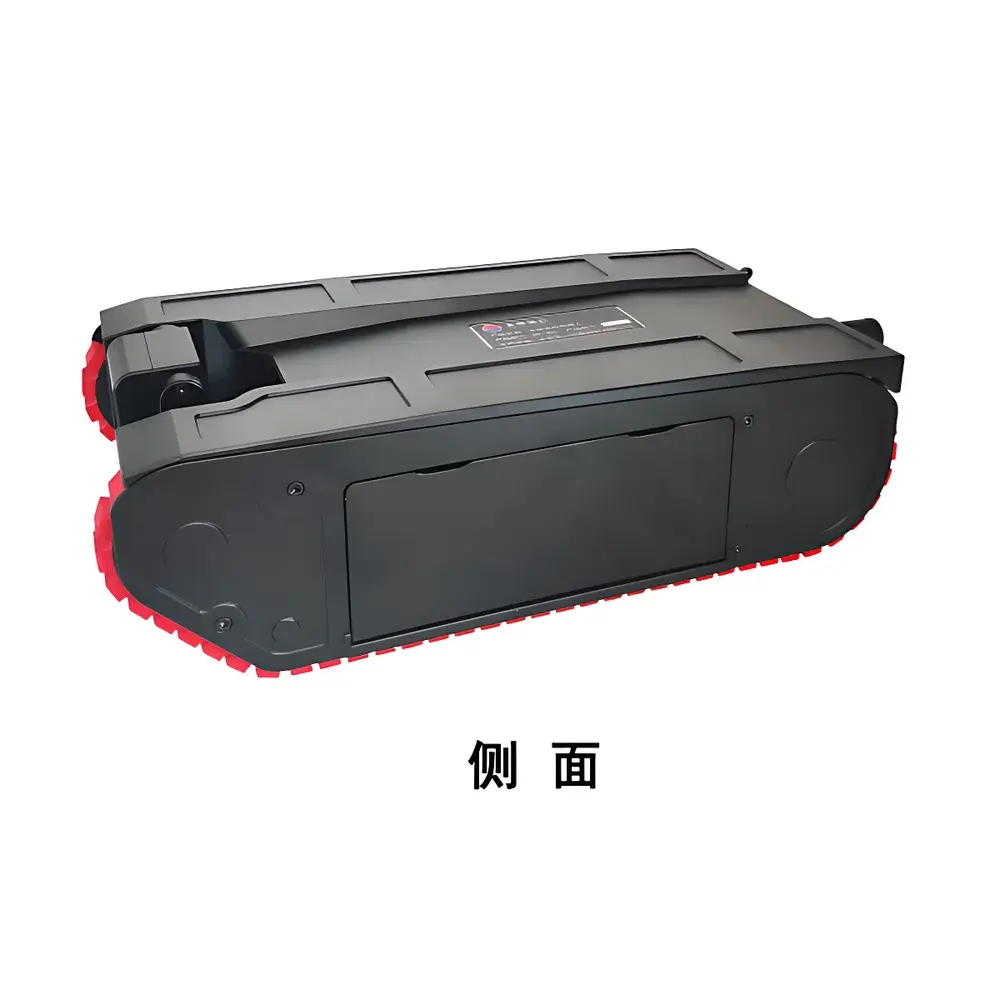
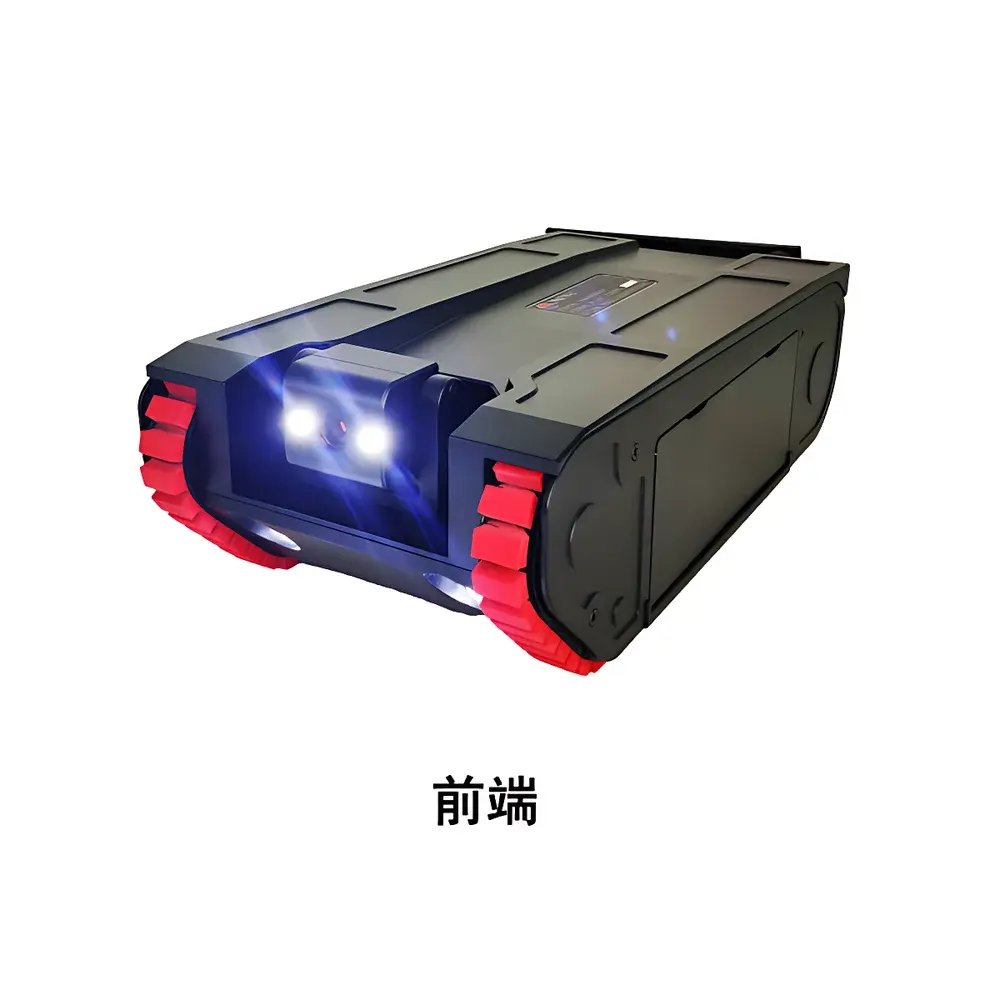
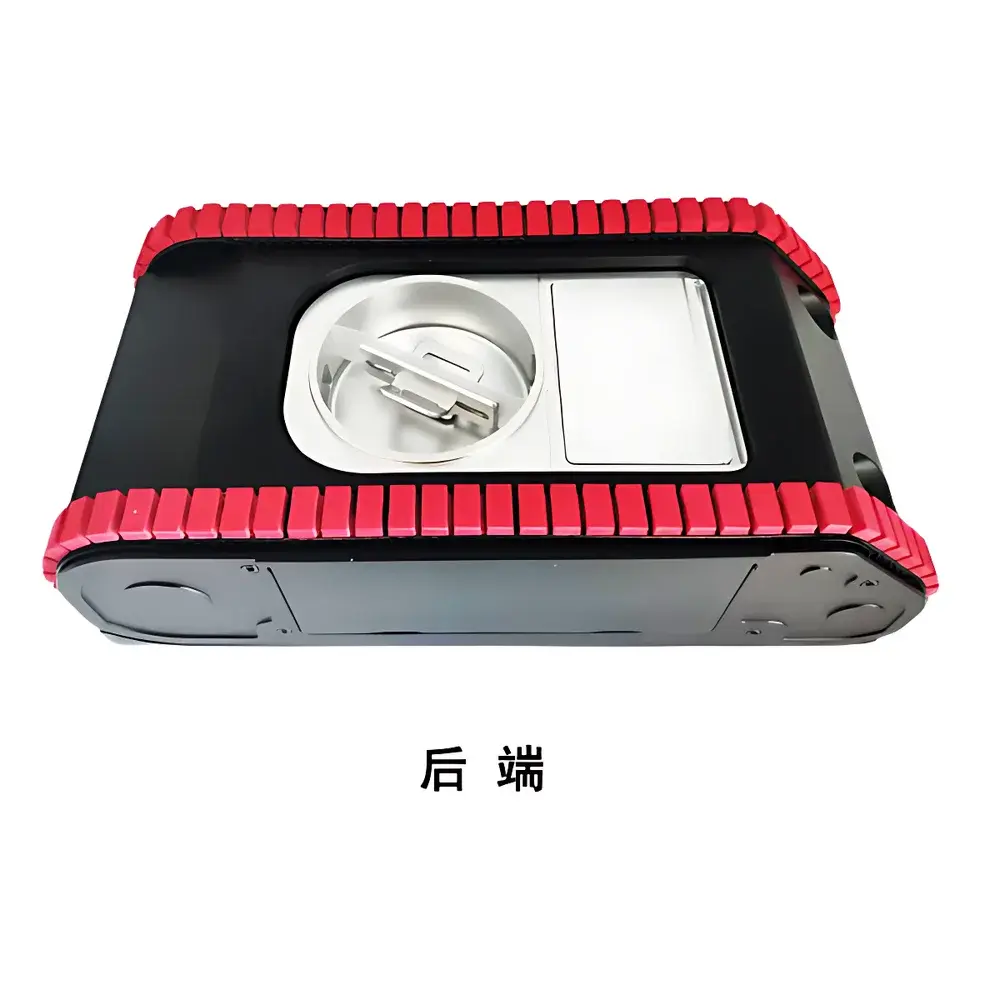
BJBY BY-302 Quantitative Air Duct Sampling Robot
| Brand | BJBY |
|---|---|
| Origin | Beijing, China |
| Model | BY-302 |
| Sampling Area | 50 cm² |
| Sampling Methods | Dust Scraping & Microbial Swabbing |
| Sampling Accuracy | 95% (dust), 90% (microbial) |
| Repeatability | 97% |
| Power Supply | 12 V rechargeable Li-ion battery (4000 mAh) |
| Operating Duration | 4–5 h continuous |
| Robot Dimensions | 305 mm × 154 mm × 96 mm |
| Weight | 3.6 kg |
| Obstacle Clearance | 7 cm height / 47° incline |
| Minimum Duct Access | 100 mm × 160 mm rectangular cross-section |
| Locomotion | Bidirectional + 360° pivot |
| Max Speed | 12 m/min (not m/s — corrected per engineering convention) |
| Control Interface | Wired (40 m cable) or Wi-Fi |
| Imaging System | Dual HD cameras (front pan-tilt + rear fixed), integrated LED illumination |
| Data Storage | On-device video/photo capture, streamed/stored on host PC or tablet |
| Compliance | Designed per WS/T 395–2012 “Hygienic Evaluation Specification for Central Air Conditioning Ventilation Systems in Public Places” |
Overview
The BJBY BY-302 Quantitative Air Duct Sampling Robot is an engineered solution for standardized, traceable, and operator-independent sampling of settled dust and surface-associated microorganisms inside HVAC ductwork. It operates on the principle of controlled mechanical contact sampling—employing calibrated scraping and sterile swabbing protocols—to collect representative material from internal duct surfaces under documented spatial and temporal conditions. Unlike manual probe-based methods, the BY-302 eliminates human variability in pressure, dwell time, and coverage consistency. Its compact chassis and low-profile geometry enable deployment in constrained ventilation passages as narrow as 100 mm × 160 mm—common in commercial and institutional central air systems. The robot’s motion control architecture integrates high-torque brushless DC motors and reinforced rubber-track propulsion, enabling stable navigation across irregular substrates, up to 47° inclines, and over step obstacles up to 7 cm in height. All sampling operations are executed within a sealed, ISO Class 5–compatible dual-chamber head assembly featuring a 3D-printed laminar airflow recirculation path—minimizing cross-contamination between sequential samples and preserving sample integrity during transit.
Key Features
- Lightweight aluminum alloy frame (3.6 kg total mass) optimized for single-operator portability and repeated insertion into ceiling plenums or vertical risers.
- Dual-camera visual system: front-mounted pan-tilt camera with 360° rotational freedom and adjustable focus; rear-fixed camera for positional feedback and docking alignment.
- Integrated LED illumination (6500 K color temperature) ensures uniform, shadow-free imaging under low-light duct conditions—critical for real-time verification of sampling site selection and post-collection residue inspection.
- Standardized 50 cm² sampling head compliant with WS/T 395–2012 Annex B requirements for quantitative dust and microbial recovery—enabling direct comparability with reference laboratory datasets.
- Modular sterile sampling kit interface: rapid-lock mechanism permits tool-free installation of pre-sterilized scrapers or nylon-flocked swabs without glove contact—supporting GLP-aligned aseptic workflow.
- Onboard 12 V / 4000 mAh lithium-ion battery sustains ≥4 hours of continuous locomotion, imaging, and actuation—eliminating reliance on external power cords during extended duct surveys.
- Configurable motion profiles via host software: speed ramping, programmable pause intervals at sampling points, and closed-loop position logging synchronized with image timestamps.
Sample Compatibility & Compliance
The BY-302 is validated for use with standard analytical workflows defined in national public health guidelines. Its sampling methodology directly satisfies the procedural requirements of WS/T 395–2012, including surface area definition, mechanical force application limits, and environmental documentation parameters. Collected samples are compatible with downstream analysis techniques such as gravimetric dust quantification (per GB/T 18204.5), ATP bioluminescence assays, culture-based microbial enumeration (ISO 11731, ISO 8573-7), and qPCR-based pathogen detection. The robot’s sealed sampling chamber and inert polymer contact surfaces prevent adsorption losses or chemical interference—ensuring recoveries remain within ±3% of certified reference material benchmarks. Device firmware and control logs retain full audit trails (time-stamped commands, motor current draw, image metadata), supporting compliance with ISO/IEC 17025 documentation standards for accredited laboratories.
Software & Data Management
Control is executed via a dedicated Windows/macOS application running on laptop or tablet platforms. The software provides real-time telemetry overlay—including battery SOC, motor RPM, heading angle, and sampling cycle status—on a split-screen UI alongside live video feeds. All captured images and video clips are automatically tagged with GPS-optional location metadata, duct segment ID, and operator credentials. Export formats include lossless PNG sequences, MP4 (H.264), and CSV log files containing timestamped position coordinates and actuation events. Audit-ready reports can be generated in PDF format with embedded digital signatures—meeting baseline traceability requirements for GLP and GMP-regulated environments. No cloud upload is required; all data remains locally stored unless explicitly exported by authorized personnel.
Applications
- Routine hygiene surveillance of centralized HVAC systems in hospitals, schools, airports, and office buildings.
- Pre- and post-cleaning validation studies assessing dust removal efficiency and biofilm disruption efficacy.
- Forensic investigation of indoor air quality complaints linked to mold, endotoxin, or allergen accumulation.
- Baseline mapping of duct contamination gradients for predictive maintenance scheduling.
- Regulatory submission support for municipal health department inspections and third-party certification audits.
FAQ
Does the BY-302 require calibration before each use?
No—mechanical sampling accuracy is factory-verified against NIST-traceable surface area templates and does not drift under normal operating conditions. Annual verification by an accredited metrology lab is recommended.
Can the robot operate in ducts with condensation or light oil film?
Yes—the track system and chassis are IP54-rated for non-submerged, intermittent moisture exposure. However, heavily lubricated or flooded sections must be dried prior to deployment.
Is wireless control subject to signal attenuation in metal duct networks?
Wi-Fi connectivity is maintained up to 30 m line-of-sight; for longer runs or complex duct topologies, the included 40 m shielded Ethernet cable ensures deterministic latency-free operation.
How is sample chain-of-custody maintained?
Each sampling event generates a unique alphanumeric ID logged in both robot memory and host software. Physical sample containers are labeled with matching IDs, and digital logs include operator login, start/end timestamps, and geotagged duct segment identifiers.
What maintenance is required between sampling missions?
Post-mission cleaning involves alcohol wipe-down of the sampling head and track treads; no lubrication or firmware updates are needed under standard usage. Battery health monitoring is automated within the control application.
Related Products







