
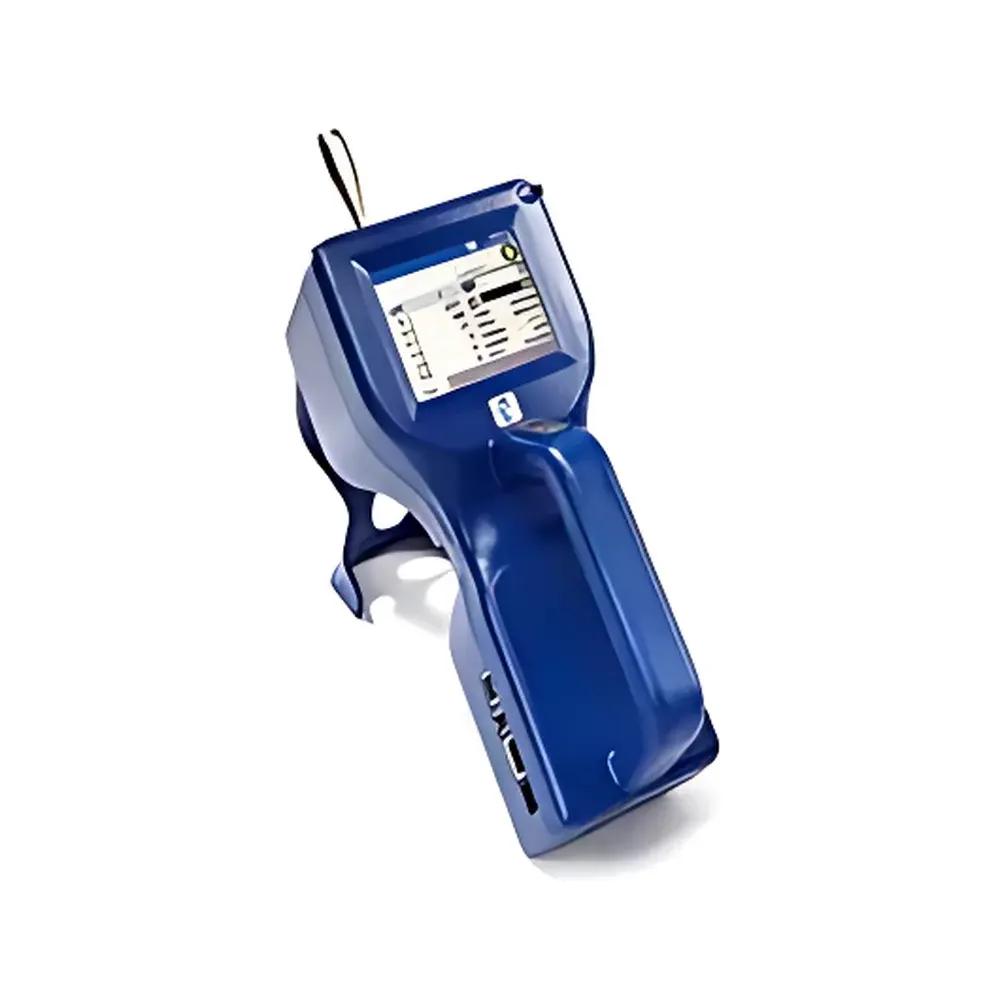
TSI AeroTrak 9306-V2 Handheld Laser Particle Counter
| Brand | TSI |
|---|---|
| Origin | USA |
| Model | 9306-V2 |
| Instrument Type | Handheld |
| Flow Rate | 2.83 L/min (0.1 ft³/min) |
| Particle Size Range | 0.3–25 µm |
| Channel Configuration | Simultaneous 6-channel detection |
| Calibration | NIST-traceable, compliant with ISO 21501-4 and JIS B9921 |
| Data Storage | 10,000 records (date/time, six channels, flow rate, sample ID) |
| Display | 9.1-cm QVGA touchscreen |
| Battery | Removable rechargeable Li-ion (6 h runtime, <2 h charge time) |
| Operating Environment | 5–35 °C, 20–95% RH non-condensing |
| Compliance | ISO 14644-1, EU GMP Annex 1, FS-209E, CE |
Overview
The TSI AeroTrak 9306-V2 Handheld Laser Particle Counter is an ISO 21501-4–compliant optical particle counter engineered for high-fidelity airborne particulate monitoring in cleanrooms, controlled environments, pharmaceutical manufacturing facilities, and HVAC validation workflows. It employs a robust 780 nm long-life laser diode to illuminate particles drawn through a precisely controlled laminar airflow path. Scattered light from each particle is detected by a high-sensitivity photodetector array; pulse height analysis enables classification into user-selectable size channels across the 0.3–25 µm range. The instrument’s design prioritizes metrological integrity—achieving ≤15% sizing uncertainty at 0.5 µm and 50% counting efficiency at 0.3 µm—ensuring traceable, repeatable measurements aligned with international cleanroom certification standards.
Key Features
- ISO 21501-4 and JIS B9921 certified performance, with NIST-traceable factory calibration and annual recalibration recommendation
- Simultaneous six-channel real-time counting (e.g., 0.3, 0.5, 1.0, 3.0, 5.0, 10.0 µm), configurable per application requirements
- Stable 2.83 L/min (0.1 ft³/min) volumetric flow, maintained via closed-loop electronic flow control with ±5% accuracy
- Integrated QVGA touchscreen (9.1 cm diagonal) with intuitive icon-driven interface supporting seven languages: English, Simplified Chinese, Japanese, German, French, Spanish, and Italian
- Removable rechargeable lithium-ion battery enabling up to six hours of continuous operation; full recharge in under two hours
- Dual communication interfaces: USB 2.0 and 10/100 Mbps Ethernet, supporting Modbus® RTU protocol for integration into facility monitoring systems
- Onboard data storage for 10,000 complete records—including timestamp, six-channel counts, flow rate, sample ID, and environmental flags—with support for 250 unique location IDs (16 characters each)
- Optional integrated temperature and relative humidity sensor (±0.5 °C, ±3% RH) for contextual environmental correlation
Sample Compatibility & Compliance
The AeroTrak 9306-V2 is validated for use with ambient air, compressed gases (with appropriate inlet filtration), and HEPA-filtered supply air streams. Its isokinetic sampling probe ensures representative particle capture without bias due to inertia or diffusion effects. The device meets regulatory expectations for Good Manufacturing Practice (GMP) environments, generating pass/fail reports compliant with ISO 14644-1 (Class 3–9), EU GMP Annex 1 (2022), and FS-209E. Audit-ready data output includes instrument ID, operator ID, calibration status, and timestamped metadata—supporting GLP/GMP documentation requirements. All firmware and reporting logic are designed to accommodate FDA 21 CFR Part 11–aligned audit trails when used with TrakPro™ Lite or FMS 5 software.
Software & Data Management
Data export and analysis are enabled via TSI’s TrakPro™ Lite (included) and FMS 5 (optional) software platforms. TrakPro Lite supports offline report generation, trend visualization, and batch export to CSV or PDF formats with embedded compliance headers. FMS 5 extends functionality to enterprise-level monitoring—enabling real-time dashboarding, alarm escalation, multi-instrument synchronization, and automated report distribution. Both applications preserve raw channel counts and metadata, ensuring full data lineage. Instrument configuration—including sampling mode (manual/automatic/buzzer-triggered), accumulation/differential modes, and concentration unit selection (particles/m³ or /ft³)—can be performed locally or remotely over Ethernet using secure HTTP-based login with dual-level password protection.
Applications
This instrument serves critical roles in ISO Class-certified cleanroom qualification (as defined in ISO 14644-1 and IEST-G-CC1002), routine environmental monitoring in sterile manufacturing suites, HVAC filter leak testing, and contamination source identification during process troubleshooting. It is routinely deployed for pre- and post-filter efficiency verification, laminar flow hood validation, isolator integrity assessment, and compressed air quality verification per ISO 8573-1. Field service engineers use its portability and rapid startup (<30 s) for on-site commissioning and requalification activities, while QA/QC laboratories rely on its reproducibility for trending particulate excursions against established action limits.
FAQ
What standards does the AeroTrak 9306-V2 comply with?
It meets ISO 21501-4 for particle counter performance, ISO 14644-1 for cleanroom classification, EU GMP Annex 1 (2022), and FS-209E. CE marking confirms conformity with EU electromagnetic compatibility and safety directives.
How often should the instrument be recalibrated?
TSI recommends annual recalibration using a NIST-traceable reference system. Field zero checks (using supplied zero filter) should be performed before each measurement session.
Can the device operate in high-humidity environments?
Yes—operational range extends to 95% RH non-condensing. However, prolonged exposure above 80% RH may affect optical window clarity; optional desiccant-equipped inlet filters are available for humidified gas streams.
Is remote configuration supported?
Yes—via Ethernet connection using secure web interface with role-based access control. IP address, network settings, and sampling parameters can be modified without physical access to the device.
What is the maximum particle concentration it can accurately measure?
The upper limit is 2,000,000 particles/ft³ (≈70.7 × 10⁶ particles/m³), with <5% coincidence loss. Beyond this, data must be interpreted with dilution correction or verified using secondary instrumentation.







