
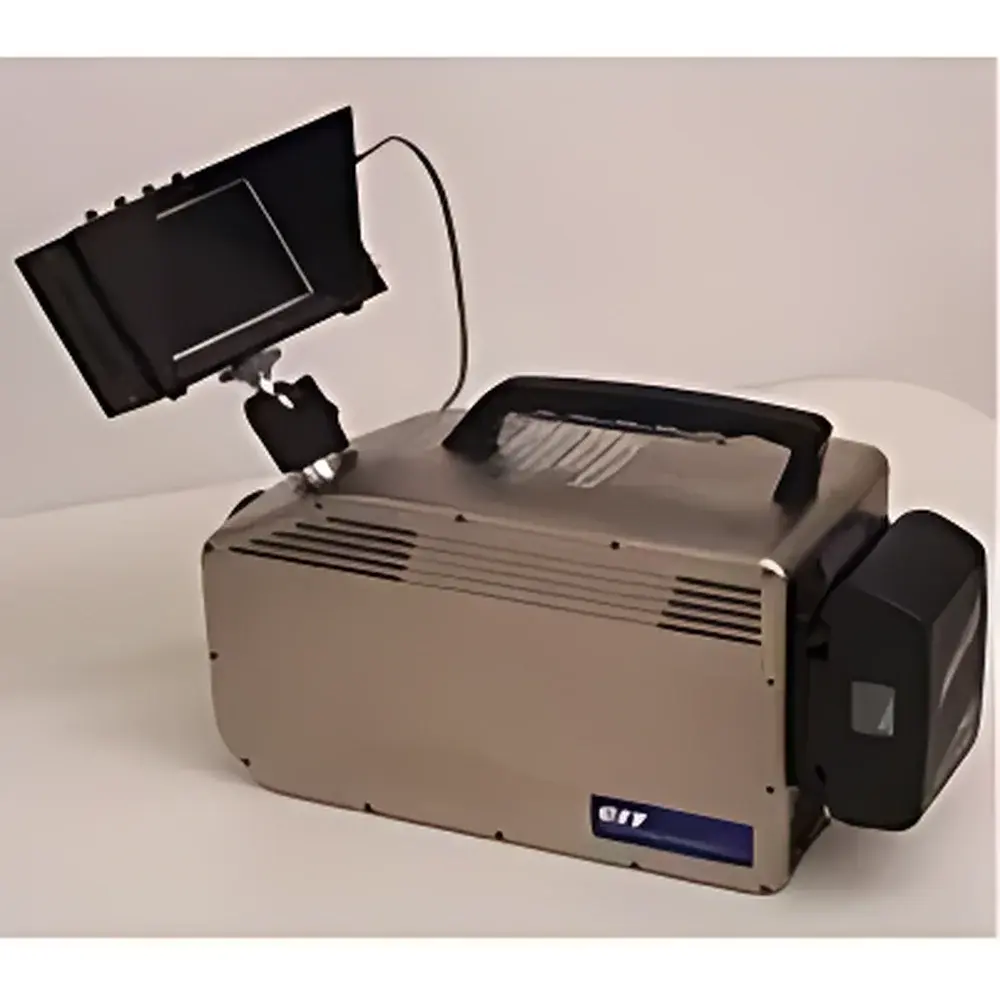
GIT Sherlock SF6 Infrared Imaging Spectrometer
| Brand | GIT (Gas Imaging Technology) |
|---|---|
| Origin | USA |
| Model | Sherlock SF6 |
| Detector Type | Photomultiplier Tube (PMT) |
| Spectral Range | 10.5 µm |
| Spectral Bandwidth | 10.5 µm |
| Wavelength Accuracy | ±1 mL/min (7 lbs/year SF₆ detection limit) |
| Wavelength Repeatability | ±1 mL/min (7 lbs/year SF₆ detection limit) |
| Spatial Resolution | 320 × 240 pixels |
| Instantaneous Field of View (IFOV) | 0.4 mrad |
| Full Field of View (FOV) | 7.3° × 5.5° |
| Focal Length | 70 mm @ 8 µm |
| Aperture | f/2.38 @ 8 µm |
| NETD | <35 mK |
| Weight (w/o battery) | 12 lb (5.4 kg) |
| Weight (with battery) | 17 lb (7.7 kg) |
| Dimensions | 12″ L × 6″ W × 8″ H (305 × 152 × 203 mm) |
| Power Supply | 12 V rechargeable battery or AC adapter |
Overview
The GIT Sherlock SF6 Infrared Imaging Spectrometer is a portable, battery-operated, passive infrared (IR) imaging spectrometer engineered for real-time detection, visualization, and quantitative assessment of sulfur hexafluoride (SF₆) gas leaks in high-voltage electrical infrastructure. Unlike active laser-based optical gas imaging (OGI) systems—such as those employing CO₂ lasers—the Sherlock SF6 utilizes passive thermal contrast detection in the long-wave infrared (LWIR) spectral region centered at 10.5 µm, where SF₆ exhibits strong fundamental absorption. This enables stand-off, non-contact imaging against ambient sky backgrounds without requiring reflective surfaces or external illumination. The instrument leverages patented Image Multi-Spectral Sensing (IMSS) technology (U.S. Patents 5,479,258; 5,867,264; 6,680,778), originally developed by Pacific Advanced Technology (PAT) for U.S. Department of Defense applications including missile warning, environmental monitoring, and chemical threat detection. IMSS integrates spatial and spectral data acquisition within a single focal plane array, delivering high-fidelity spectral signatures across the LWIR band with calibrated radiometric output suitable for trace gas quantification.
Key Features
- Passive LWIR imaging at 10.5 µm optimized for SF₆’s vibrational-rotational absorption band—no laser source required.
- Dual-mode operation: real-time video imaging + spectral analysis for leak localization and concentration estimation.
- Embedded digital video clip recorder with automated file naming and timestamped metadata—supports immediate report generation without post-processing.
- Ergonomic handheld design with one-handed control interface, integrated sunshade, and 640 × 480-pixel LCD display.
- Adjustable integration time (10 discrete settings) to optimize signal-to-noise ratio under varying thermal contrast conditions.
- Calibrated radiometric output enabling quantitative SF₆ leak rate estimation down to 1 mL/min (equivalent to ~7 lbs/year), validated per ASTM D7986-15 guidelines for optical gas imaging performance verification.
- Robust mechanical architecture rated for field deployment: IP54 ingress protection, MIL-STD-810G compliant shock/vibration tolerance.
Sample Compatibility & Compliance
The Sherlock SF6 is specifically tuned for SF₆ detection in industrial environments and is not intended for broad-spectrum gas analysis. It is certified for use in electric utility applications involving gas-insulated switchgear (GIS), circuit breakers, and high-voltage substations. The system complies with IEC 62497-1:2010 (requirements for optical gas imaging equipment) and supports audit-ready documentation workflows aligned with ISO/IEC 17025:2017 laboratory quality management principles. While not a regulatory compliance device per se, its measurement traceability—via factory calibration against NIST-traceable blackbody sources—and documented minimum detectable leak rate meet technical requirements specified in EPA Method 21 (for VOC leak detection) and IEEE C37.122.3-2020 (guidelines for SF₆ handling and leak management in power systems).
Software & Data Management
The Sherlock SF6 operates with embedded firmware and HyPAT™ software—a Windows-based application designed for spectral image processing, leak quantification, and reporting. HyPAT provides spectral unmixing algorithms calibrated for SF₆’s unique absorption profile, enabling pixel-level concentration mapping and volumetric leak rate estimation using plume dispersion modeling. All acquired video clips and spectral data are stored with embedded EXIF-style metadata—including GPS coordinates (when paired with optional GNSS module), operator ID, timestamp, ambient temperature, and relative humidity. Data export formats include AVI (compressed video), CSV (quantitative leak metrics), and ENVI-compatible spectral cube (.hdr/.dat) for third-party analysis. The embedded Ethernet and USB interfaces support secure, encrypted data transfer compliant with FDA 21 CFR Part 11 requirements when configured with user authentication and electronic signature modules.
Applications
- Routine predictive maintenance of SF₆-filled GIS, dead-tank circuit breakers, and bus ducts in transmission and distribution networks.
- Commissioning verification and post-maintenance leak screening without system shutdown or purging.
- Regulatory compliance monitoring under EPA Greenhouse Gas Reporting Program (GHGRP) Subpart DD for SF₆ emissions tracking.
- Forensic leak investigation following dielectric failures or pressure anomalies in substation assets.
- Training and competency assessment for utility technicians via standardized video-based evaluation protocols.
FAQ
Is the Sherlock SF6 certified for use in hazardous locations (e.g., Class I Div 1)?
No—this instrument is rated for general industrial use only and must be operated outside classified hazardous areas per NEC Article 500. Intrinsically safe variants are not available.
Can the Sherlock SF6 detect gases other than SF₆?
No—it is a narrowband, single-gas imager optimized exclusively for SF₆ at 10.5 µm. Cross-sensitivity to other gases (e.g., refrigerants or hydrocarbons) is negligible due to spectral filtering and IMSS spectral discrimination.
What calibration is required before field use?
Factory calibration is performed annually against NIST-traceable blackbody references. Users perform daily non-uniformity correction (NUC) via built-in shutter mechanism prior to operation.
Does the system support remote operation or integration into SCADA platforms?
Yes—via Ethernet TCP/IP, the embedded computer exposes RESTful API endpoints for remote video streaming, status polling, and trigger control, enabling integration with asset management systems (e.g., IBM Maximo, SAP PM) and centralized OGI fleet monitoring dashboards.
How is measurement uncertainty characterized for leak rate estimates?
Uncertainty is derived from combined radiometric error (±12%), plume geometry assumptions (±25%), and environmental parameter inputs (ambient T/RH). Total expanded uncertainty (k=2) is ±37% for leak rates ≥1 mL/min under typical field conditions, consistent with ISO 5725-2 repeatability criteria.





