
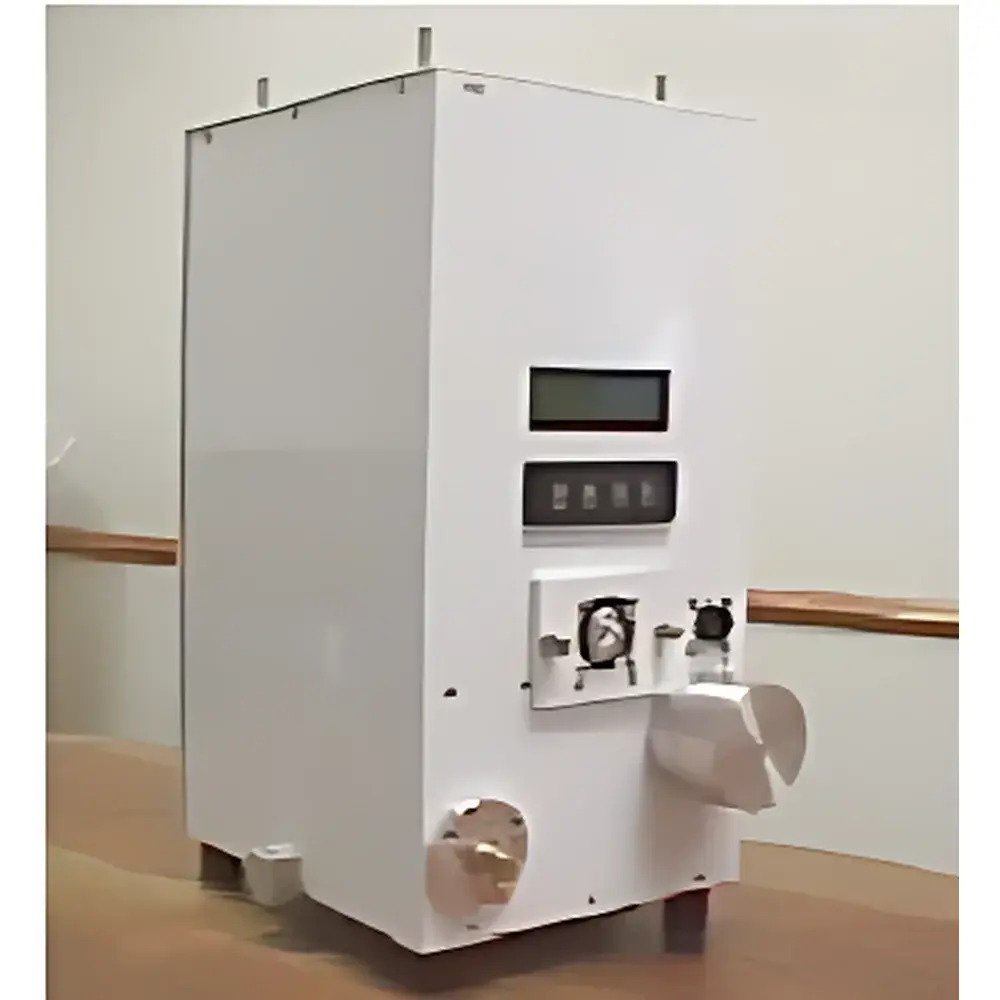
Optec NGN-3A Heated PM₂.₅ Integrating Nephelometer
| Brand | Optec |
|---|---|
| Origin | USA |
| Model | NGN-3A |
| Wavelength | 530 nm (±40 nm bandwidth) |
| Scattering Angle Integration | 5°–175° |
| Measurement Range | 0–30,000 Mm⁻¹ (scattering coefficient), 0–10,000 µg/m³ (PM₂.₅ mass concentration) |
| Resolution | ±1 Mm⁻¹ or ±0.3 µg/m³ |
| Cutpoint | 2.5 µm at 7 L/min |
| Sample Flow Control | Adjustable pump, critical orifice, pressure transducer |
| Heating | Integrated sample heater (chamber temperature maintained ≥10°C above ambient) |
| Calibration | Automated clean-air calibration (user-scheduled), manual clean-air & span-gas (SUVA-134a) verification |
| Power | 13.8 VDC, 10 A |
| Operating Temperature | −20°C to +45°C |
| Relative Humidity | 0–100% RH |
| Data Interface | RS232 serial, analog outputs (0–5 V or 4–20 mA), local LCD with keypad |
| Compliance | Designed for IMPROVE network specifications, compatible with US NPS, EPA, and international visibility monitoring protocols |
Overview
The Optec NGN-3A Heated PM₂.₅ Integrating Nephelometer is a field-deployable, research-grade optical instrument engineered for continuous, real-time measurement of the dry aerosol scattering coefficient (bsp) and derived PM₂.₅ mass concentration in ambient air. It operates on the principle of angular-integrated light scattering—illuminating sampled air with a stabilized 530 nm LED source (40 nm FWHM bandwidth) and detecting scattered intensity across a precisely defined solid angle from 5° to 175°. Unlike filter-based gravimetric methods—which require hours to days for integration and laboratory analysis—the NGN-3A delivers validated bsp values at user-configurable intervals as short as two minutes. Its integrated 2.5 µm aerodynamic cutpoint cyclone, active sample heating system, and closed-loop flow control ensure consistent measurement of *dry*, size-selected fine particulate matter under variable ambient humidity and temperature conditions. The instrument was developed in direct response to the technical requirements of long-term visibility monitoring networks including the Interagency Monitoring of Protected Visual Environments (IMPROVE) program and the U.S. National Park Service (NPS), where traceable, low-drift nephelometric data are essential for aerosol extinction budgeting and source apportionment modeling.
Key Features
- Integrated 2.5 µm sharp-cut cyclone inlet certified for PM₂.₅ size selection at 7 L/min nominal flow; designed for minimal maintenance (monthly cleaning recommended; weekly in high-dust environments)
- Active sample heating system maintaining optical chamber temperature ≥10°C above ambient—ensuring consistent particle dehydration without volatilization artifacts
- High-fidelity optical train featuring precision-machined baffles, anti-reflective coated optics, and thermally stabilized photodetector assembly for stable angular integration (5°–175°)
- Onboard CMOS microcontroller executing autonomous operation: real-time bsp calculation, mass concentration derivation (using site-specific or default σsp/mass conversion factors), flow regulation, and thermal monitoring
- Automated clean-air calibration with user-definable schedule; manual clean-air and SUVA-134a span-gas verification capability via front-panel keypad or RS232 command
- Local 128×64 pixel LCD display with intuitive keypad interface for live parameter viewing, diagnostic access, and configuration without external hardware
- Dual-output architecture: isolated analog outputs (0–5 V or 4–20 mA, configurable per parameter) and RS232 serial port compliant with standard ASCII telemetry protocols
- Robust mechanical design optimized for unattended outdoor deployment: IP65-rated enclosure, wide operating temperature range (−20°C to +45°C), and full 0–100% RH tolerance
Sample Compatibility & Compliance
The NGN-3A is explicitly configured for ambient atmospheric sampling of dry PM₂.₅ aerosols. Its inlet system meets the performance criteria specified in IMPROVE Protocol Version 6.0 for size-selective sampling and is functionally aligned with EPA Reference Method EQPM-0899-001 for nephelometer-based PM₂.₅ monitoring. The instrument does not measure wet or hygroscopically swollen particles; its heating system ensures samples remain below the deliquescence threshold of common ambient salts (e.g., NH₄NO₃, NaCl), thereby preserving optical equivalence between scattering signal and dry mass. While not a regulatory reference method per 40 CFR Part 53, the NGN-3A is widely accepted as a Federal Equivalent Method (FEM)-compatible monitor when deployed within networked observational frameworks requiring traceable, high-temporal-resolution scattering data. It supports GLP-aligned operational documentation through timestamped calibration logs, diagnostic flags, and internal memory storage of raw detector voltages and environmental metadata.
Software & Data Management
The NGN-3A operates autonomously without host software dependency. All firmware logic—including scattering integration algorithms, flow compensation routines, and temperature-compensated gain correction—is embedded in non-volatile memory. Data output follows standardized telemetry formats: RS232 packets include UTC timestamps, bsp (Mm⁻¹), derived PM₂.₅ (µg/m³), sample flow rate (L/min), chamber temperature (°C), ambient temperature (°C), and diagnostic status bits. Analog outputs mirror primary parameters with factory-calibrated scaling. Field data acquisition is typically performed using Campbell Scientific CR1000/CR6 or similar dataloggers supporting Modbus RTU or ASCII parsing. Remote diagnostics and configuration updates are supported via modem-connected terminal emulation. No proprietary software installation is required for routine operation, minimizing IT overhead in remote or resource-constrained monitoring sites.
Applications
- Long-term visibility trend analysis in Class I federal areas (e.g., national parks, wilderness zones) per Clean Air Act Section 169A
- Source contribution studies using bsp time-series correlation with chemical speciation data from co-located IMPROVE samplers
- Validation and ground-truthing of satellite-derived aerosol optical depth (AOD) products over heterogeneous terrain
- Urban air quality network expansion where high-frequency PM₂.₅ scattering data inform near-real-time exposure modeling
- Field intercomparison campaigns evaluating nephelometer inter-instrument variability under controlled RH and temperature gradients
- Process evaluation of aerosol drying systems and impactor performance in mobile laboratory platforms
FAQ
What is the purpose of the integrated heater?
The heater maintains the optical chamber temperature at least 10°C above ambient to ensure complete desiccation of sampled aerosol—eliminating water-induced scattering enhancement and enabling consistent, dry-mass-referenced measurements.
Can the NGN-3A be used without the 2.5 µm cyclone?
No—the cyclone is integral to the PM₂.₅ specification; removal invalidates the instrument’s stated size cutpoint and compromises compliance with IMPROVE and NPS protocols.
Is the 530 nm wavelength configurable?
Yes; while 530 nm is standard, alternate center wavelengths (e.g., 450 nm, 635 nm) are available as factory options to support multi-wavelength scattering ratio analysis.
How often is span-gas calibration required?
Monthly manual verification with SUVA-134a is recommended; frequency may increase in high-pollution or coastal environments based on drift assessment.
Does the NGN-3A meet FDA 21 CFR Part 11 requirements?
It is not designed for pharmaceutical GMP environments; however, its audit-trail-capable calibration logging and tamper-evident configuration locks support ISO/IEC 17025-compliant QA/QC workflows in environmental laboratories.




