
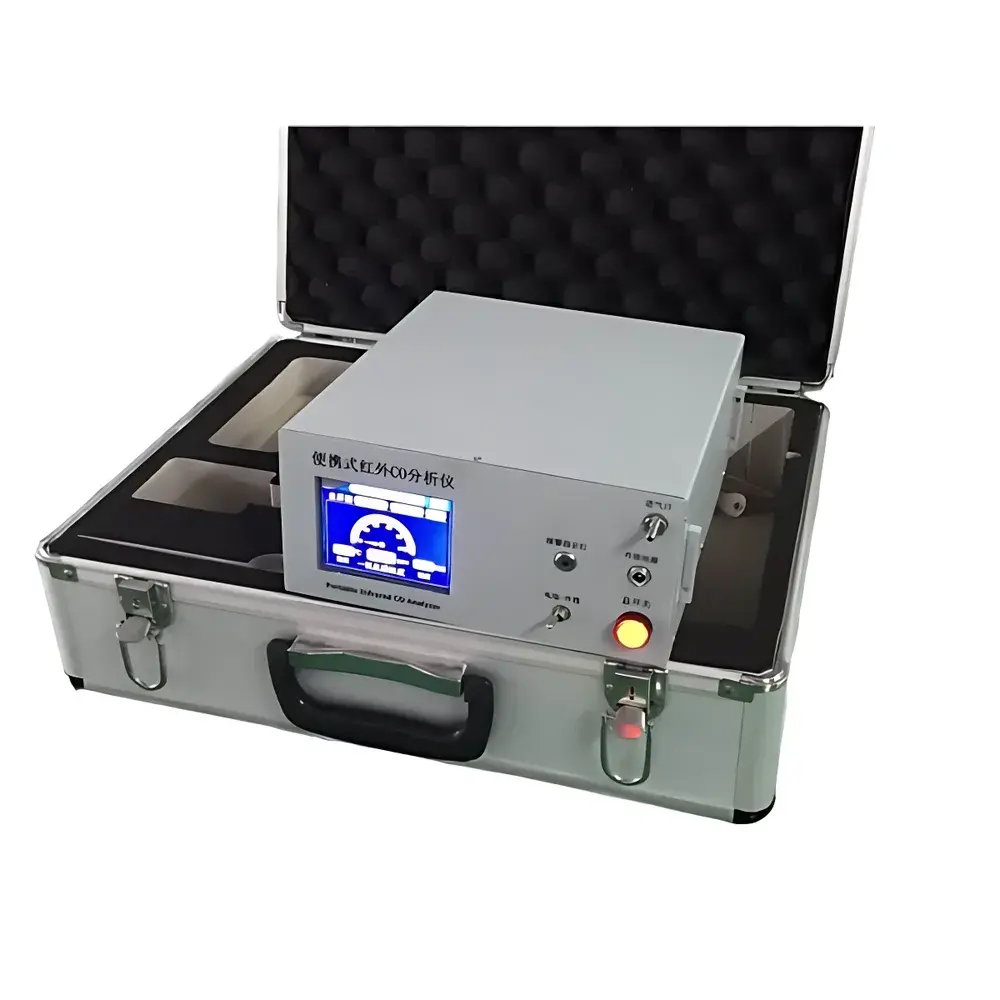
BJBY HX-2800 Portable Dual-Gas NDIR Analyzer for CO and CO₂
| Brand | BJBY |
|---|---|
| Origin | Beijing, China |
| Model | HX-2800 |
| Instrument Type | Portable |
| Detection Principle | Non-Dispersive Infrared (NDIR) Spectroscopy |
| Measurement Range | CO: 0–100 ppm, CO₂: 0–5000 ppm |
| Resolution | CO: 0.1 ppm, CO₂: 0.001% (10 ppm) |
| Linearity Error | ≤±2% FS |
| Repeatability | ≤1.0% FS |
| Zero Drift | ≤±2% FS/h |
| Span Drift | ≤±2% FS/3h |
| Response Time | CO ≤60 s, CO₂ ≤30 s |
| Preheat Time | 30 min |
| Flow Rate | 0.5–2.0 L/min |
| Digital Interfaces | RS-232, USB, Modbus RTU via RS-485 |
| Data Storage Capacity | Up to 5000 measurement records |
| Display | Color TFT touchscreen |
| Power Supply | AC 220 V (±10%) or rechargeable Li-ion battery |
| Alarm | Visual and audible alarm with configurable thresholds |
| Compliance | GB/T 18204.23–2000, GB/T 9801–1988, GB/T 18204.24–2000, JJG 635–2011 |
Overview
The BJBY HX-2800 Portable Dual-Gas NDIR Analyzer is an engineered solution for field-deployable, simultaneous quantification of carbon monoxide (CO) and carbon dioxide (CO₂) in ambient air, indoor environments, industrial workspaces, and combustion exhaust streams. It operates on the principle of non-dispersive infrared (NDIR) spectroscopy—leveraging the unique absorption bands of CO (at ~4.6 µm) and CO₂ (at ~4.26 µm) within the mid-infrared region. Dual-wavelength detection optics, thermopile detectors, and temperature-stabilized reference cells ensure high selectivity and immunity to cross-interference from water vapor, methane, or hydrocarbons under typical environmental conditions. The instrument integrates a built-in sampling pump with adjustable flow control (0.5–2.0 L/min), enabling consistent sample draw-through the optical cell without external accessories. Designed for rapid deployment, it achieves operational readiness after a 30-minute warm-up period and delivers stable readings compliant with national metrological verification protocols.
Key Features
- Simultaneous dual-gas measurement using independent NDIR optical channels optimized for CO (0–100 ppm) and CO₂ (0–5000 ppm)
- High-resolution detection: 0.1 ppm for CO and 0.001% (equivalent to 10 ppm) for CO₂, supporting low-concentration monitoring in occupational hygiene and IAQ assessments
- Robust thermal and mechanical architecture with drift-compensated electronics—zero drift ≤±2% full scale per hour; span drift ≤±2% full scale over 3 hours
- Color TFT touchscreen interface (≥3.5″) with intuitive icon-driven navigation, real-time trend graphs, and configurable alarm thresholds (visual + audible)
- Onboard data logging capacity for up to 5000 timestamped records, including gas concentrations, date/time, pump status, and battery level
- Dual power operation: AC mains (220 V ±10%) or internal rechargeable lithium-ion battery (≥4 h continuous runtime at nominal flow)
- Standard digital interfaces: RS-232 (for direct PC connection), USB (mass storage mode for CSV export), and RS-485 (Modbus RTU protocol support for integration into SCADA or building management systems)
Sample Compatibility & Compliance
The HX-2800 is validated for use with ambient air, diluted flue gases (post-scrubbing), indoor ventilation streams, and confined-space atmospheres where CO and CO₂ are primary safety or regulatory indicators. Its NDIR methodology eliminates reliance on chemical reagents or consumables, ensuring long-term stability and minimal maintenance. The analyzer conforms to multiple Chinese national standards governing method validation and metrological traceability: GB/T 18204.23–2000 (CO determination in public places), GB/T 9801–1988 (non-dispersive infrared method for ambient CO), GB/T 18204.24–2000 (CO₂ determination in public spaces), and JJG 635–2011 (verification procedure for infrared CO/CO₂ analyzers). While not certified to ISO 12039 or EN 14625, its performance envelope aligns with the technical requirements for workplace exposure monitoring per GBZ 2.1–2019 and supports documentation for GLP-aligned environmental reporting workflows.
Software & Data Management
Data acquisition and post-processing are supported via optional PC-based software (sold separately), which enables real-time telemetry, batch export to CSV or Excel, calibration log review, and report generation compliant with internal QA/QC templates. Raw data files include metadata such as instrument ID, operator tag, GPS coordinates (if connected via external module), and environmental parameters (temperature, pressure—when interfaced with optional sensors). All stored records maintain immutable timestamps and are retained even during power interruption. Firmware updates are delivered via USB drive, and configuration backups can be exported for audit trail preservation. The device supports basic audit functionality—including user-accessible event logs for alarm triggers, zero/span calibrations, and system resets—though it does not implement full FDA 21 CFR Part 11 electronic signature or role-based access control.
Applications
- Occupational health & safety: Real-time CO exposure monitoring in boiler rooms, garages, tunnels, and welding zones
- Indoor air quality (IAQ) assessment: CO₂-based demand-controlled ventilation (DCV) verification in offices, schools, and hospitals
- Environmental field surveys: Ambient CO mapping near traffic corridors or industrial perimeters
- Maintenance diagnostics: Combustion efficiency evaluation in HVAC systems and small-scale boilers via CO/CO₂ ratio analysis
- Educational laboratories: Hands-on instruction in gas sensing principles, infrared spectroscopy, and environmental metrology
- Emergency response: Rapid screening during fire aftermath or gas leak investigations
FAQ
What calibration gases are required for routine verification?
A certified 50 ppm CO/N₂ and 2000 ppm CO₂/N₂ mixture are recommended for span checks; zero air (hydrocarbon-free, <0.1 ppm CO/CO₂) is required for zero adjustment.
Is the instrument suitable for measuring CO in high-humidity environments?
Yes—the optical path includes passive condensation management and the algorithm applies empirically derived humidity compensation within 10–90% RH (non-condensing); however, prolonged exposure to >95% RH is not advised.
Can the HX-2800 be integrated into a fixed monitoring network?
Via RS-485 Modbus RTU, it can serve as a node in multi-instrument deployments; however, it lacks built-in Ethernet, Wi-Fi, or cellular telemetry—external gateways are required for cloud connectivity.
How often should zero and span calibration be performed?
Daily zero check is recommended before critical measurements; span calibration is advised every 7 days or after exposure to extreme concentrations (>80% of range) or physical shock.
Does the device provide analog output signals?
No—the HX-2800 offers only digital interfaces (RS-232, USB, RS-485); 4–20 mA or 0–10 V analog outputs are not available on this model.
Related Products







