
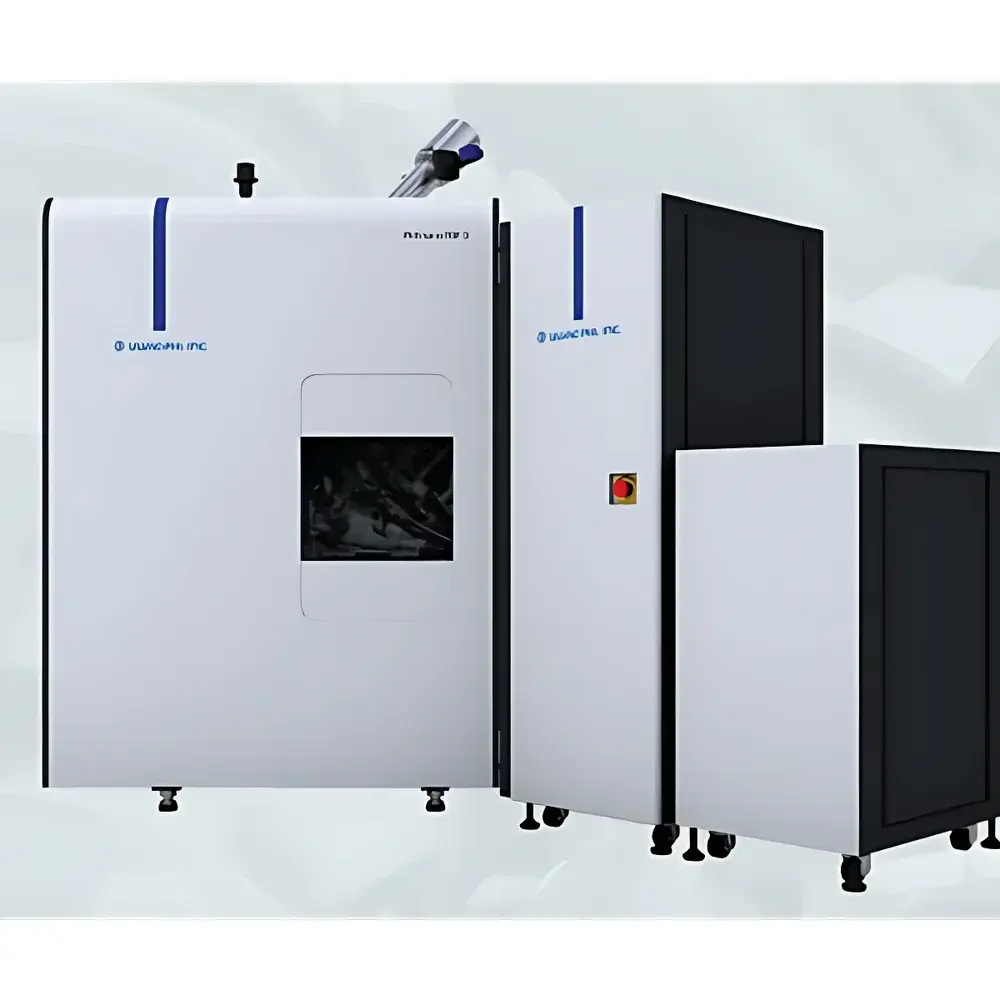
PHI oTOF 3 Time-of-Flight Secondary Ion Mass Spectrometer
| Brand | PHI |
|---|---|
| Origin | Japan |
| Model | oTOF 3 |
| Instrument Type | Time-of-Flight (TOF) |
| Primary Beam Energy | 30 kV |
| Mass Range | 15,000 u |
| Mass Resolution | 13,500 |
| Configuration | Parallel Imaging MS/MS |
| Charge Neutralization | Dual-beam (low-energy electrons + low-energy inert gas ions), self-regulating, position-resolved |
| Optional Features | Dual-cluster ion source, sub-500 nm HR2 chemical imaging, DE-free acquisition mode, high beam current HR2 imaging, large angular acceptance & depth of field |
Overview
The PHI oTOF 3 is a high-performance time-of-flight secondary ion mass spectrometer engineered for quantitative, spatially resolved molecular and elemental surface analysis. Operating on the principle of static secondary ion mass spectrometry (SIMS), it utilizes pulsed primary ion beams to desorb and ionize surface atoms and molecules with minimal subsurface damage—enabling true monolayer sensitivity and isotopic fidelity. Unlike scanning microprobe SIMS systems, the oTOF 3 employs parallel detection architecture with a reflectron TOF mass analyzer, delivering simultaneous acquisition of full mass spectra across the entire field of view. This architecture ensures high mass accuracy (< 5 ppm), exceptional mass resolution (m/Δm = 13,500 at m/z 100), and dynamic range exceeding 10⁵—critical for co-detection of trace organics and major inorganic constituents in heterogeneous samples. Its design integrates hardware-level solutions for surface charging mitigation, making it uniquely suited for insulating materials—including oxides, polymers, biological tissues, and functional thin films—without reliance on post-acquisition artifact correction.
Key Features
- Parallel imaging MS/MS capability for unambiguous peak identification and suppression of isobaric interferences via precursor ion selection and fragment mapping
- Dual-cluster ion source (e.g., Bi₃⁺/C₆₀⁺ or Ga⁺/Ar-GCIB) enabling < 500 nm lateral resolution in high-resolution mode (HR2) while maintaining high secondary ion yield
- Self-regulating, position-resolved dual-beam charge neutralization combining low-energy electrons and low-energy inert gas ions (e.g., Ar⁺ or O₂⁺), eliminating topography-induced spectral distortion and enabling artifact-free imaging of rough, tilted, or highly insulating surfaces
- Delay Extraction (DE)-free acquisition mode: high primary beam current operation without temporal pulse broadening, preserving mass resolution and eliminating DE-related calibration drift and spectral skew
- Large angular acceptance (> ±15°) and extended depth of field (> 100 µm), supporting robust analysis of non-planar, curved, or FIB-sectioned cross-sectional specimens
- Integrated vacuum architecture with base pressure < 5 × 10⁻¹⁰ mbar, optimized for ultra-high vacuum (UHV) stability during long-duration imaging and depth profiling
Sample Compatibility & Compliance
The oTOF 3 accommodates conductive, semiconductive, and insulating solid samples up to 25 mm in diameter—including wafers, polished cross-sections, freeze-fractured biological sections, polymer blends, battery electrode coatings, and perovskite thin films. Its charge compensation system meets ASTM E1527-22 requirements for surface charge management in SIMS analysis of dielectrics. The instrument supports GLP/GMP-compliant workflows through audit-trail-enabled acquisition software, electronic signature support, and metadata-rich data files compliant with ISO/IEC 17025 documentation standards. All firmware and control logic are validated against FDA 21 CFR Part 11 requirements for electronic records and signatures in regulated environments.
Software & Data Management
Acquisition and processing are performed using PHI’s proprietary MultiMode™ software suite, which provides real-time spectral visualization, automated mass calibration (internal/external reference), pixel-by-pixel spectral deconvolution, and multivariate statistical analysis (PCA, MCR-ALS). Data files are stored in vendor-neutral HDF5 format with embedded experimental metadata (beam parameters, dwell time, charge compensation settings, vacuum status). The software includes built-in tools for depth profile alignment, 3D reconstruction from serial FIB-SIMS datasets, and export to common chemometric platforms (MATLAB, Python SciPy, Thermo Scientific Compound Discoverer). Remote monitoring and batch processing are supported via secure TLS-encrypted API endpoints.
Applications
- Organic semiconductor layer interdiffusion and interface chemistry in OLED and OPV devices
- Trace metal contamination mapping in semiconductor fabrication wafers (e.g., Cu, Fe, Ni at sub-ppb levels)
- Molecular distribution of lipids, metabolites, and peptides in frozen-hydrated tissue sections for spatial omics
- Oxidation state mapping and dopant segregation in high-k gate dielectrics and solid-state electrolytes
- Chemical evolution of SEI layers in lithium-ion battery electrodes during in situ electrochemical cycling
- Authentication and degradation analysis of heritage polymer artifacts and conservation coatings
FAQ
What is the typical mass calibration stability over a 24-hour acquisition?
Mass calibration remains stable within ±0.002 u over 24 h when using internal lock-mass referencing and UHV conditions.
Can the oTOF 3 perform depth profiling on insulating materials without signal decay?
Yes—its adaptive dual-beam charge neutralization dynamically adjusts electron/ion flux based on local surface potential, sustaining secondary ion yield across > 10 µm sputter depths in SiO₂ or PMMA.
Is HR2 imaging compatible with large-area mapping (e.g., > 100 × 100 µm²)?
Yes—HR2 mode supports step-scan stitching of up to 1 mm² fields with sub-pixel registration accuracy and seamless spectral merging.
Does the system support external ion sources such as Ar-GCIB or water cluster beams?
The oTOF 3 platform accepts third-party cluster sources via standardized UHV feedthroughs and beamline integration kits, subject to compatibility validation by PHI Applications Engineering.
How is data integrity ensured during long-term regulatory submissions?
All raw and processed datasets include cryptographic hashes, timestamped operator logs, and immutable acquisition parameter sets—fully traceable under 21 CFR Part 11 and EU Annex 11 compliance frameworks.




