
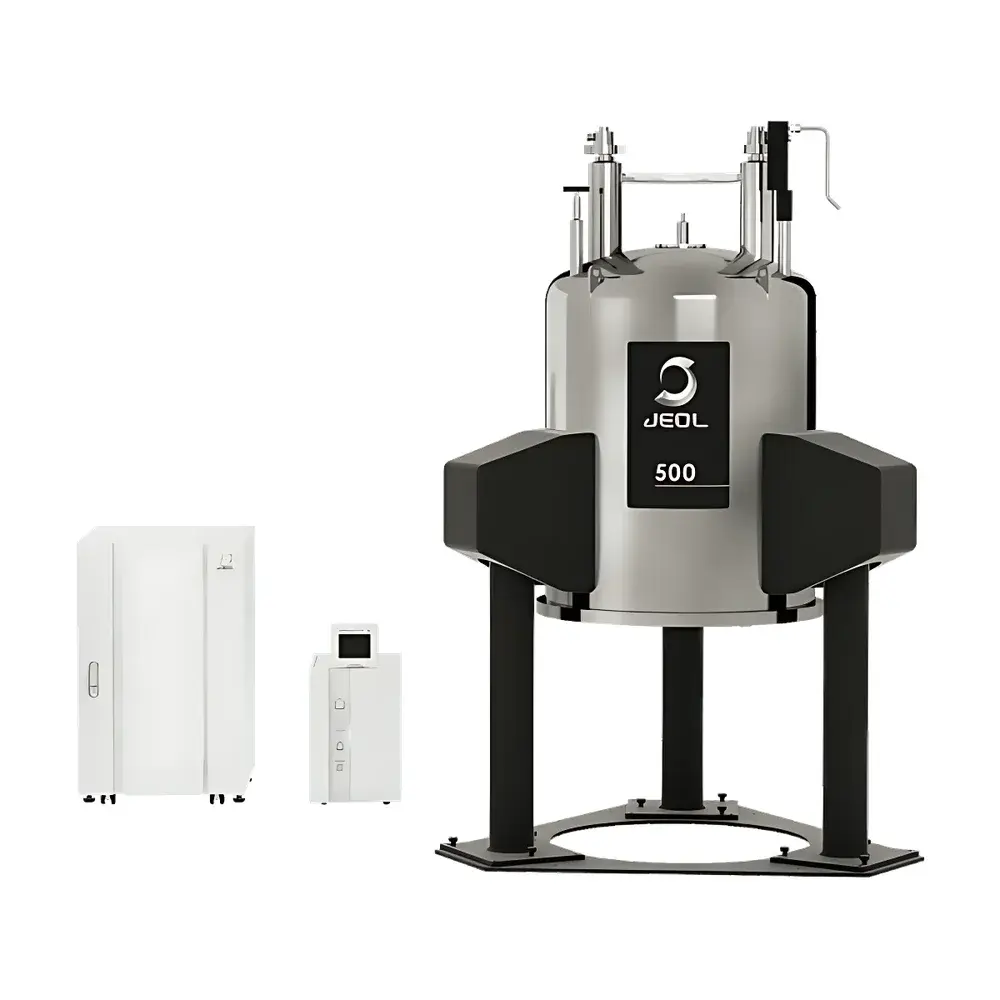
JEOL JNM-ECZL400R 400 MHz Solid-State Nuclear Magnetic Resonance Spectrometer
| Brand | JEOL |
|---|---|
| Origin | Japan |
| Model | JNM-ECZL400R |
| NMR Frequency | 400 MHz (¹H) |
| Magnet Type | Superconducting, Cryogen-Free Option Available |
| Field Homogeneity | < 0.1 Hz/30 min (shimmed) |
| Temperature Control Range | –140 °C to +140 °C |
| Sample Format | Solid, Semi-Solid, Gel, Liquid, and Heterogeneous Samples |
| Probe Compatibility | Broadband Solid-State MAS Probes (e.g., 2.5–4 mm rotors), Static & Variable-Temperature Configurations |
| Optional FFC Module | SPINMASTER FFC2000 (0.01–42 MHz field-cycling range) |
| Optional SMARTracer Module | 0.1–10 MHz |
| Optional 3 T Permanent Magnet Add-on | Extends ¹H Larmor frequency to ~130 MHz |
| Sample Tube Standard | 4 mm or 3.2 mm ZrO₂ MAS rotors (solid) |
Overview
The JEOL JNM-ECZL400R is a high-performance, 400 MHz solid-state nuclear magnetic resonance (NMR) spectrometer engineered for advanced structural and dynamic characterization of heterogeneous, non-soluble, and paramagnetic materials. Operating at a ¹H Larmor frequency of 400 MHz (corresponding to a 9.4 T superconducting magnet), the system delivers high sensitivity and spectral resolution essential for quantitative analysis of rigid lattices, disordered solids, surface-bound species, and complex soft matter. Unlike solution-state NMR systems optimized for homogeneous molecular dissolution, the JNM-ECZL400R integrates robust magic-angle spinning (MAS), variable-temperature (VT) control, and field-cycling capabilities—enabling rigorous investigation of spin relaxation mechanisms, local atomic environments, and slow molecular motions in pharmaceuticals, porous media, polymers, catalysts, and geological samples. Its modular architecture supports both routine QC workflows and frontier academic research requiring compliance with ISO/IEC 17025 traceability frameworks.
Key Features
- High-field 400 MHz ⁴⁰⁰ MHz ¹H NMR platform with actively shielded 9.4 T superconducting magnet; cryogen-free operation optional via pulse-tube cooling
- Advanced MAS probe family supporting rotor speeds up to 60 kHz (4 mm) and precise temperature regulation from –140 °C to +140 °C under inert gas flow
- Integrated field-cycling capability via SPINMASTER FFC2000 module (0.01–42 MHz), enabling direct measurement of T₁ρ, T₂, and spectral density functions across multiple field strengths
- SMARTracer low-field module (0.1–10 MHz) for relaxometry profiling, pore-size distribution mapping, and diffusion-relaxation correlation (D–T₂, T₁–T₂)
- Optional 3 T permanent magnet add-on extends effective ¹H operating range to ~130 MHz for hybrid high-/low-field experiments
- Digital console with 1 GHz real-time processing, 24-bit ADC, and phase-coherent multi-channel excitation (¹H, ¹³C, ¹⁵N, ²⁹Si, ³¹P, etc.)
- Automated shimming and lock routines compliant with GLP audit requirements, including full electronic logbook and timestamped parameter archiving
Sample Compatibility & Compliance
The JNM-ECZL400R accommodates diverse physical states without sample derivatization: crystalline and amorphous solids, hydrated gels, lyophilized biologics, carbonaceous materials, mineral powders, and multiphase composites—including turbid suspensions and liquid crystals. It accepts standard 4 mm ZrO₂ MAS rotors for high-resolution solid-state experiments and conventional 5 mm NMR tubes for comparative solution-phase reference measurements. All hardware and software modules comply with IEC 61000-6-3 (EMC) and IEC 61000-6-4 (industrial emission) standards. Data acquisition and processing meet FDA 21 CFR Part 11 requirements when deployed with JEOL’s validated Delta software suite, featuring role-based access control, electronic signatures, and immutable audit trails for GMP-regulated environments.
Software & Data Management
Controlled by JEOL’s Delta v6.x platform, the system provides unified workflow management—from pulse sequence design (including custom Python scripting via DeltaScript API) to automated batch processing and statistical multivariate analysis (PCA, PLS). Raw FID data are stored in vendor-neutral JCAMP-DX format with embedded metadata (pulse width, temperature, rotor speed, shim settings). The software supports ASTM E2810-compliant line-shape fitting, USP <711> dissolution NMR quantification protocols, and ISO 18322-compliant porosity modeling using T₂ distribution inversion. Integrated network storage supports DICOM export for cross-platform MRI/NMR correlation studies, and all processed spectra are exportable as SVG/PDF with embedded calibration references.
Applications
- Pharmaceutical solid-form screening: polymorph identification, hydrate/solvate characterization, and amorphous content quantification per ICH Q5A and Q6A guidelines
- Petroleum geoscience: pore-network topology analysis in shale cores and sandstones via ¹H T₁–T₂ correlation and diffusion editing
- Materials science: quantification of surface silanol density on mesoporous silica, carbon nanotube dispersion homogeneity, and polymer chain mobility gradients
- Food science: water compartmentalization in plant tissues, fat crystallinity kinetics, and protein aggregation monitoring during thermal processing
- Electrochemical interfaces: in situ/operando NMR of battery electrode degradation pathways and SEI layer evolution on Li-ion anodes
- Liquid crystal alignment dynamics and defect structure mapping under controlled shear and thermal stress
FAQ
What sample volume is required for solid-state MAS experiments?
Typical MAS experiments use 20–50 mg of finely ground solid packed into a 4 mm ZrO₂ rotor (~150 µL internal volume); no minimum volume is enforced, though signal-to-noise scales linearly with mass.
Is the system compatible with quantitative ¹³C CP-MAS under high-power decoupling?
Yes—the JNM-ECZL400R supports adiabatic broadband decoupling (SPINAL-64, DUMBO) up to 150 kHz ¹H irradiation, enabling quantitative ¹³C CP-MAS with <5% relative error across natural-abundance samples.
Can field-cycling data be correlated with high-field MAS spectra?
Yes—Delta software synchronizes FFC2000 and SMARTracer timing with the main console, allowing time-resolved relaxation maps to be spatially registered against high-resolution MAS spectra using common sample positioning markers.
Does JEOL provide validation documentation for regulated labs?
Yes—IQ/OQ/PQ protocols, 21 CFR Part 11 configuration files, and ASTM/ISO method transfer reports are available upon request and included in the GxP Support Package.
What maintenance intervals apply to the cryogen-free magnet option?
The pulse-tube cooler requires annual performance verification; helium boil-off rate remains <1 L/year under nominal operation, eliminating routine liquid helium refills.




