
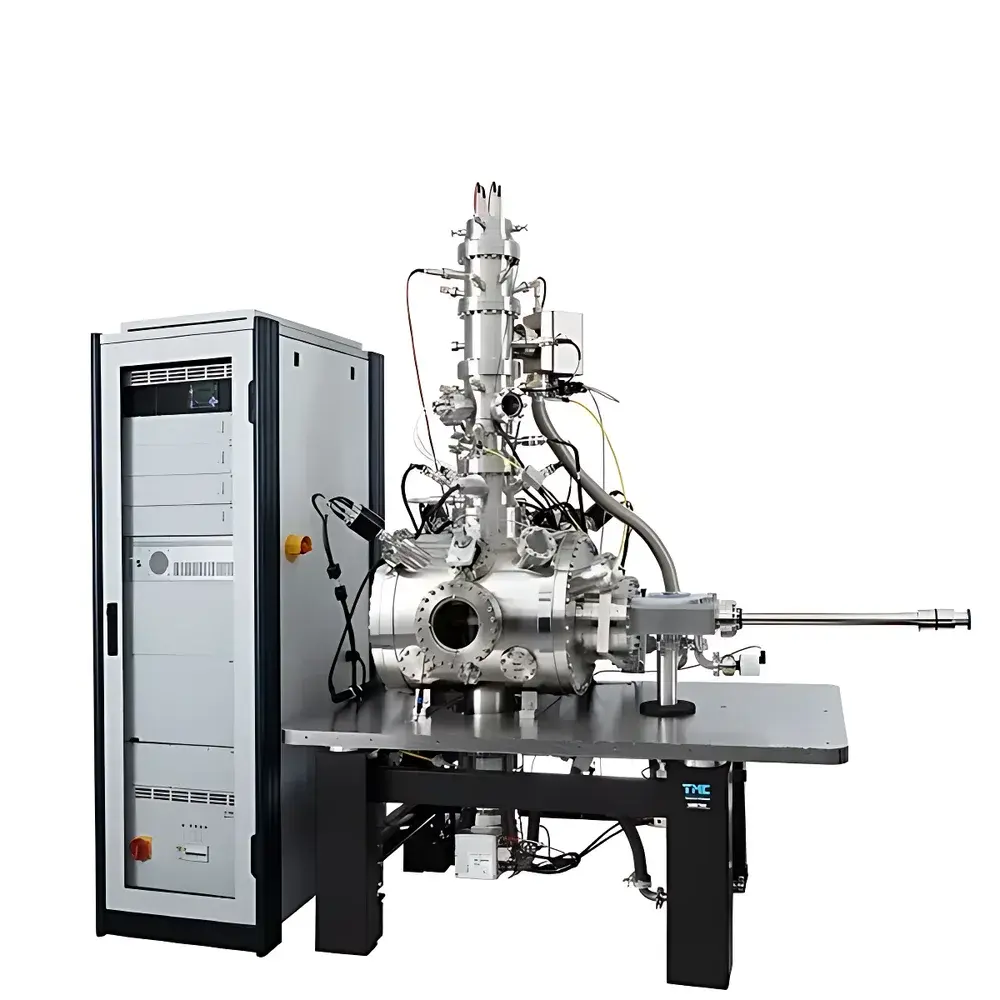
Makeway MKW-5250 Multi-Technique X-ray Photoelectron Spectrometer (XPS)
| Brand | Makeway |
|---|---|
| Origin | Shanghai, China |
| Model | MKW-5250 |
| Energy Resolution | 40 meV |
| X-ray Source | Al Kα (1486.6 eV) |
| Spatial Resolution | ≤ 5 µm (focused monochromated beam) |
| Analysis Area | Up to 300 µm × 300 µm |
| Detection Sensitivity | 11,800 kcps (for C 1s at pass energy 20 eV) |
| Sample Stage | Motorized XYZ + tilt/rotation |
| Compatible Techniques | XPS, UPS, LEIPS, REELS, AES, HAXPES (with optional Cr/Mg anode), GCIB depth profiling, angle-resolved XPS (AR-XPS) |
Overview
The Makeway MKW-5250 is a high-performance, multi-technique X-ray photoelectron spectrometer engineered for comprehensive surface and interface analysis of advanced functional materials. Based on the core principles of photoemission spectroscopy—where monochromatic X-rays eject core-level electrons whose kinetic energy is measured to determine elemental composition, chemical state, and electronic structure—the MKW-5250 integrates a focused, monochromated Al Kα X-ray source (1486.6 eV) with a high-transmission hemispherical analyzer and a multi-channel detection system. Its ≤ 5 µm micro-focused beam enables spatially resolved chemical mapping, while its sub-40 meV energy resolution ensures precise differentiation of oxidation states and subtle shifts in binding energy—critical for characterizing battery interfaces, catalyst active sites, and semiconductor heterojunctions. Designed as a modular platform, it supports seamless integration of complementary surface science techniques including ultraviolet photoelectron spectroscopy (UPS), low-energy inverse photoemission spectroscopy (LEIPS), reflection electron energy loss spectroscopy (REELS), Auger electron spectroscopy (AES), gas cluster ion beam (GCIB) sputtering, and hard X-ray photoelectron spectroscopy (HAXPES) via optional anodes.
Key Features
- Micro-focused X-ray beam (≤ 5 µm spot size) enabling high-resolution chemical imaging and targeted micro-area analysis
- High-sensitivity detection system delivering >11,800 kcps count rate for C 1s under standard conditions, facilitating rapid acquisition of high-S/N spectra
- Automated sample handling with triple 80 mm × 80 mm sample trays and ultra-high-vacuum (UHV) transfer lock for unattended multi-sample analysis
- Integrated dual-beam charge neutralization system optimized for insulating samples—including polymers, oxides, and Li-ion battery cathodes—ensuring stable, reproducible quantification
- Motorized 5-axis sample stage (XYZ + tilt + rotation) supporting angle-resolved XPS (AR-XPS), depth profiling, and precise navigation via secondary electron imaging (SXI)
- Modular architecture accommodating optional upgrades: Cr/Mg anodes for HAXPES, Arn+ GCIB for gentle depth profiling of organic and hybrid layers, and differential pumping for ambient-pressure-compatible measurements
Sample Compatibility & Compliance
The MKW-5250 accommodates diverse solid-state specimens without requiring conductive coating: powders (mounted on adhesive tape or indium foil), rough or irregularly shaped components, insulating ceramics, thin-film stacks, and air-sensitive battery cross-sections (via transfer vessel compatibility). Its UHV analysis chamber (< 5 × 10⁻¹⁰ mbar base pressure) meets ISO 14644-1 Class 4 cleanroom requirements for surface integrity. All data acquisition and processing workflows support audit-trail-enabled operation compliant with GLP and GMP frameworks. Full traceability—including instrument parameters, calibration history, and user actions—is maintained per FDA 21 CFR Part 11 guidelines when paired with validated software configurations.
Software & Data Management
Control and analysis are executed through a unified, icon-driven GUI designed for operational efficiency and minimal training overhead. The software suite includes real-time SXI-based navigation, automated peak fitting with Shirley/Tougaard background subtraction, quantitative stoichiometric modeling (based on Scofield sensitivity factors), and layer-by-layer depth profile reconstruction using TRIDYN simulation integration. Raw spectral data are stored in VAMAS format (ISO 14976), ensuring interoperability with third-party tools such as CasaXPS and commercial DFT databases. Batch processing scripts support standardized reporting for QC/QA documentation, including ASTM E1521–22 (Standard Guide for XPS Data Reporting) and ISO 18118:2017 (Surface Chemical Analysis — XPS — Terminology).
Applications
- Battery R&D: Quantitative Li speciation mapping across solid-electrolyte interphases (SEI), depth-resolved analysis of LiPON/LiCoO2 interfaces, and oxidation-state tracking of transition metals during cycling
- Semiconductor & Microelectronics: Non-destructive chemical state analysis of gate dielectrics (e.g., SiO2/SiNx/GaN stacks), metal silicide formation, and solder joint interfacial reactions via HAXPES
- Organic Electronics: Band alignment determination at organic/metal interfaces (e.g., C60/Au) using UPS/LEIPS combined with GCIB depth profiling
- Heterogeneous Catalysis: Surface adsorbate identification, active site coordination analysis, and coke deposition monitoring on supported metal nanoparticles
- Photovoltaics & Nanomaterials: Interface dipole characterization in perovskite solar cells, dopant distribution in quantum dot films, and surface ligand coverage on plasmonic nanoparticles
FAQ
Is the MKW-5250 compatible with air-sensitive samples such as lithium metal or sulfide-based electrolytes?
Yes—when configured with a load-lock transfer vessel and inert-gas glovebox integration, the system enables direct transfer of moisture- and oxygen-sensitive specimens without atmospheric exposure.
Can the instrument perform true in-situ or operando measurements?
While the base configuration operates under UHV, optional differentially pumped stages and environmental cells allow quasi-in-situ analysis up to 10−3 mbar partial pressures for catalytic or electrochemical surface studies.
What level of automation is supported for routine QA/QC workflows?
The platform supports fully scripted sequences—including auto-alignment, standard calibration, multi-point mapping, and depth profiling—with pass/fail criteria embedded in report generation for ISO/IEC 17025-compliant laboratories.
Does the system meet international standards for XPS data reporting and metrology?
Yes—software export functions comply with VAMAS, NIST SRD 20, and ISO 18118 metadata requirements; energy scale calibration follows ISO 15472:2020 using Ag 3d5/2, Cu 2p3/2, and Au 4f7/2 reference peaks.
How is long-term stability ensured for quantitative analysis across multiple users and sessions?
Hardware-based energy calibration (using internal reference electrodes), automated flood-gun optimization routines, and session-specific charge compensation logs ensure inter-operator reproducibility within ±0.05 eV binding energy drift over 12-month intervals.






