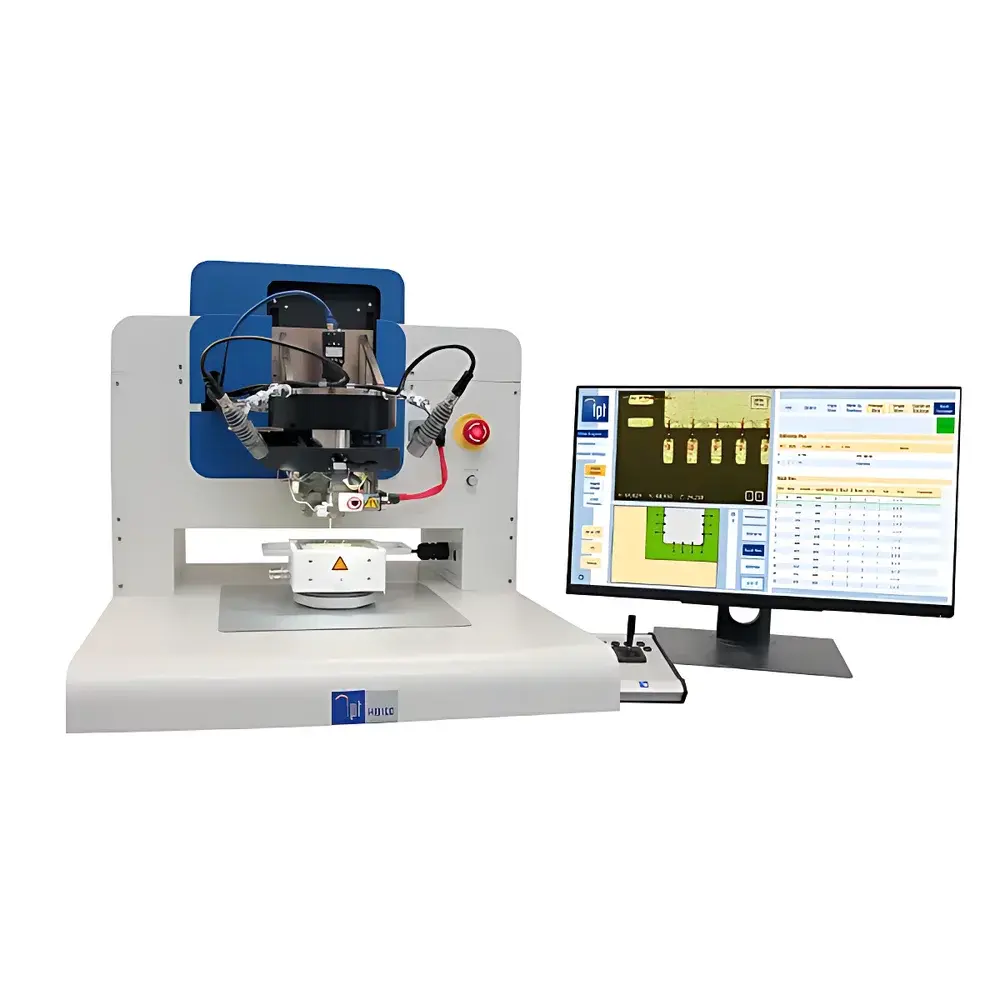
TPT HB100 Automatic Wire Bonder
| Brand | TPT |
|---|---|
| Origin | Germany |
| Model | HB100 |
| Bonding Types | Ball & Wedge |
| Wire Diameter Range | 17–75 µm |
| Ultrasonic Frequency | 63.3 kHz (PLL-controlled, optional 110 kHz) |
| Ultrasonic Power | 0–10 W |
| Bonding Force | 10–200 cN·mm |
| Z-Axis Resolution | 0.5 µm |
| X-Y Resolution | 0.1 µm |
| X-Y Travel | 90 mm |
| Z Travel | 100 mm |
| Heating Stage | Ø90 mm, up to 200 °C ±1 °C |
| Power Supply | 100–240 V AC, 50/60 Hz, ≤10 A |
| Dimensions (W×D×H) | 620 × 750 × 680 mm |
| Weight | 72 kg |
Overview
The TPT HB100 Automatic Wire Bonder is a precision-engineered, German-manufactured desktop bonding platform designed for R&D laboratories and low-volume semiconductor packaging environments. It implements dual-mode thermosonic wire bonding—supporting both ball bonding (for gold and copper wires) and wedge bonding (for aluminum, gold, and copper)—within a single, interchangeable bond head assembly. The system operates on a robust kinematic architecture featuring linear motor-driven X-Y stages and a high-resolution screw-driven Z-axis, enabling sub-micron positional repeatability critical for fine-pitch die interconnects. Thermosonic bonding is achieved through synchronized application of ultrasonic energy (63.3 kHz, PLL-stabilized; optional 110 kHz), controlled thermal input via a programmable heated stage (up to 200 °C ±1 °C), and precisely regulated mechanical force (10–200 cN·mm). This tripartite energy coupling ensures reliable metallurgical interfacial formation while minimizing substrate stress and wire deformation—key requirements for high-reliability microelectronics packaging in automotive, aerospace, and medical device applications.
Key Features
- Single bond head capable of both ball and wedge bonding—no hardware swap required; only tooling (capillary or wedge) change needed
- 21-inch industrial-grade touchscreen HMI with ergonomic hand controller for intuitive jog-and-teach operation
- High-precision linear motor X-Y stage (0.1 µm resolution, 90 mm travel) and servo-driven Z-axis (0.5 µm resolution, 100 mm travel)
- Dual-camera optical system: simultaneous wide-field overview and high-magnification (up to 150×) detail imaging for accurate bond site alignment
- Negative EFO (Electronic Flame-Off) control with software-tuned ball size regulation for consistent free-air ball formation
- Integrated anti-collision safety logic for Z-axis contact descent—prevents accidental damage to dies, substrates, or tooling
- Deep-cavity 90° wire feed mechanism (14 mm insertion depth) optimized for high-loop profiles and cavity-down packages
- Motorized wire clamp with programmable tear-off direction (upward/downward) and dual severing modes (bond-head or clamp-induced break)
Sample Compatibility & Compliance
The HB100 accommodates a broad range of substrate geometries and material systems common in advanced packaging: QFN, DFN, SOIC, bare dies (up to 400 mm width), ceramic and organic laminates, silicon carbide (SiC) and gallium nitride (GaN) power modules, and MEMS sensor assemblies. Its vacuum- and mechanical-clamping options for the heating stage ensure secure fixation of thin, warped, or low-rigidity substrates. The system complies with CE marking requirements and meets electromagnetic compatibility (EMC) standards per EN 61326-1. While not certified as GMP or ISO 13485 production equipment, its architecture supports GLP-aligned documentation workflows—including timestamped parameter logging, user access levels, and audit-trail-ready process recipes—making it suitable for pre-production qualification per JEDEC J-STD-020, MIL-STD-883, and AEC-Q200 test protocols.
Software & Data Management
The HB100 runs on TPT’s proprietary BondControl™ software suite, built on a real-time Linux kernel for deterministic motion and I/O response. Each bonding sequence is defined via hierarchical recipe structures: global parameters (temperature, US power), step-level settings (force, time, loop height), and per-bond coordinates with conditional branching (e.g., skip defective sites). All process data—including ultrasonic current waveforms, Z-position traces, and thermal ramp logs—are stored in HDF5 format with embedded metadata (operator ID, timestamp, recipe version). Export interfaces include CSV, XML, and direct ODBC connectivity to LIMS or MES platforms. Optional FDA 21 CFR Part 11 compliance package provides electronic signature enforcement, role-based permissions, and immutable audit trails for regulated development environments.
Applications
- Development and validation of wire bond processes for SiC/GaN power modules requiring high-current, low-resistance interconnects
- Prototyping of heterogeneous integration schemes—e.g., chiplet-to-interposer bonding using 17–25 µm Au or Cu wires
- Reliability testing per JEDEC JESD22-A114 (wire bond pull/shear strength) and JESD22-B116 (thermal cycling)
- Failure analysis support: re-bonding of lifted leads or repair of test vehicles without full reflow
- Educational use in semiconductor packaging courses—demonstrating fundamental thermosonic mechanisms, parameter sensitivity, and DOE-based optimization
FAQ
Can the HB100 bond both gold and aluminum wires without hardware modification?
Yes—the same bond head supports Au (17–75 µm) and Al (17–75 µm) wires via interchangeable tooling (capillary for ball, wedge for wedge) and software-selectable ultrasonic parameters.
Is vacuum chucking mandatory for all substrates?
No—mechanical clamping is standard; vacuum chucks are optional accessories, recommended for thin (<100 µm) or highly warped substrates.
What level of traceability does the system provide for quality audits?
Full parameter logging per bond (force, time, temperature, US amplitude), operator ID, and timestamp; optional Part 11 add-on enables electronic signatures and immutable audit trails.
Does the HB100 support automated vision-based alignment?
It includes dual-camera optics and manual alignment tools; fully automated pattern recognition requires integration with third-party machine vision SDKs via Ethernet/IP.
Are service and calibration supported outside Germany?
TPT authorizes certified field service engineers across North America, EMEA, and APAC; annual calibration services follow ISO/IEC 17025-accredited procedures.