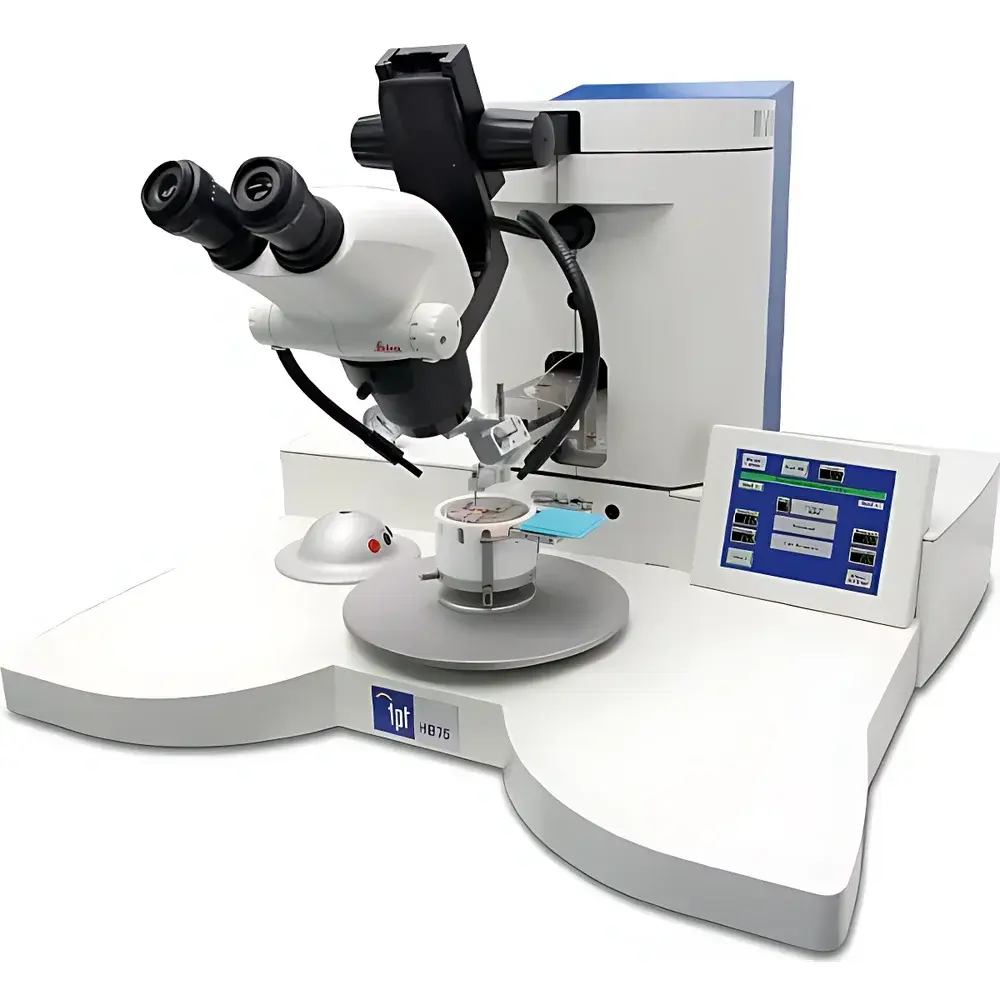
TPT HB75 Manual Pick-and-Place System
| Brand | TPT |
|---|---|
| Origin | Germany |
| Model | HB75 |
| Z-Axis Drive | Motorized |
| Control Interface | 6.5" TFT Touchscreen |
| Placement Accuracy | Sub-10 µm (typical, under optimized conditions) |
| Chip Size Range | 100 µm × 100 µm to 10 mm × 10 mm |
| Placement Time | 1–10,000 ms (optional extension to 20,000 ms) |
| Placement Force | 10–150 cN·m (350 cN·m optional) |
| Vacuum Source | Integrated pump |
| Nozzle Diameter | Ø1.58 mm, 19 mm length |
| Z-Travel | 17 mm |
| Arm Length | 165 mm |
| X-Y Manipulator Range | ±10 mm |
| Mechanical Lever Ratio | 6:1 |
| Temperature Control | Up to 250 °C ±1 °C |
| Power Supply | 100–240 VAC, ±10%, 50/60 Hz, max. 10 A |
| Dimensions (W×D×H) | 680 × 640 × 490 mm |
| Net Weight | 42 kg |
Overview
The TPT HB75 Manual Pick-and-Place System is a precision-engineered desktop platform designed for high-fidelity die placement in semiconductor R&D, MEMS prototyping, optoelectronic assembly, and low-volume production environments. Unlike fully automated SMT machines, the HB75 leverages motorized Z-axis actuation combined with mechanical micro-manipulation (6:1 lever ratio) to deliver repeatable, tactile-controlled placement—enabling operators to perform fine alignment, force-sensitive bonding, and sequential pick-and-place tasks with sub-10 µm positional reproducibility under calibrated lighting and microscope integration. Its core architecture follows the principles of orthogonal kinematics: independent X-, Y-, and Z-motion axes ensure minimal crosstalk during chip pickup, adhesive dispensing (optional), and contact placement. The system supports both manual operation—where the operator directly controls motion via ergonomic joysticks—and semi-automatic mode, where preloaded programs execute defined sequences including vacuum-on/off, Z-descent profiles, dwell time, and thermal ramping (when equipped with heated stage). This dual-mode capability makes the HB75 particularly suited for process development requiring iterative parameter tuning prior to transfer to high-throughput lines.
Key Features
- Mechanically amplified X-Y manipulator with 6:1 leverage ratio for intuitive, high-resolution manual positioning over ±10 mm range
- Motor-driven Z-axis with 17 mm travel and programmable descent velocity, dwell time (1–10,000 ms standard; up to 20 s optional), and contact force control (10–150 cN·m, extendable to 350 cN·m)
- Integrated vacuum generation system eliminating external pump requirements; compatible with standard ISO cleanroom vacuum protocols
- Rotatable tool head enabling rapid nozzle exchange without recalibration; accommodates Ø1.58 mm, 19 mm-length suction nozzles for die sizes from 100 µm × 100 µm to 10 mm × 10 mm
- Dedicated dip-and-place functionality for controlled adhesive transfer using capillary or meniscus-based pickup
- Optional dispensing module supporting precise dot or line deposition adjacent to placement zone (e.g., epoxy, UV-curable adhesives)
- Heated stage with PID-controlled temperature up to 250 °C ±1 °C—critical for thermoset curing, solder reflow simulation, and wafer-level bonding studies
- 6.5-inch industrial-grade TFT touchscreen interface with intuitive menu navigation, real-time parameter feedback, and on-device storage for up to 100 user-defined placement routines
Sample Compatibility & Compliance
The HB75 accommodates a broad spectrum of substrate geometries and material systems common in advanced packaging workflows: silicon dies, glass MEMS caps, ceramic substrates, flexible PCBs, and bio-compatible sensor carriers. Its open-frame design allows integration with stereo microscopes (e.g., Leica M-series, Olympus SZX), IR inspection tools, and external environmental chambers. From a regulatory standpoint, the system’s electrical architecture complies with IEC 61000-6-2 (immunity) and IEC 61000-6-4 (emission) standards. While not certified as medical device manufacturing equipment per ISO 13485, its construction—stainless steel frame, ESD-safe surfaces, and traceable calibration paths—supports GLP-compliant documentation when paired with external metrology logs. All firmware operations are timestamped and support audit-trail export for internal quality records.
Software & Data Management
The embedded control software provides non-volatile storage for 100 placement programs, each configurable with up to 16 discrete steps—including coordinate offsets, Z-height targets, vacuum activation timing, thermal setpoints, and inter-step delays. Programs can be imported/exported via USB flash drive in plain-text CSV format for version control and cross-platform validation. No proprietary runtime environment is required; configuration files are human-readable and editable offline. While the HB75 does not implement FDA 21 CFR Part 11 electronic signature functionality natively, its logging framework—recording operator ID (manually entered), program name, timestamp, and final Z-position—meets baseline data integrity requirements for laboratory notebooks and engineering change orders.
Applications
- MEMS/MOEMS die attachment and lid sealing under controlled force and temperature
- Hybrid integration of III-V photonic chips onto silicon photonics interposers
- Micro-optical component alignment (lenses, filters, VCSEL arrays) with active feedback loops
- Prototyping of heterogeneous 3D-packaged sensors for automotive and IoT edge devices
- Medical microdevice assembly involving biocompatible adhesives and sterilizable substrates
- Fundamental research into interfacial mechanics during thermocompression bonding and anisotropic conductive film (ACF) lamination
FAQ
Is the HB75 suitable for production environments?
The HB75 is engineered for R&D, pilot-line validation, and low-volume manufacturing (typically <500 units/month). It is not intended for 24/7 continuous operation but supports scheduled maintenance intervals aligned with ISO 9001 preventive maintenance plans.
Can it integrate with vision alignment systems?
Yes—the HB75 features standardized mounting interfaces (M4 and M6 threaded holes) and programmable I/O triggers (TTL-compatible) for synchronization with third-party machine vision platforms such as Cognex In-Sight or Basler ace cameras.
What vacuum level does the integrated pump achieve?
The built-in diaphragm pump delivers ≥60 kPa (≥0.6 bar) vacuum at the nozzle tip, sufficient for handling silicon, glass, and ceramic dies up to 10 mm square; higher vacuum options are available via external booster modules.
Does TPT provide calibration certificates?
Factory calibration reports—including Z-axis linearity verification, temperature uniformity mapping across the stage, and vacuum decay testing—are supplied with each unit. NIST-traceable recalibration services are available through authorized European service centers.
Is technical support available in English-speaking regions?
TPT maintains direct engineering support channels in Germany and partners with regional distributors in North America and APAC who provide localized application assistance, training, and spare parts logistics under formal service-level agreements.