
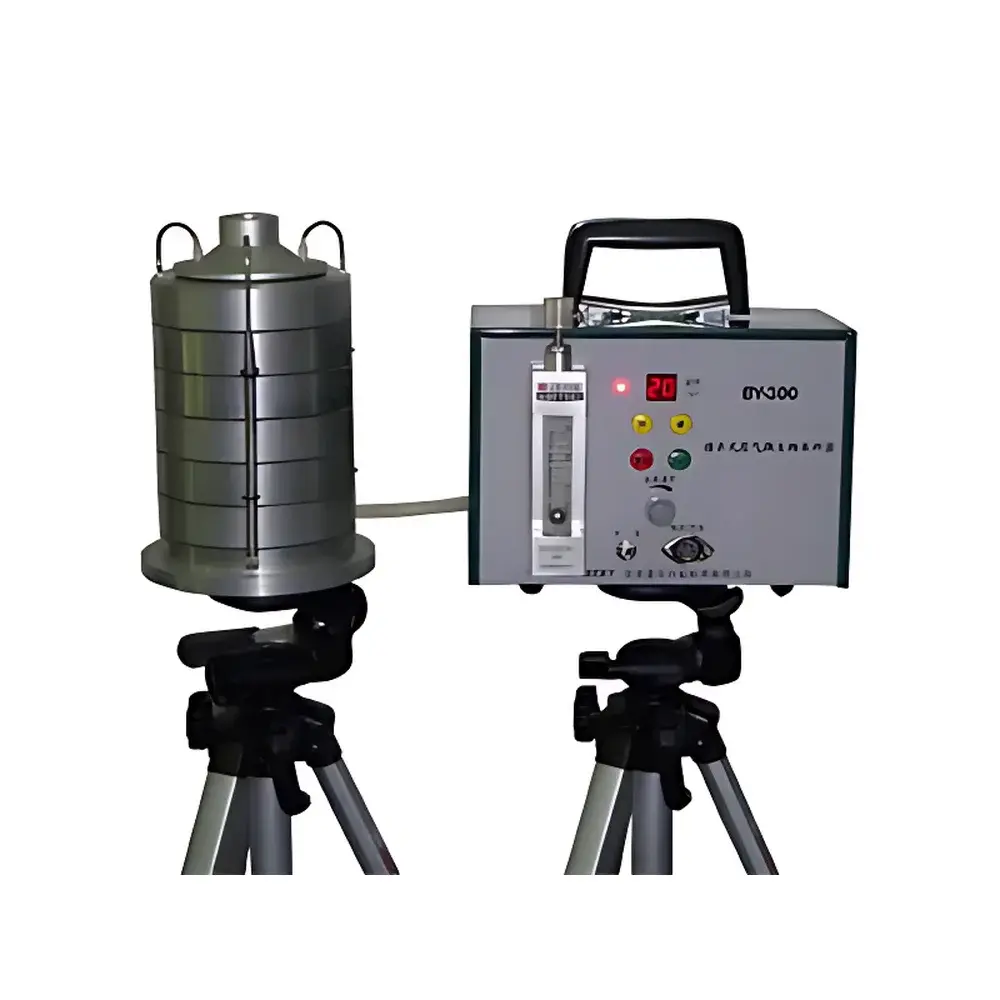
BJBY BY-300 Anderson-Type Air Microbial Sampler
| Brand | BJBY |
|---|---|
| Origin | Beijing, China |
| Model | BY-300 |
| Flow Range | 0–30 L/min |
| Flow Accuracy | Class 2.5 |
| Sampling Principle | Impaction |
| Timer Range | 1–99 min |
| Negative Pressure | ≥2000 Pa |
| Capture Efficiency | ≥98% |
| Power Supply | Rechargeable Li-ion battery (5 h runtime) + AC/DC adapter (220 V, 50 Hz) |
| Weight | 2.0 kg |
| Dimensions | 20 × 13.5 × 14 cm |
| Sampler Head | 6-stage Anderson-style impactor (Aluminum alloy, rubber-gasketed stages) |
| Particle Size Cutoffs | Stage 1: >7.0 µm |
| Stage 2 | 4.7–7.0 µm |
| Stage 3 | 3.3–4.7 µm |
| Stage 4 | 2.1–3.3 µm |
| Stage 5 | 1.1–2.1 µm |
| Stage 6 | 0.65–1.1 µm |
| Collection Medium | Standard 90 mm Petri dishes |
Overview
The BJBY BY-300 Anderson-Type Air Microbial Sampler is a portable, precision-engineered instrument designed for quantitative assessment of viable airborne microorganisms in indoor and outdoor environments. It operates on the principle of inertial impaction—where aerosolized particles are accelerated through calibrated nozzles onto nutrient agar surfaces within standard 90 mm Petri dishes. This method enables size-resolved collection across six aerodynamically defined stages, conforming to the widely accepted Andersen cascade impactor design. The device maintains a stable, user-selectable volumetric flow rate between 0 and 30 L/min throughout sampling, compensating dynamically for increasing backpressure as microbial deposits accumulate on the collection media. Its dual-power architecture—supporting both rechargeable lithium-ion battery operation (up to 5 hours per charge) and AC/DC input (220 V, 50 Hz)—ensures operational continuity in field settings where mains power is unavailable. The compact form factor (20 × 13.5 × 14 cm), lightweight construction (2.0 kg), and integrated tripod mounting capability make it suitable for routine environmental monitoring in hospitals, HVAC systems, cleanrooms, laboratories, and public health surveillance programs.
Key Features
- True constant-flow sampling via digitally regulated diaphragm pump with real-time backpressure compensation
- Six-stage aluminum Anderson-style impactor head with precision-machined nozzle diameters and elastomeric sealing gaskets for leak-free staging
- Class 2.5 flow accuracy compliant with ISO 14644-1 and GB/T 18204.1–2013 requirements for air microbiological testing
- Programmable digital timer (1–99 minutes) with audible end-of-cycle alert and automatic pump shutoff
- Integrated power management system supporting simultaneous charging and operation; battery status indicator included
- Nozzle-specific particle cut-points traceable to aerodynamic diameter standards: Stage 1 (>7.0 µm), Stage 2 (4.7–7.0 µm), Stage 3 (3.3–4.7 µm), Stage 4 (2.1–3.3 µm), Stage 5 (1.1–2.1 µm), Stage 6 (0.65–1.1 µm)
- ≥98% collection efficiency for particles ≥0.65 µm under nominal 28.3 L/min conditions, validated per ASTM D1465 and ISO 8573-7 protocols
Sample Compatibility & Compliance
The BY-300 is optimized for use with conventional microbiological growth media—including Tryptic Soy Agar (TSA), Sabouraud Dextrose Agar (SDA), and Malt Extract Agar (MEA)—poured into standard 90 mm disposable or reusable Petri dishes. Its six-stage configuration allows stratified analysis of bioaerosol size distribution, supporting identification of respirable (≤4 µm), thoracic (≤10 µm), and inhalable fractions per ISO 7708 and ACGIH TLV definitions. The instrument meets national regulatory requirements outlined in China’s WS/T 648–2019 (Technical Specifications for Airborne Microbial Monitoring in Healthcare Facilities) and aligns with international guidance for environmental monitoring in GMP-compliant pharmaceutical manufacturing (Annex 1, EU GMP) and ISO 14644-1 cleanroom classification. All metallic components are anodized aluminum, ensuring corrosion resistance and compatibility with alcohol-based disinfectants used during decontamination cycles.
Software & Data Management
The BY-300 operates as a standalone hardware platform without embedded firmware or proprietary software dependencies. All operational parameters—including set flow rate, elapsed time, and total sampled volume—are displayed on a high-contrast LCD interface. For laboratory information management system (LIMS) integration, users may record metadata manually or via optional barcode-scanned sample IDs linked to electronic lab notebooks (ELNs). While the device itself does not generate digital audit trails, its mechanical timer and physical calibration certificate support GLP-compliant documentation when paired with standardized SOPs. Calibration verification is performed using NIST-traceable primary standard flow calibrators (e.g., dry calibrators or bubble meters), eliminating reliance on rotor meter-based secondary references—a key advantage for metrological traceability in accredited labs.
Applications
- Routine monitoring of airborne bioburden in hospital isolation rooms, operating theaters, and immunocompromised patient wards
- Validation and routine testing of HVAC filtration efficiency and ductwork cleanliness in commercial and institutional buildings
- Environmental qualification of ISO Class 5–8 cleanrooms per ISO 14644-2 and FDA Guidance for Industry: Sterile Drug Products Produced by Aseptic Processing
- Epidemiological investigations of nosocomial infection sources and outbreak tracing in public health laboratories
- Research applications in aerobiology, fungal spore dispersion modeling, and antimicrobial surface efficacy testing
- Compliance-driven sampling for food processing facilities under SQF, BRCGS, and FSSC 22000 environmental monitoring plans
FAQ
What calibration standards are recommended for routine verification of flow accuracy?
NIST-traceable dry calibrators or soap-bubble meters meeting ISO 6707-1 specifications are recommended. Calibration should be performed at least quarterly or before each critical sampling campaign.
Can the BY-300 be used with non-standard Petri dish sizes?
No—it is mechanically engineered exclusively for 90 mm diameter Petri dishes. Deviations compromise stage alignment and aerodynamic performance.
Is the six-stage impactor autoclavable?
The aluminum impactor head and collection plates are autoclavable at 121°C for 15 minutes; however, rubber gaskets must be replaced after repeated sterilization cycles to maintain seal integrity.
Does the device comply with FDA 21 CFR Part 11 requirements?
As a manual, non-networked instrument without electronic records or signature functionality, it falls outside the scope of Part 11—but supports compliance when used within documented, auditable workflows.
What maintenance intervals are advised for optimal long-term performance?
The pump diaphragm and inlet filter should be inspected every 200 operating hours; battery health should be assessed annually using capacity discharge testing.







