
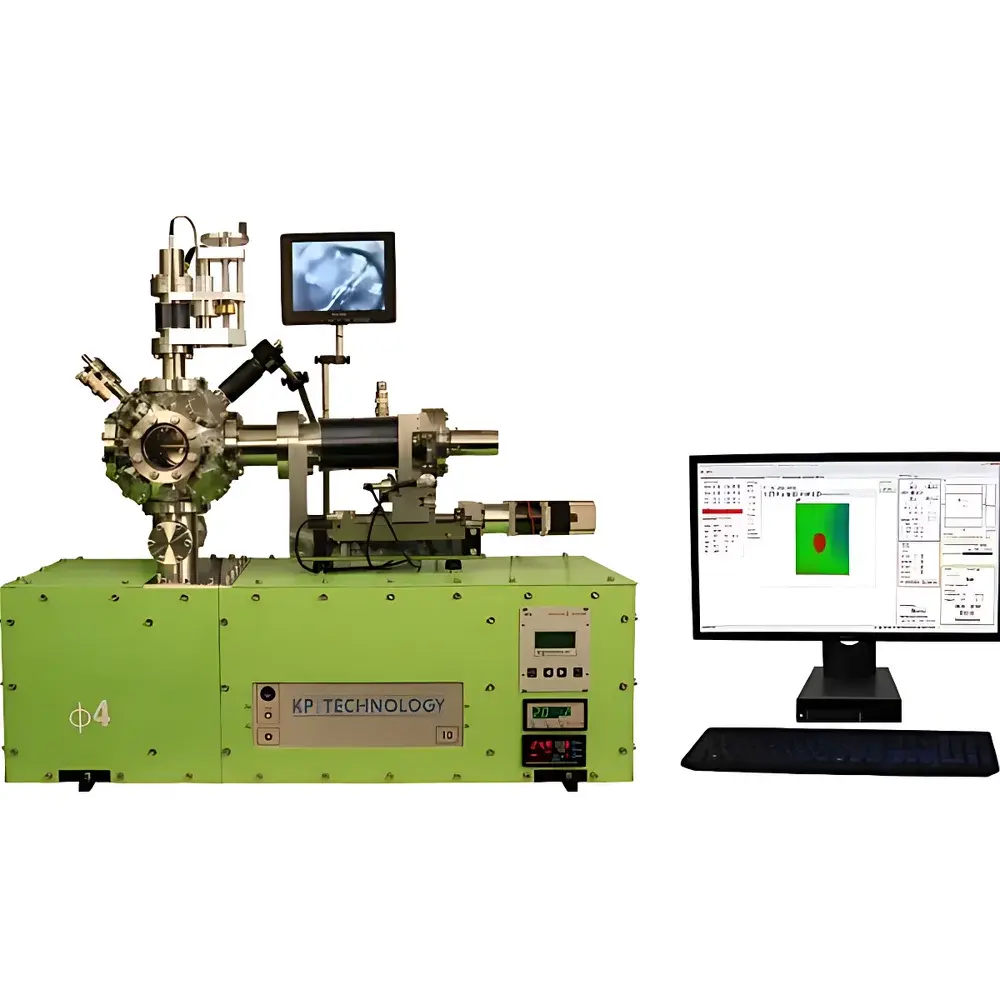
KP HVKP Ultra-High Vacuum Kelvin Probe System
| Brand | KP (UK) |
|---|---|
| Origin | United Kingdom |
| Model | HVKP |
| Vacuum Compatibility | UHV (≤1×10⁻¹⁰ mbar) |
| Measurement Principle | Non-contact, vibrating capacitor-based Kelvin probe force microscopy (KPFM) with off-null detection |
| Work Function Resolution | 1–3 meV (2 mm tip), 5–10 meV (50 µm tip) |
| Tip-to-Sample Distance Control | Down to 400 nm with patented Height Regulation (HR) mode |
| Spatial Resolution | Sub-micron (dependent on tip geometry and vacuum conditions) |
| Detection Mode | Off-Null (ON) signal amplification |
| Actuation | Voice-coil (VC) driver |
| Data Output | Digital export to Excel, Origin, or third-party analysis software |
| Compliance | Designed for GLP/GMP-aligned surface science workflows |
Overview
The KP HVKP Ultra-High Vacuum Kelvin Probe System is a precision surface science instrument engineered for quantitative, non-contact measurement of work function (WF) and surface potential (SP) under ultra-high vacuum (UHV) conditions—typically ≤1×10⁻¹⁰ mbar. Based on the fundamental principles of the Kelvin probe method, the system operates as a dynamic capacitive sensor: a conductive probe oscillates at a fixed frequency above the sample surface, inducing an alternating current proportional to the contact potential difference (CPD) between probe and sample. By applying a nullifying DC bias to eliminate this AC component, the system directly determines the CPD, which correlates linearly with WF for conductors or surface band bending for semiconductors and insulators. Unlike ambient or controlled-atmosphere SKP systems, the HVKP eliminates adsorbate interference, surface oxidation, and uncontrolled water layers—enabling atomic-layer-sensitive characterization of clean, well-defined surfaces critical for catalysis, thin-film electronics, and fundamental solid-state physics research.
Key Features
- UHV-Integrated Architecture: Fully bakeable stainless-steel chamber with all-metal seals, ion pump, and turbomolecular pumping stack—compatible with standard UHV feedthroughs and in-situ sample preparation (e.g., sputtering, annealing, MBE integration).
- Off-Null (ON) Detection Technology: Proprietary high-gain, wide-dynamic-range amplifier operating at elevated signal levels—eliminates low-SNR limitations inherent to traditional lock-in amplifier (LIA)-based null-detection systems, delivering superior immunity to electromagnetic noise and thermal drift.
- Patented Height Regulation (HR) Mode: Real-time, closed-loop control of tip–sample separation during scanning—compensates for topographic artifacts and ensures constant electrostatic coupling, enabling quantitative SP mapping independent of local roughness.
- Voice-Coil (VC) Actuation: Provides stable, linear, high-amplitude oscillation (±5 µm peak-to-peak) across broad frequency ranges (1–5 kHz), supporting robust operation with both macro (2 mm) and micro (50 µm) tips—and enabling future parallel multi-tip configurations.
- Digital Parameter Control: All operational parameters—including oscillation amplitude/frequency, feedback gain, averaging time, and output channel routing—are fully programmable via USB 2.0 interface and managed through KP’s native ControlSuite software.
- Modular Probe Interface: Quick-change tip mount (QT) with standardized electrical and mechanical interfaces—supports interchangeable tungsten, Pt/Ir, and gold-coated probes (GCT) for tailored work function matching and contamination resistance.
Sample Compatibility & Compliance
The HVKP accommodates electrically conductive, semiconducting, and dielectric samples up to Ø75 mm diameter and 25 mm thickness. Sample stages are compatible with liquid nitrogen cooling (80 K) and resistive heating (up to 800 °C) for in-situ thermodynamic studies. The system meets stringent requirements for surface analytical instrumentation under ISO/IEC 17025-accredited laboratories: full audit trail logging, user-access-level permissions, electronic signature support, and FDA 21 CFR Part 11–compliant data integrity features are available via optional Software Validation Package. It adheres to ASTM E1978 guidelines for Kelvin probe force microscopy methodology and supports traceable calibration using certified Au/Al reference samples (RS) with documented WF values (4.55 eV / 4.28 eV).
Software & Data Management
ControlSuite v5.x provides integrated acquisition, visualization, and post-processing for 2D/3D surface potential maps, line profiles, time-resolved WF kinetics, and co-registered topography (when used with optional profilometry add-ons). Data export modules support native .kpf binary format plus direct conversion to CSV, HDF5, Origin OPJ, and MATLAB MAT files. All measurements include embedded metadata: timestamp, vacuum pressure log, tip ID, calibration status, and operator credentials. The software architecture supports automated script sequencing (Python API), batch processing of multi-sample datasets, and integration with LabVIEW or EPICS for synchrotron or UHV cluster environments.
Applications
- Surface electronic structure mapping of single-crystal catalysts (e.g., Pt(111), NiO, MoS₂) before/after gas exposure
- Work function engineering of transparent conductive oxides (ITO, AZO) and 2D materials (graphene, h-BN)
- In-situ monitoring of interfacial dipole formation during molecular monolayer self-assembly
- Quantitative assessment of Fermi level pinning at semiconductor/metal interfaces under UHV
- Correlation of surface photovoltage (SPV) transients with charge carrier dynamics in perovskite thin films
- Fundamental studies of electron affinity variation across phase-separated polymer blends
- UHV-compatible validation of DFT-predicted surface dipoles and band alignments
FAQ
What vacuum level is required for optimal HVKP performance?
The system is specified for continuous operation at ≤1×10⁻¹⁰ mbar; base pressure below 5×10⁻¹¹ mbar is recommended for highest-resolution WF measurements on atomically clean surfaces.
Can the HVKP be integrated into an existing UHV cluster?
Yes—standard CF-63 and CF-100 flanges, differential pumping compatibility, and 24-pin electrical feedthroughs enable seamless integration with MBE, XPS, or AES chambers.
Is height regulation active during scanning or only in point-mode?
HR mode operates continuously in both point-measurement and raster-scan modes, maintaining constant tip–sample distance with sub-nanometer stability over 100 µm lateral ranges.
How is calibration verified without atmospheric contamination?
Calibration is performed in situ using the supplied Au/Al reference sample (RS) under identical vacuum and thermal conditions—eliminating ambient-induced hysteresis or oxide-related offsets.
Does the system support time-resolved surface potential kinetics?
Yes—minimum dwell time per pixel is 100 ms, enabling second-scale temporal resolution for photoinduced or gas-dosing experiments when combined with external trigger inputs (TTL via OC channel).



