
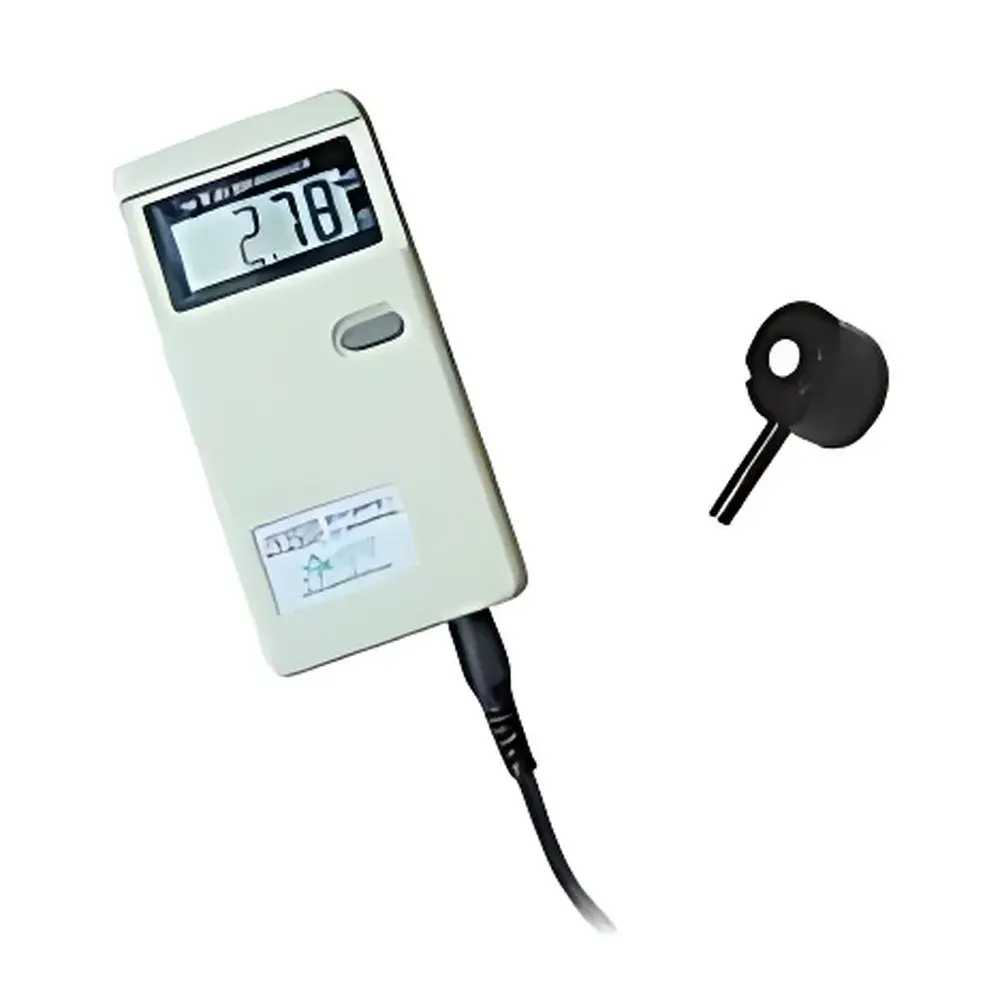
BJBY UV-2000 Portable UV Radiometer
| Brand | BJBY |
|---|---|
| Model | UV-2000 |
| Measurement Range | 0.1–199,900 µW/cm² |
| Spectral Response | 230–290 nm (Peak at 254 nm) |
| Accuracy | ±5% |
| Response Time | 1 s |
| Out-of-Band Rejection | <0.1% |
| Operating Temperature | 0–40 °C |
| Relative Humidity | <85% RH |
| Power Supply | 9 V alkaline battery |
| Power Consumption | ≤80 mW |
| Dimensions | 130 × 70 × 30 mm |
| Weight | 200 g |
| Probe Calibration | 254 nm UV-C specific |
Overview
The BJBY UV-2000 Portable UV Radiometer is a compact, hand-held optical instrument engineered for quantitative measurement of ultraviolet irradiance in the germicidal UV-C spectral band. It operates on the principle of photodiode-based radiometric detection, with a spectrally tuned filter and quartz window optimized for high selectivity at 254 nm—the primary emission wavelength of low-pressure mercury vapor lamps widely used in disinfection applications. Unlike broadband illuminance meters, the UV-2000 employs a narrowband optical architecture that minimizes spectral interference from visible or near-UV radiation, ensuring compliance with ISO 15858:2016 (UV-C radiation safety and measurement) and supporting routine validation per CDC/NIOSH and WHO UV disinfection guidelines. Its rugged, palm-sized form factor and battery-powered operation enable field-deployable measurements in HVAC ducts, surface disinfection stations, water treatment chambers, and biosafety cabinet verification workflows.
Key Features
- UV-C–optimized photodetector with peak spectral responsivity at 254 nm and effective rejection of wavelengths outside 230–290 nm (out-of-band stray light <0.1%)
- High dynamic range: 0.1–199,900 µW/cm² enables accurate assessment across low-intensity ambient UV monitoring and high-output germicidal lamp output verification
- Real-time analog response with ≤1 second settling time—critical for mapping spatial irradiance gradients during lamp alignment or dose uniformity testing
- Integrated temperature-compensated circuitry to maintain ±5% accuracy across 0–40 °C operating range, eliminating thermal drift artifacts common in uncalibrated UV sensors
- Low-power design (≤80 mW) powered by a single 9 V alkaline battery, supporting >20 hours of continuous operation without external power
- Ergonomic handheld housing (130 × 70 × 30 mm, 200 g) with tactile button interface and LCD display with auto-ranging and hold function
Sample Compatibility & Compliance
The UV-2000 is calibrated specifically for planar irradiance measurement of collimated or diffuse UV-C sources emitting predominantly at 254 nm—including low-pressure Hg lamps, amalgam lamps, and pulsed-xenon systems. It is not intended for broadband UV-A/UV-B characterization or solar UV index estimation. The instrument meets the essential performance criteria outlined in ASTM E2995–22 (Standard Guide for Use of UV Radiometers in Disinfection Applications) and supports traceable calibration against NIST-traceable reference standards. Its probe geometry and cosine-corrected diffuser comply with CIE S 023/E:2013 for directional response uniformity. For regulated environments, data collection can be documented manually to support GLP-compliant disinfection validation reports; while the device itself does not provide electronic audit trails, its stable analog output and repeatable readings facilitate integration into validated SOPs under FDA 21 CFR Part 11–aligned quality systems when paired with controlled logbook procedures.
Software & Data Management
The UV-2000 operates as a standalone analog radiometer with no embedded microprocessor or digital connectivity. All measurements are displayed directly on the integrated LCD screen and require manual recording. This architecture ensures electromagnetic immunity in high-noise industrial settings (e.g., near ballasts or RF sterilization equipment) and eliminates firmware-related obsolescence or cybersecurity concerns. Users may pair the instrument with external data loggers via optional analog voltage output (0–2 V DC proportional to irradiance), enabling time-series acquisition for dose-integration calculations (J/m² = W/m² × s). While no proprietary software is supplied, raw analog outputs are compatible with standard SCADA platforms, LabVIEW, or Excel-based logging tools using universal analog input modules.
Applications
- Verification of UV lamp output intensity prior to and after maintenance in hospital room disinfection systems
- Validation of UV dose delivery on conveyorized food packaging surfaces in accordance with FDA Food Code Annex 3-303.11
- Monitoring UV transmittance decay in quartz sleeves of UV water purifiers per NSF/ANSI 55 Class A requirements
- Quantitative assessment of UV-C leakage from enclosed disinfection cabinets to ensure operator safety per IEC 62471
- Calibration cross-checking of fixed-mount UV sensors in pharmaceutical cleanroom air handling units
- Field measurement of UV irradiance during UVGI (Ultraviolet Germicidal Irradiation) retrofits in educational or municipal facilities
FAQ
Is the UV-2000 suitable for measuring UV-A or UV-B radiation?
No. Its optical filter and detector response are strictly limited to 230–290 nm, centered at 254 nm. It does not respond meaningfully to UV-A (315–400 nm) or UV-B (280–315 nm) bands.
Does the instrument require annual recalibration?
Yes. To maintain traceability and ±5% accuracy, BJBY recommends recalibration every 12 months against a NIST-traceable UV-C source, especially after mechanical shock or prolonged exposure to intense irradiation.
Can the UV-2000 be used underwater or in high-humidity enclosures?
It is rated for operation up to 85% relative humidity but is not waterproof or submersible. Condensation on the probe window will compromise measurement integrity and must be avoided.
What is the angular acceptance error of the sensor?
The probe features a cosine-corrected diffuser conforming to CIE S 023/E:2013, limiting directional error to <±3% for incident angles up to 60° from normal incidence.
Is the 9 V battery user-replaceable?
Yes. The battery compartment is accessible via a screw-secured cover, and standard 9 V alkaline batteries (e.g., Duracell MN1604) are compatible. Battery status is indicated by a low-voltage icon on the LCD display.






