
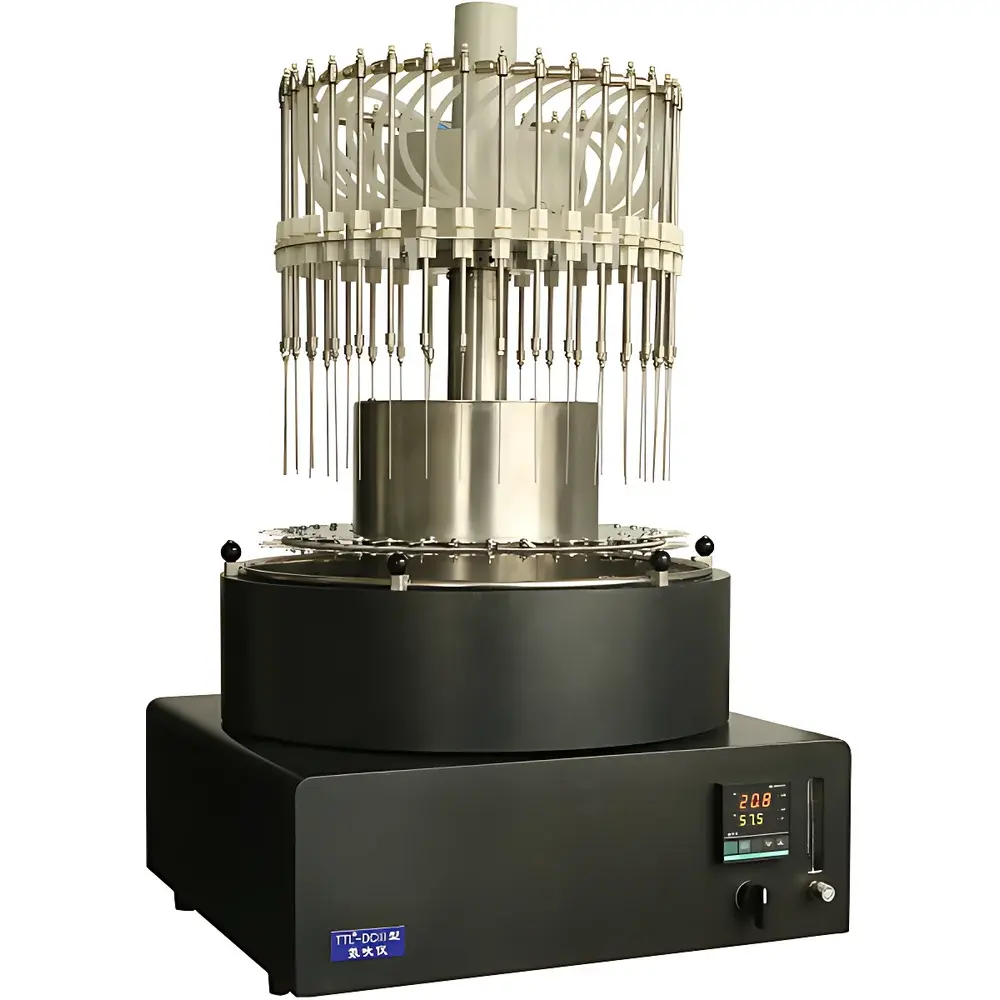
Tongtai Union TTL-GDC Dry-Block Nitrogen Evaporator
| Brand | Tongtai Union (TTL) |
|---|---|
| Origin | Beijing, China |
| Manufacturer Type | Direct Manufacturer |
| Region of Origin | Domestic (China) |
| Model | TTL-GDC |
| Heating Method | Dry-block (aluminum bead bath) |
| Temperature Range | Ambient to 130 °C |
| Temperature Uniformity | ±1 °C |
| Sample Capacity | 36 positions |
| Tube Diameter Compatibility | 10–29 mm |
| Gas Flow Rate | 0–15 L/min |
| Heating Power | 1000 W |
Overview
The Tongtai Union TTL-GDC Dry-Block Nitrogen Evaporator is an engineered solution for high-throughput, solvent-free concentration and gentle sample drying in analytical laboratories. Unlike water-bath nitrogen evaporators, the TTL-GDC employs a dry-block heating system based on thermally stable aluminum beads—providing rapid thermal response, spatially uniform temperature distribution across the entire heating block, and elimination of moisture-related contamination risks. Its core operational principle relies on directed nitrogen (or compressed air) flow applied coaxially to sample vessels while maintaining precise, independent control over both thermal and pneumatic parameters. Designed for routine use in QC/QA labs, environmental testing facilities, food safety centers, and pharmaceutical R&D environments, the instrument supports reproducible evaporation under GLP-compliant workflows where trace-level analyte integrity and cross-contamination prevention are critical.
Key Features
- Dry-block heating architecture with aluminum bead medium ensures fast ramp-up, minimal thermal lag, and no requirement for fluid medium replacement or maintenance.
- 36-position sample capacity with universal tube compatibility (10–29 mm OD), accommodating test tubes, centrifuge tubes, conical flasks, and beakers without adapter changes.
- Motorized vertical translation of the gas manifold (stroke: 100 ±2 mm) enables precise needle-to-surface distance adjustment for each vessel—critical for optimizing evaporation efficiency and minimizing splashing.
- Individually adjustable stainless-steel gas needles with quick-release bayonet couplings facilitate rapid cleaning and configuration for heterogeneous sample formats.
- Independent per-needle gas flow regulation via precision needle valves, coupled with a built-in rotameter featuring calibrated scale for total gas consumption monitoring (0–15 L/min).
- Rotatable heating block and gas manifold assembly—both rotate synchronously around a central axis—ensuring ergonomic access: samples remain continuously front-facing during loading, unloading, and operation.
- Modular design separates the heating block from the electronic control unit, reducing thermal stress on sensitive components and extending service life.
- All wetted and structural surfaces fabricated from laboratory-grade 316 stainless steel and PTFE-coated aluminum—resistant to corrosion from organic solvents, acids, alkalis, and elevated temperatures up to 130 °C.
Sample Compatibility & Compliance
The TTL-GDC accommodates a broad range of container geometries and volumes typical in preparative chromatography, pesticide residue analysis, clinical toxicology, and environmental contaminant quantification. Its mechanical stability and inert surface finish comply with ISO 17025 requirements for equipment suitability in accredited testing laboratories. While not certified to specific regulatory standards out-of-the-box, its design supports implementation within FDA 21 CFR Part 11–aligned environments when integrated with validated SOPs and audit-trail-capable LIMS or ELN systems. The absence of water-based heating eliminates condensation-induced contamination—a key consideration for volatile organic compound (VOC) analysis per EPA Methods 502.2, 524.4, and 8260.
Software & Data Management
The TTL-GDC operates via an embedded microcontroller with tactile membrane keypad and LED display. It does not include onboard data logging or network connectivity; however, analog outputs (0–10 V or 4–20 mA) for temperature and gas flow signals are available upon request for integration into centralized process monitoring systems. For full traceability, users may pair the unit with external digital recorders or SCADA platforms compliant with GMP Annex 11 and ALCOA+ principles. All parameter settings—including setpoint temperature, dwell time, and gas flow profiles—are manually recorded as part of standard operating procedures to satisfy ISO/IEC 17025 clause 7.7 (Control of Equipment Records).
Applications
- Concentration of extracts prior to GC-MS or LC-MS/MS analysis in food, environmental, and forensic laboratories.
- Preparative cleanup steps in solid-phase extraction (SPE) and QuEChERS workflows.
- Removal of residual solvents following derivatization or enzymatic digestion protocols.
- Drying of calibration standards and reference materials under inert atmosphere to prevent oxidation.
- Parallel processing of biological matrices (plasma, urine, tissue homogenates) in clinical research settings requiring batch-wise throughput consistency.
FAQ
Can the TTL-GDC be used with compressed air instead of nitrogen?
Yes—provided the air supply is oil-free, particle-filtered, and dew-point controlled to prevent condensation or contamination.
Is the aluminum bead medium replaceable or serviceable?
No—aluminum beads are permanently sealed within the heating block and require no periodic replacement or cleaning under normal operation.
Does the instrument support programmable temperature ramps or multi-step protocols?
No—the TTL-GDC features fixed-setpoint temperature control only; advanced protocol programming requires external controller integration.
What safety certifications does the unit carry?
It complies with IEC 61010-1:2010 for electrical safety in laboratory equipment; CE marking is available upon request for EU-market configurations.
How is gas flow calibrated and verified?
Each needle valve is factory-adjusted and traceably calibrated using NIST-traceable flow meters; users should perform periodic verification using a secondary rotameter or mass flow meter per ISO 5167.



