
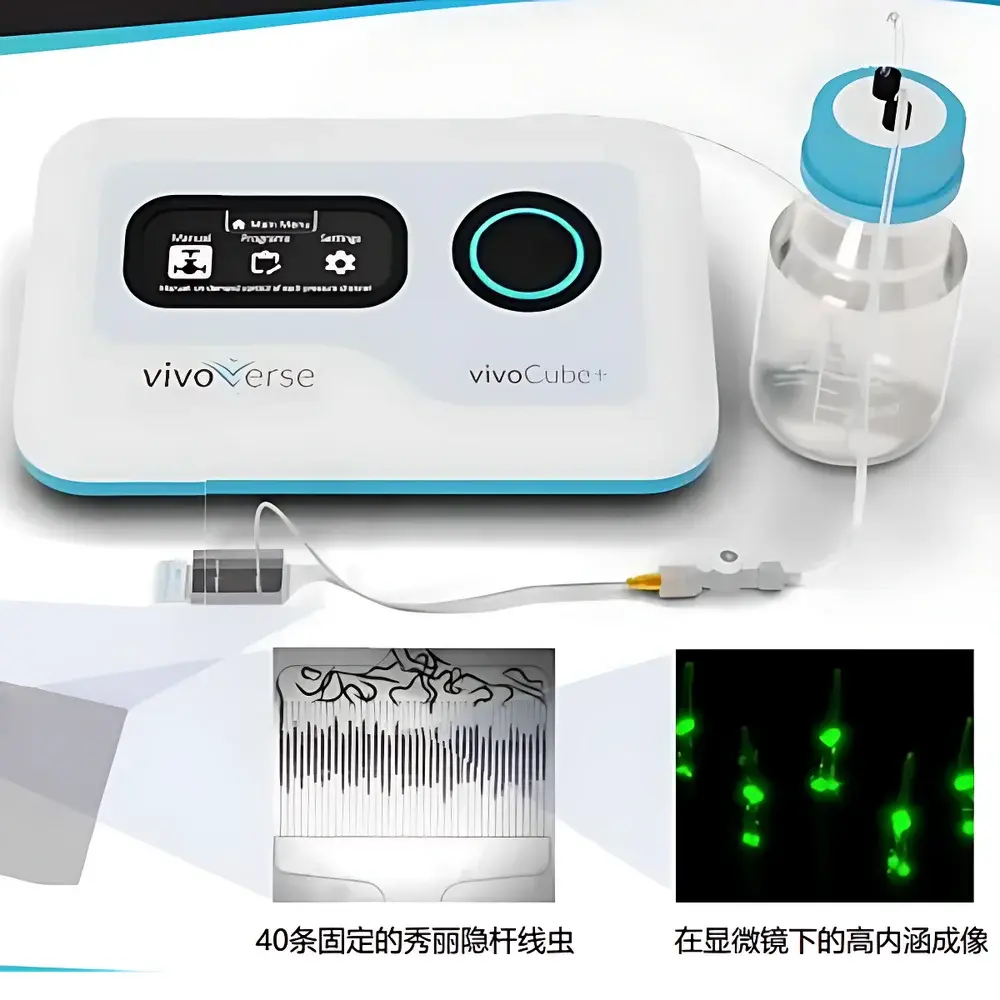
VivoVerse vivoChip-2X High-Throughput Microfluidic C. elegans Immobilization and Imaging System
| Brand | VivoVerse |
|---|---|
| Origin | USA |
| Manufacturer Type | Authorized Distributor |
| Origin Category | Imported |
| Model | vivoChip-2X |
| Pricing | Available Upon Request |
Overview
The VivoVerse vivoChip-2X is a precision-engineered microfluidic platform designed for non-invasive, anesthesia-free immobilization and high-resolution in vivo imaging of Caenorhabditis elegans. It operates on the principle of controlled hydrodynamic confinement—using calibrated micro-pressure gradients to gently position live nematodes within geometrically defined microchannels without mechanical compression or chemical sedation. This enables longitudinal observation under physiologically relevant conditions, preserving native motility, neuronal activity, and developmental dynamics. The system supports standardized, reproducible sample handling across developmental stages (L1–D5), making it suitable for time-lapse microscopy, quantitative phenotyping, and high-content screening workflows in academic and pharmaceutical research laboratories.
Key Features
- Two-channel parallel architecture (2×40 configuration) enabling simultaneous alignment and imaging of up to 80 synchronized C. elegans individuals per chip run.
- Engineered microchannel geometry ensures consistent lateral orientation and axial immobilization—critical for automated image analysis and spatial registration across large cohorts.
- Integrated micro-pressure actuation system delivers stable, low-shear fluidic control; no prior microfluidics expertise required—pre-programmed protocols streamline operation.
- Reusable silicon-based microfluidic chips validated for ≥5 cycles of sterilization and re-use via gentle buffer rinsing; no detectable impact on animal viability or imaging fidelity between uses.
- Modular design allows seamless integration with upright, inverted, confocal, light-sheet, and widefield microscopes—including systems equipped with motorized stages, autofocus, and multi-channel fluorescence detection.
Sample Compatibility & Compliance
The vivoChip-2X accommodates C. elegans across all post-embryonic life stages (L1 through adult day 5), with chip variants optimized for body length and cuticle compliance at each stage. It is compatible with transgenic strains expressing fluorescent reporters (e.g., GCaMP, mCherry, GFP-tagged synaptic proteins), RNAi-treated animals, and compound-exposed specimens. The system adheres to GLP-aligned operational practices: chip priming, pressure calibration, and imaging parameters are fully documented and repeatable. While not certified as FDA 21 CFR Part 11-compliant out-of-the-box, its software interface (when paired with VivoVerse acquisition modules) supports audit-trail logging, user access controls, and electronic signature capability—enabling integration into regulated DART/DNT study environments compliant with OECD TG 213, ISO 10993-3, and ASTM E2920 standards.
Software & Data Management
The vivoChip-2X operates with VivoVerse Control Suite—a cross-platform application supporting Windows and macOS. It provides intuitive protocol sequencing for chip loading, pressure ramping, flow stabilization, and synchronized microscope triggering. Real-time pressure monitoring and error logging ensure traceability. Export formats include TIFF (stacked z-series), CSV (positional metadata), and JSON (acquisition parameters). When used with vivoScreen-compatible hardware, the suite extends to automated image segmentation, worm centroid tracking, fluorescence intensity quantification, and motion parameter extraction (e.g., thrashing frequency, velocity, curvature). All data files comply with MIAME and MIAPE metadata conventions and can be ingested into downstream analysis pipelines (e.g., Python-based WormLab, MATLAB WormTracker, or KNIME workflows).
Applications
- Developmental and Reproductive Toxicology (DART): Quantitative assessment of embryonic lethality, vulval morphology, gonad migration, and brood size under chemical exposure.
- Developmental Neurotoxicity (DNT): High-resolution imaging of neuronal architecture, synapse distribution, and calcium dynamics in intact, unanesthetized animals.
- Germline integrity studies: Live observation of meiotic progression, chromosome segregation errors, and DNA damage response markers.
- High-content mutagenesis and RNAi screens: Parallel phenotypic profiling across hundreds of genetic backgrounds using standardized immobilization and illumination.
- Time-lapse cell division tracking: Sub-minute temporal resolution for mitotic timing, cytokinesis fidelity, and asymmetric division symmetry in early embryos and somatic lineages.
- Microvascular and thrombosis modeling: With optional accessory modules, the same microfluidic infrastructure supports co-culture assays involving human endothelial cells, platelets, and fibrin networks.
FAQ
Is the vivoChip-2X compatible with spinning-disk confocal microscopes?
Yes—the chip’s optical path is designed for high numerical aperture (NA ≤ 1.4) objectives and minimal spherical aberration; it has been validated with Nikon Eclipse Ti2-E, Zeiss Axio Observer.Z1, and Leica DMi8 platforms.
Can I use the same micro-pressure controller for both vivoChip-2X and vivoChip-24X?
Yes—the VivoVerse MP-1000 pressure controller is cross-compatible and auto-detects chip type to load appropriate flow profiles.
Does chip reuse affect imaging signal-to-noise ratio?
No—surface passivation and channel geometry remain stable across ≥5 wash cycles (PBS + 70% ethanol rinse); fluorescence background and photobleaching rates show no statistically significant deviation (p > 0.05, n = 12 chips, 3 independent experiments).
What level of training is required to operate the system?
Basic operation requires ≤2 hours of hands-on instruction; advanced protocol customization and data export scripting are supported by comprehensive documentation and remote technical support from authorized VivoVerse partners.
Are custom chip geometries available for non-C. elegans species?
Yes—VivoVerse offers OEM microfabrication services for species-specific channel dimensions (e.g., Pristionchus pacificus, Strongyloides ratti) under NDA; lead time is typically 6–8 weeks.
Related Products




