
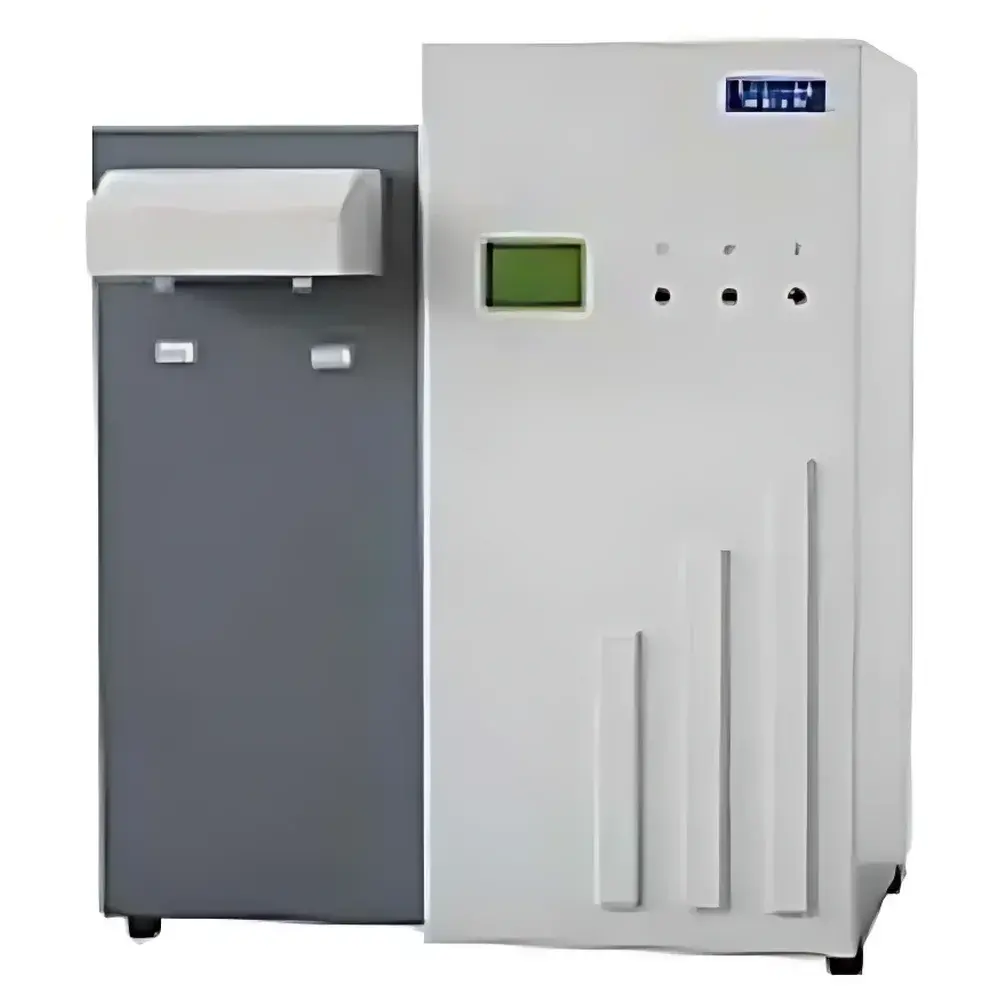
TTL-6 Ultra Pure Water System
| Brand | TTL (Tongtai Lian) |
|---|---|
| Origin | Beijing, China |
| Manufacturer Type | Direct Manufacturer |
| Product Category | Domestic |
| Model | TTL-6 |
| Price Range | USD 1,400 – 4,200 (FOB) |
| Purified Water Grade | ASTM Type I / GB/T 6682-2008 Grade I |
| Resistivity | 18.2 MΩ·cm @ 25°C |
| Heavy Metals & Soluble Silica | < 0.1 ppb |
| Total Organic Carbon (TOC) | < 10 ppb |
| Endotoxin | < 0.001 EU/mL |
| Microbial Count | < 1 CFU/mL |
| Particles (> 0.1 µm) | < 1 particle/mL |
| Feed Water Requirement | Potable municipal supply, TDS < 200 mg/L |
| Flow Rate | 10 L/h or 25 L/h |
| Purification Stages | Single-pass RO + Dual-stage polishing cartridge system with real-time resistivity and TOC monitoring |
Overview
The TTL-6 Ultra Pure Water System is an integrated, microprocessor-controlled laboratory water purification platform engineered for consistent production of Type I ultrapure water per ASTM D1193-20 and GB/T 6682-2008 specifications. It employs a single-pass reverse osmosis (RO) pretreatment stage followed by dual-stage ion exchange and activated carbon polishing, complemented by integrated 185/254 nm UV oxidation and 0.1 µm final filtration. The system continuously monitors critical water quality parameters—including resistivity (up to 18.2 MΩ·cm at 25°C), TOC (<10 ppb), endotoxin (<0.001 EU/mL), and microbial load (<1 CFU/mL)—via in-line sensors calibrated traceably to NIST-traceable standards. Designed for ambient laboratory environments, the TTL-6 delivers stable output under variable feed water conditions (TDS ≤ 200 mg/L), making it suitable for applications requiring stringent chemical and biological purity, including HPLC mobile phase preparation, cell culture media formulation, molecular biology assays, and trace elemental analysis.
Key Features
- Real-time dual-parameter monitoring: Simultaneous display of resistivity and TOC on an intuitive LCD interface with Chinese/English bilingual menu navigation
- Electrical and hydraulic isolation architecture: Fully segregated circuitry and fluid pathways eliminate moisture-induced short circuits and enhance operational safety and service life
- Dual-stage replaceable polishing cartridges: Independent monitoring of pre- and post-polishing resistivity enables predictive maintenance and cost-efficient consumable management
- Automated system diagnostics: Power-on self-test, scheduled automatic drain cycles, time/date-stamped operation logs, and intelligent filter saturation alerts
- Corrosion-resistant housing: High-impact ABS polymer enclosure rated IP54 for resistance to acids, bases, and organic solvents encountered in routine lab cleaning protocols
- Programmable dispensing: Timed delivery mode with adjustable volume presets (10–999 mL) and manual override via touch-sensitive keypad
Sample Compatibility & Compliance
The TTL-6 is validated for compatibility with standard laboratory glassware, stainless steel reservoirs, and polyethylene/polypropylene storage containers. Its output meets or exceeds the performance criteria defined in ISO 3696:1987 (Grade 1), ASTM D1193-20 (Type I), CLSI EP22-A (water for clinical laboratories), and USP “Water for Pharmaceutical Purposes” for non-sterile applications. While not certified for ISO 13485 or FDA 21 CFR Part 11 compliance out-of-the-box, its audit-ready data logging (with timestamped event records and user-accessible configuration history) supports GLP/GMP-aligned documentation practices when deployed with validated SOPs and periodic third-party calibration.
Software & Data Management
The embedded control firmware stores up to 30 days of continuous water quality telemetry—including hourly resistivity, TOC, temperature, and system status flags—in non-volatile memory. Data export is supported via USB port (CSV format) for integration into LIMS or internal QA databases. Firmware updates are performed locally using signed binary files; no cloud connectivity or remote access functionality is implemented, preserving network security integrity. All parameter modifications—including alarm thresholds, dispensing presets, and service intervals—are logged with operator ID (if configured via optional external authentication module) and timestamp, satisfying basic electronic record requirements per ALCOA+ principles.
Applications
- HPLC, UHPLC, and LC-MS mobile phase and blank preparation where low TOC and metal contamination are critical
- Preparation of buffers and reagents for ELISA, PCR, qRT-PCR, and next-generation sequencing workflows
- Cell culture media supplementation and sterile filtration support (when coupled with 0.22 µm point-of-use filters)
- Atomic absorption spectroscopy (AAS), inductively coupled plasma mass spectrometry (ICP-MS), and graphite furnace AAS blanking
- Calibration standard dilution in environmental and clinical testing laboratories operating under ISO/IEC 17025
- General analytical chemistry use requiring resistivity ≥18.0 MΩ·cm and endotoxin-free water for pyrogen-sensitive assays
FAQ
What feed water quality is required for optimal TTL-6 performance?
Potable municipal water with total dissolved solids (TDS) ≤ 200 mg/L and chlorine ≤ 3 mg/L is recommended. Pre-filtration (e.g., 5 µm sediment + activated carbon) is advised if feed water exceeds these limits.
Can the TTL-6 produce water compliant with USP for pharmaceutical use?
It meets key physical and chemical specifications for Purified Water and Water for Injection (WFI) *except* for mandatory bacterial endotoxin testing frequency and sterility validation—these require additional process controls beyond the unit’s scope.
How often must the polishing cartridges be replaced?
Replacement interval depends on feed water quality and daily usage volume; typical service life ranges from 6 to 12 months under standard lab conditions (≤ 60 L/day). The system triggers visual and audible alerts when cartridge exhaustion is detected via resistivity decay rate analysis.
Is remote monitoring or Ethernet connectivity available?
No. The TTL-6 operates as a standalone instrument with local USB data export only—no network interfaces, APIs, or cloud services are included, aligning with secure lab infrastructure policies.
Does the system include validation documentation?
Factory test reports (including initial resistivity, TOC, and microbial challenge data) are provided. Full IQ/OQ/PQ protocol templates and third-party certification services are available upon request through authorized distributors.
Related Products



