
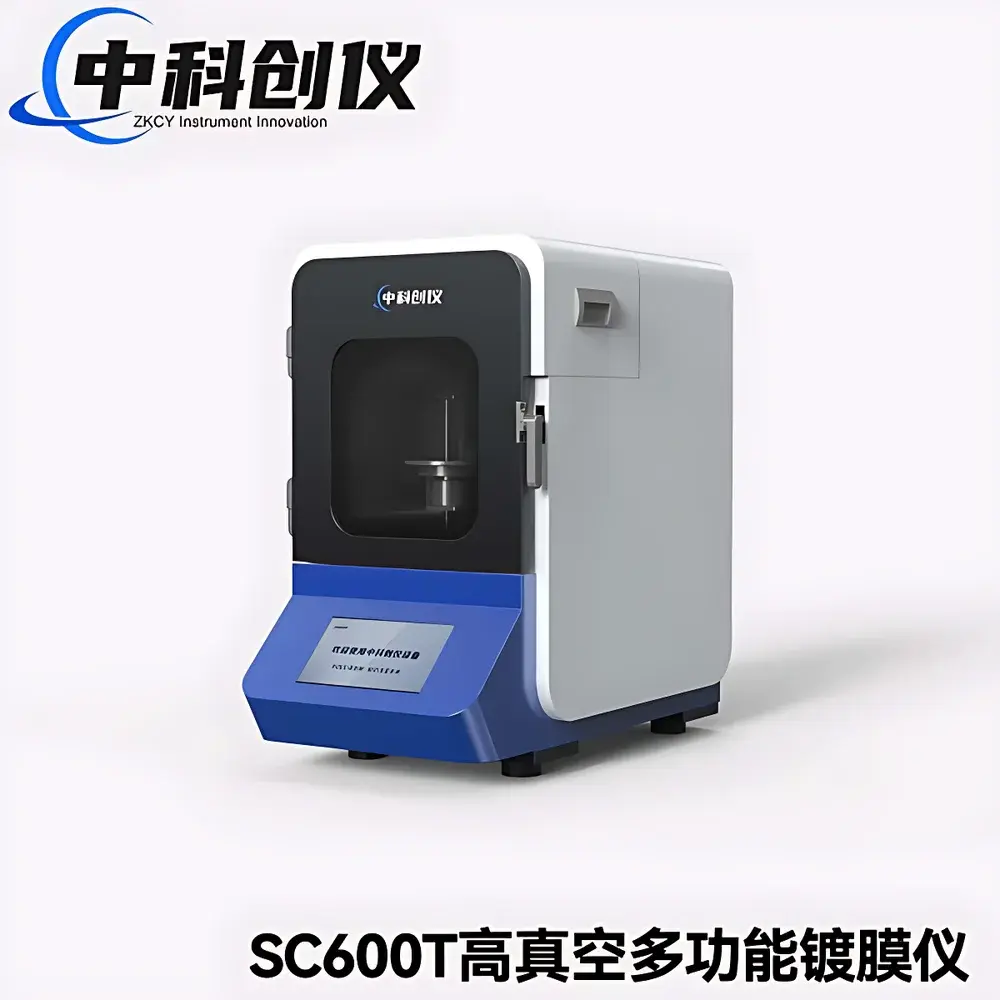
ZKCY SC600T High-Vacuum Multifunctional Coater with Magnetron Sputtering and Carbon Thermal Evaporation
| Brand | ZKCY |
|---|---|
| Origin | Beijing, China |
| Model | SC600T |
| Vacuum Chamber Dimensions | 170(L)×150(H)×163.5(D) mm |
| External Dimensions | 278(L)×494(H)×467(D) mm |
| Ultimate Vacuum | ≤5×10⁻³ Pa |
| Main Pump | 90 L/s Turbo-Molecular Pump + Rotary Vane Pump (dry pump optional) |
| Sputtering Target | Φ50 mm, thickness 0.1–2 mm |
| Sputtering Current | 1–200 mA (1 mA step) |
| Coating Time | 1–9999 s (1 s step) |
| Evaporation Source | High-Purity Carbon Fiber |
| Evaporation Modes | Continuous & Pulsed |
| Sample Stage | Φ80 mm, motorized tilt, lift, and rotation |
| Pre-Sputtering | Fully Automated |
| Real-Time Monitoring | Vacuum Pressure & Current Curve Display |
| Power Supply | AC 220 V / 50 Hz, <1000 W |
Overview
The ZKCY SC600T is a high-vacuum, dual-mode thin-film deposition system engineered for precision conductive coating in electron microscopy sample preparation. It integrates magnetron sputtering and resistive thermal evaporation—two complementary physical vapor deposition (PVD) techniques—within a single, compact metal vacuum chamber. Magnetron sputtering enables uniform, low-damage metallic coatings (e.g., Au, Pt, Cr, Ir) on non-conductive specimens for SEM imaging, while carbon thermal evaporation delivers ultra-thin, amorphous carbon support films for TEM grid preparation. The system operates under high vacuum (≤5×10⁻³ Pa), achieved via a 90 L/s turbo-molecular pump backed by a rotary vane pump (dry pump available as an option), minimizing residual gas contamination and ensuring film purity and reproducibility. Its monolithic stainless-steel vacuum chamber is CNC-machined for dimensional stability and leak integrity, supporting rigorous laboratory workflows requiring traceable, repeatable film thickness control.
Key Features
- Dual-mode operation with one-button switching between magnetron sputtering and carbon thermal evaporation—no hardware reconfiguration required.
- Fully automated pre-sputtering sequence to clean target surfaces and remove oxide layers prior to deposition, reducing particle generation and enhancing film stoichiometry.
- Integrated anti-contamination shielding for both sputtering and evaporation sources, extending component service life and maintaining long-term vacuum integrity.
- Motorized sample stage with synchronized tilt (±45°), vertical lift (0–30 mm), and continuous rotation (0–360°), enabling conformal coating of irregular or multi-angle specimens.
- Real-time graphical display of vacuum pressure and sputtering current during operation, supporting process diagnostics and GLP-compliant documentation.
- Programmable sputtering parameters: current range 1–200 mA (1 mA resolution); evaporation time range 1–9999 s (1 s resolution); pulsed or continuous carbon evaporation modes.
Sample Compatibility & Compliance
The SC600T accommodates standard SEM stubs (up to Φ80 mm), TEM grids (200–400 mesh), and custom substrates within its 170×150×163.5 mm vacuum chamber. It supports all electrically conductive sputtering targets (Φ50 mm, 0.1–2 mm thick), including noble metals, transition metals, and conductive oxides. For carbon evaporation, high-purity carbon fiber filaments ensure low oxygen content and minimal spitting. The system meets fundamental safety and electromagnetic compatibility requirements per IEC 61000-6-3 and IEC 61000-6-4. While not certified to ISO/IEC 17025, its programmable, repeatable parameters and real-time data logging align with internal quality assurance protocols used in academic core facilities and industrial R&D labs conducting ASTM E1558 (SEM specimen preparation) and ISO 13702 (TEM support film evaluation).
Software & Data Management
Operation is managed via an embedded industrial touchscreen controller with intuitive icon-driven interface. All process parameters—including vacuum level, current, time, and stage position—are timestamped and stored locally in non-volatile memory. Export functionality supports CSV file generation for post-run analysis in Excel or MATLAB. The system does not include remote access or cloud connectivity; however, its local audit trail satisfies basic GLP record-keeping requirements for laboratories performing routine EM sample preparation. No FDA 21 CFR Part 11 compliance features are implemented, as the device is classified as a general-purpose research instrument rather than a regulated medical device manufacturing tool.
Applications
- Preparation of conductive coatings on biological, polymeric, or ceramic samples for high-resolution SEM imaging at accelerating voltages ≥1 kV.
- Routine fabrication of ultra-thin carbon films (1–5 nm) on copper or nickel TEM grids for high-contrast imaging of nanoparticles, macromolecules, and 2D materials.
- Deposition of chromium or iridium films for charge dissipation in low-voltage SEM and FIB-SEM workflows.
- Prototyping of simple metal–insulator–metal (MIM) structures in microfabrication education and exploratory thin-film studies.
- Surface modification of AFM tips and MEMS devices where minimal thermal budget and low ion energy are critical.
FAQ
What vacuum level is required for reliable carbon film formation?
A base pressure ≤5×10⁻³ Pa is recommended to minimize hydrocarbon cracking and ensure amorphous, pinhole-free carbon films. The SC600T achieves this using its 90 L/s turbo-molecular pump.
Can non-metallic targets be sputtered?
Only conductive targets are compatible with DC magnetron sputtering. Insulating materials (e.g., SiO₂, Al₂O₃) require RF sputtering capability, which is not supported by the SC600T.
Is the sample stage heated?
No—the standard SC600T configuration does not include stage heating. A heated stage option is available upon request but is not part of the base model.
How is film thickness controlled?
Thickness is inferred indirectly via calibrated time–current relationships and verified post-deposition using TEM cross-section or quartz crystal microbalance (QCM) add-on (sold separately).
Does the system support automatic recipe recall?
Yes—up to 20 user-defined deposition protocols (including sputtering current, time, stage motion, and evaporation mode) can be saved and recalled with one touch.



