
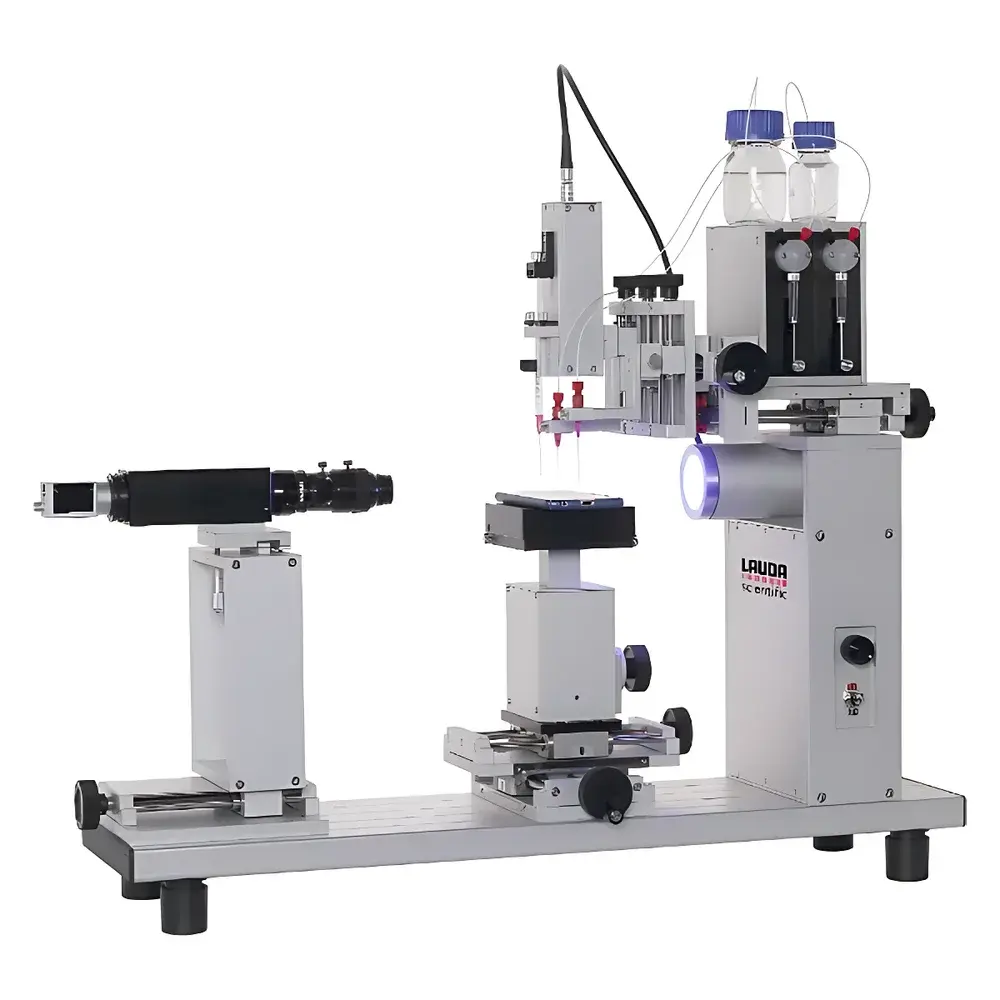
LAUDA Scientific LSA200P Video-Based Optical Contact Angle Analyzer
| Brand | LAUDA Scientific |
|---|---|
| Origin | Germany |
| Model | LSA200P |
| Instrument Type | Benchtop Video Optical Contact Angle Analyzer |
| Contact Angle Range | 0–180° |
| Contact Angle Accuracy | ±0.1° |
| Contact Angle Resolution | 0.01° |
| Surface/Interfacial Tension Range | 0.001–2000 mN/m |
| Surface/Interfacial Tension Resolution | 0.01 mN/m |
| Sample Stage Dimensions | 100 × 100 mm |
| Maximum Sample Size (L×W×H) | ∞ × 310 × 76 mm |
| Stage Load Capacity | 12 kg |
| Imaging Magnification | 6.5× Zoom Lens |
| High-Speed Camera | USB 3.0, 1920 × 1200 px, up to 3300 fps |
| Field of View | 2.7 × 1.7 to 17.5 × 11.0 mm (W×H) |
| Illumination | Monochromatic Uniform LED Cold Light Source |
| Power Supply | 110/240 V, 50/60 Hz, 120 W |
| Dimensions (L×W×H) | 620 × 200 × 543 mm |
| Weight | 19 kg |
Overview
The LAUDA Scientific LSA200P is a high-precision, benchtop video-based optical contact angle analyzer engineered for rigorous surface and interfacial characterization in academic research, pharmaceutical development, materials science, and quality control laboratories. It operates on the principle of real-time digital image capture and advanced contour analysis of liquid droplets deposited on solid substrates or at liquid–liquid interfaces. By combining side-view, top-view, and dual-view imaging modalities with automated stage and dispensing systems, the LSA200P enables true three-dimensional contact angle quantification—capturing not only sessile and pendant drop geometries but also dynamic wetting behavior across heterogeneous, curved, or fibrous surfaces. Its core measurement capabilities include static and dynamic contact angle (advancing/receding, roll-off/sliding angles), surface and interfacial tension (via pendant drop, sessile drop, drop volume, and du Noüy ring methods), solid surface free energy estimation (using Owens–Wendt, Wu, Fowkes, van Oss–Chaudhury–Good models), and interfacial rheology (oscillating drop method). The system complies with ASTM D7334 (surface wettability of polymer films), ISO 19403-2/-4 (contact angle determination), and supports GLP/GMP-aligned data integrity through audit-trail-enabled software.
Key Features
- Triple-view optical architecture: Independent side-view, top-view, and synchronized dual-view acquisition for comprehensive droplet shape analysis—including curved baseline, fiber, and patterned surface measurements
- High-speed imaging platform: USB 3.0 camera with 1920 × 1200 pixel resolution and frame rates up to 3300 fps, enabling precise tracking of rapid wetting dynamics and transient interfacial relaxation
- Motorized XYZ sample stage (100 × 100 mm active area, 12 kg load capacity) with micrometer-level positioning repeatability (< 1 µm)
- Triple independent dispensing units: Supports simultaneous multi-liquid dosing, non-contact electro-dispensing, high-viscosity direct injection, and programmable volume feedback (response time < 20 ms)
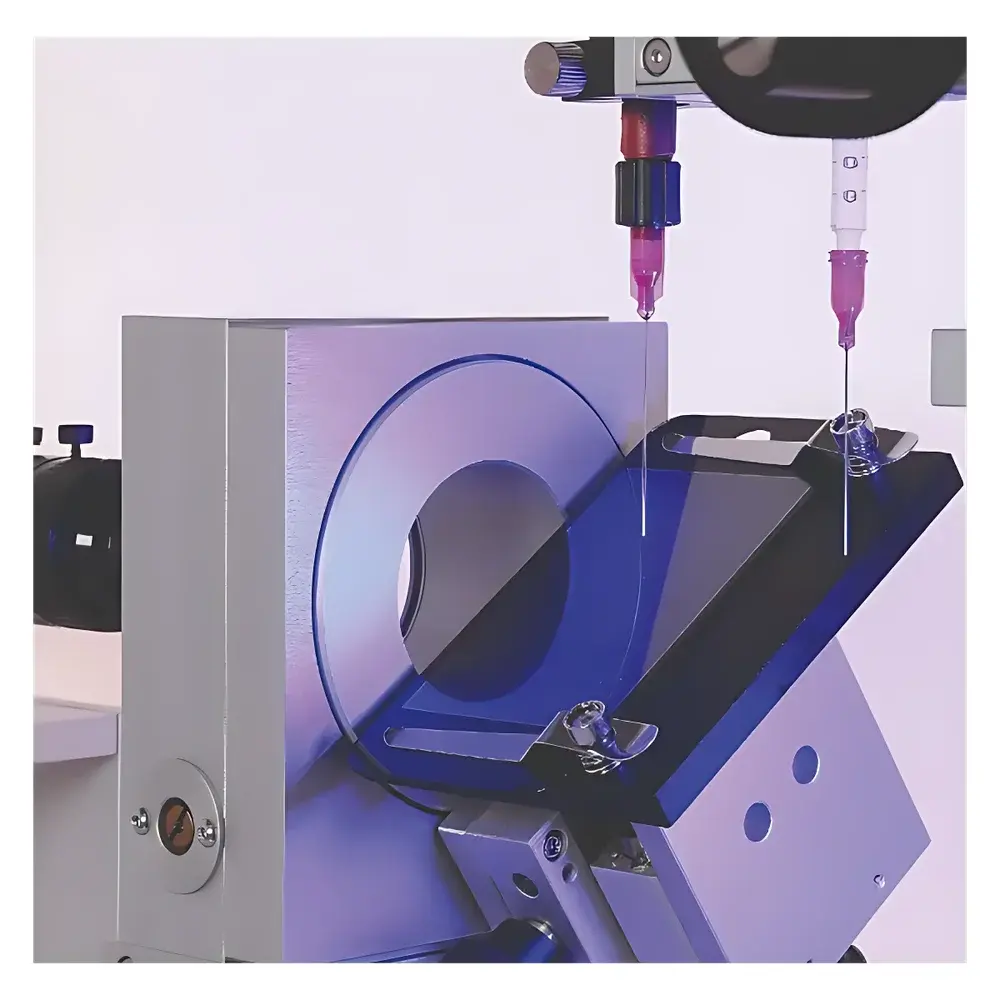
- Integrated 360° motorized tilt stage for automated advancing/receding angle, roll-off angle, and sliding velocity measurements under controlled inclination
- Dedicated hardware modules: Washburn cell for porous media wettability, retention force balance for solid–liquid adhesion quantification, and oscillating drop interface rheometer for dilatational modulus and phase angle analysis
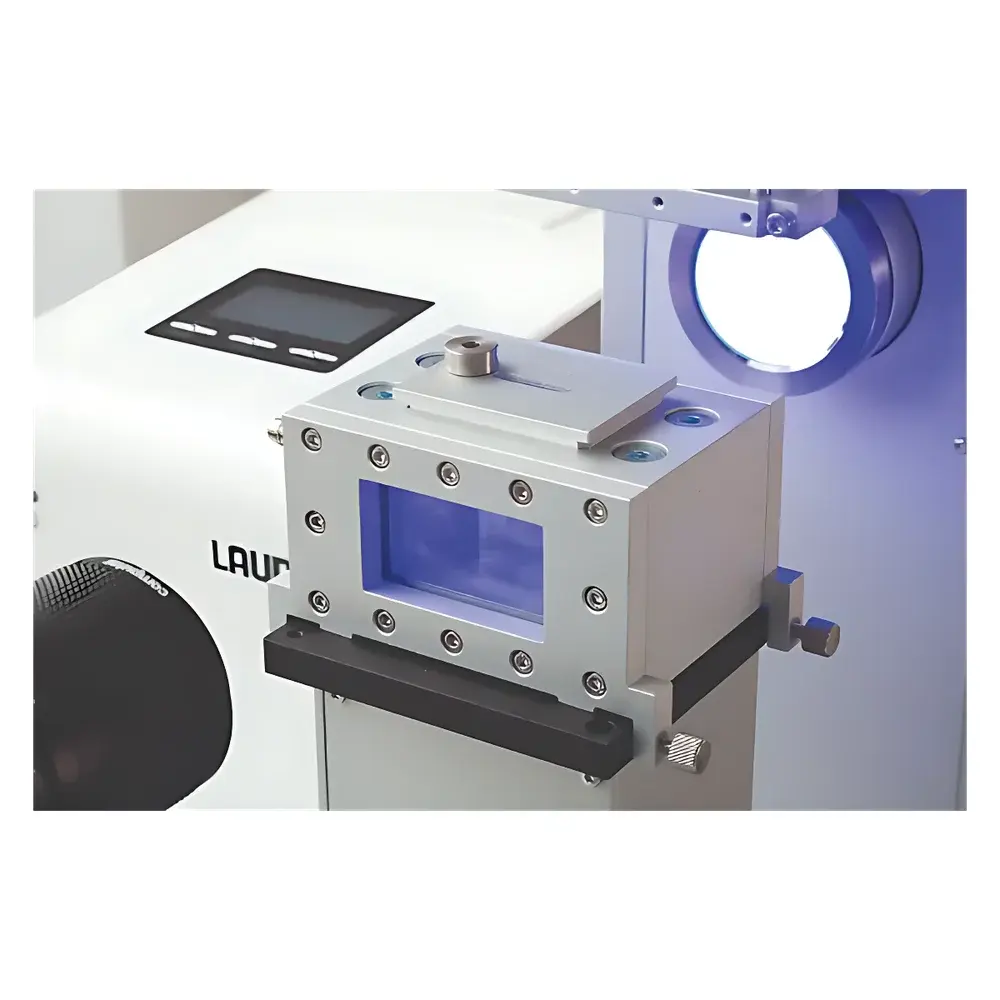
- Temperature-controlled environment options: Peltier-cooled stage, heated sample chamber (up to 200 °C), and thermostatic liquid reservoirs for isothermal interfacial studies
Sample Compatibility & Compliance
The LSA200P accommodates an exceptionally broad range of sample geometries—from standard flat wafers and thin films to irregularly shaped components, fibers (down to single filament), powders, foams, and hydrogels. Its open-stage design allows unlimited length samples (up to 310 mm width and 76 mm height), making it suitable for roll-to-roll coated substrates and large-area functional coatings. All measurement protocols adhere to internationally recognized standards: contact angle determinations follow ISO 19403-2 (static) and ISO 19403-4 (dynamic); surface tension measurements conform to ISO 1409 (pendant drop) and ASTM D971 (drop volume); and interfacial rheology aligns with ISO/CD 19403-6. Software-generated reports include full metadata (timestamp, operator ID, instrument calibration status, environmental conditions) and support 21 CFR Part 11 compliance when configured with electronic signature and audit trail modules.
Software & Data Management
The proprietary ADVANCE software suite provides modular, application-specific workflows with embedded algorithm validation. Core modules include Static/Dynamic Contact Angle Analysis, Solid Surface Energy Calculator (with component decomposition), Interfacial Tension Suite (pendant/sessile/drop volume/du Noüy), CMC Auto-Detection Engine, Washburn Kinetics Processor, and Oscillating Drop Rheology Toolkit. Image segmentation employs adaptive edge detection, B-spline fitting, and Young–Laplace equation solving with iterative convergence criteria. All raw images, processed contours, and numerical outputs are stored in HDF5 format with embedded EXIF metadata. Export options include CSV, PDF, and XML for LIMS integration. Batch processing, script automation (Python API), and remote monitoring via secure HTTPS are supported. Audit trails log every user action—including parameter changes, image reprocessing, and report generation—with immutable timestamps and role-based access controls.
Applications
The LSA200P serves as a foundational tool across multiple domains requiring quantitative interfacial property assessment. In biomaterials R&D, it characterizes protein adsorption kinetics, hydrophilicity of implant coatings, and cell-adhesive surface patterning. In battery research, it evaluates electrolyte wettability on separator membranes and electrode porosity. For semiconductor manufacturing, it verifies photoresist uniformity and cleaning efficacy via contact angle hysteresis mapping. In formulation science, it determines surfactant efficiency, emulsion stability, and CMC values under varying ionic strength and temperature. In packaging development, it assesses corona treatment effectiveness on polyolefins and barrier layer performance. Additional use cases include inkjet printability prediction, textile moisture management testing, and nanocomposite dispersion quality control.
FAQ
What measurement methods does the LSA200P support for surface free energy calculation?
It supports Owens–Wendt, Wu, Fowkes, van Oss–Chaudhury–Good, and Acid–Base models using contact angle data from at least two probe liquids.
Can the system measure contact angles on rough or chemically heterogeneous surfaces?
Yes—dual-view imaging combined with local baseline correction algorithms enables robust contact angle extraction even on microstructured, gradient, or patterned surfaces.
Is the software compliant with FDA 21 CFR Part 11 requirements?
When deployed with optional electronic signature and audit trail licensing, ADVANCE software meets Part 11 criteria for electronic records and signatures in regulated environments.
Does the LSA200P support automated CMC determination?
Yes—the integrated CMC module performs sequential surface tension measurements during surfactant titration and applies first-derivative peak detection with statistical confidence intervals.
What is the minimum droplet volume resolvable by the high-speed camera system?
With 6.5× zoom and 1920 × 1200 pixel resolution, the system reliably resolves droplets as small as ~0.1 µL under optimal lighting and contrast conditions.



