
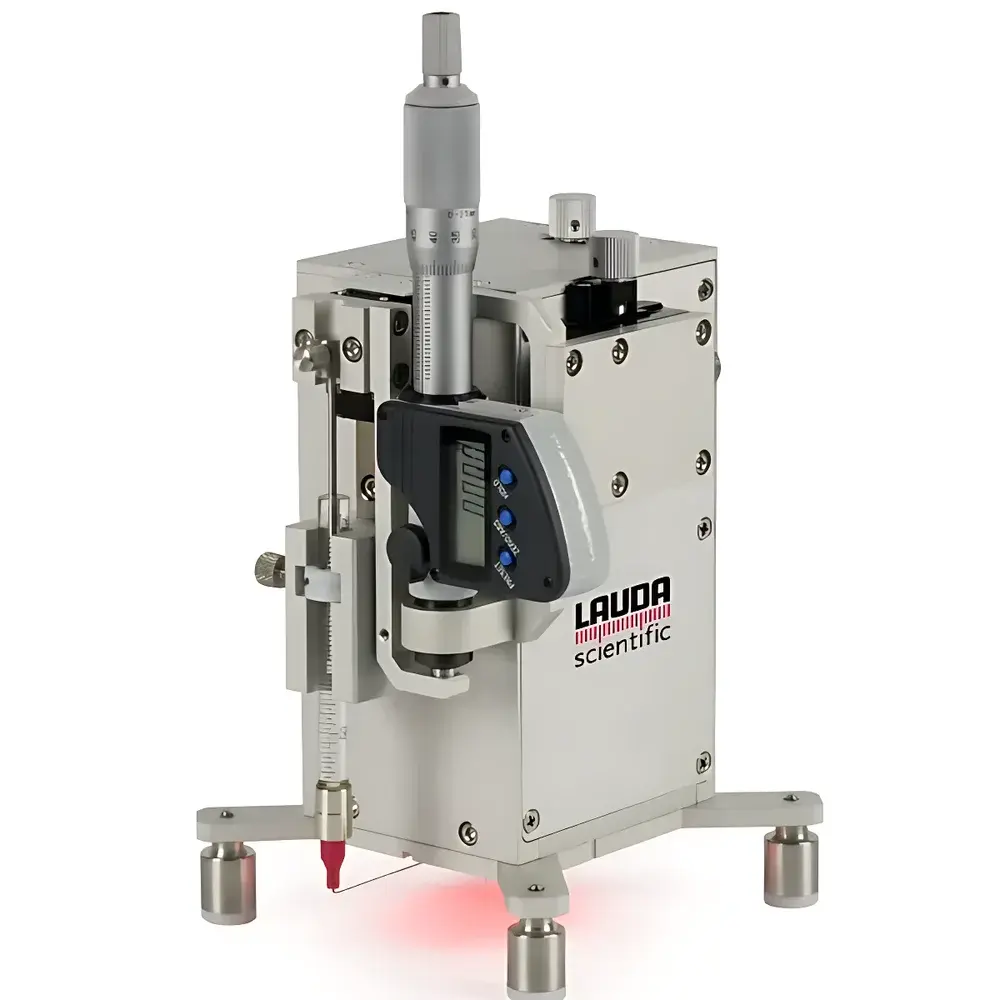
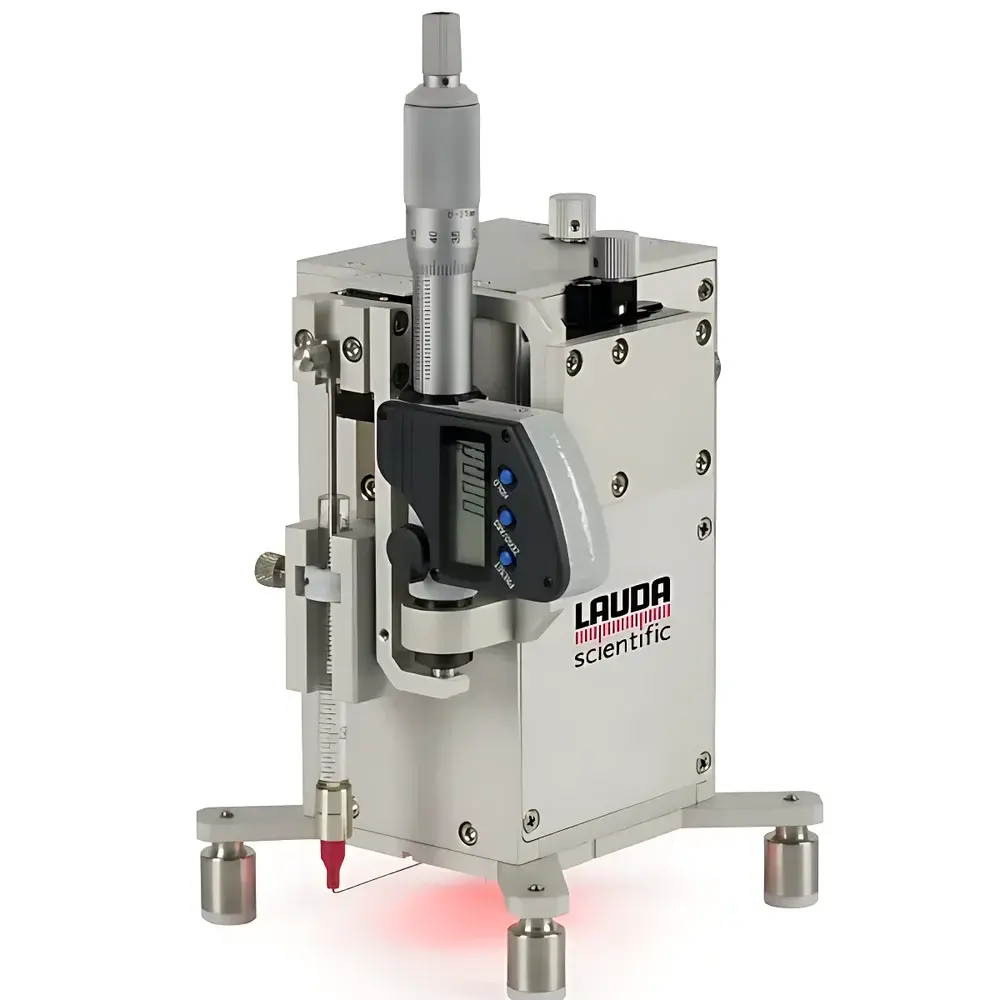
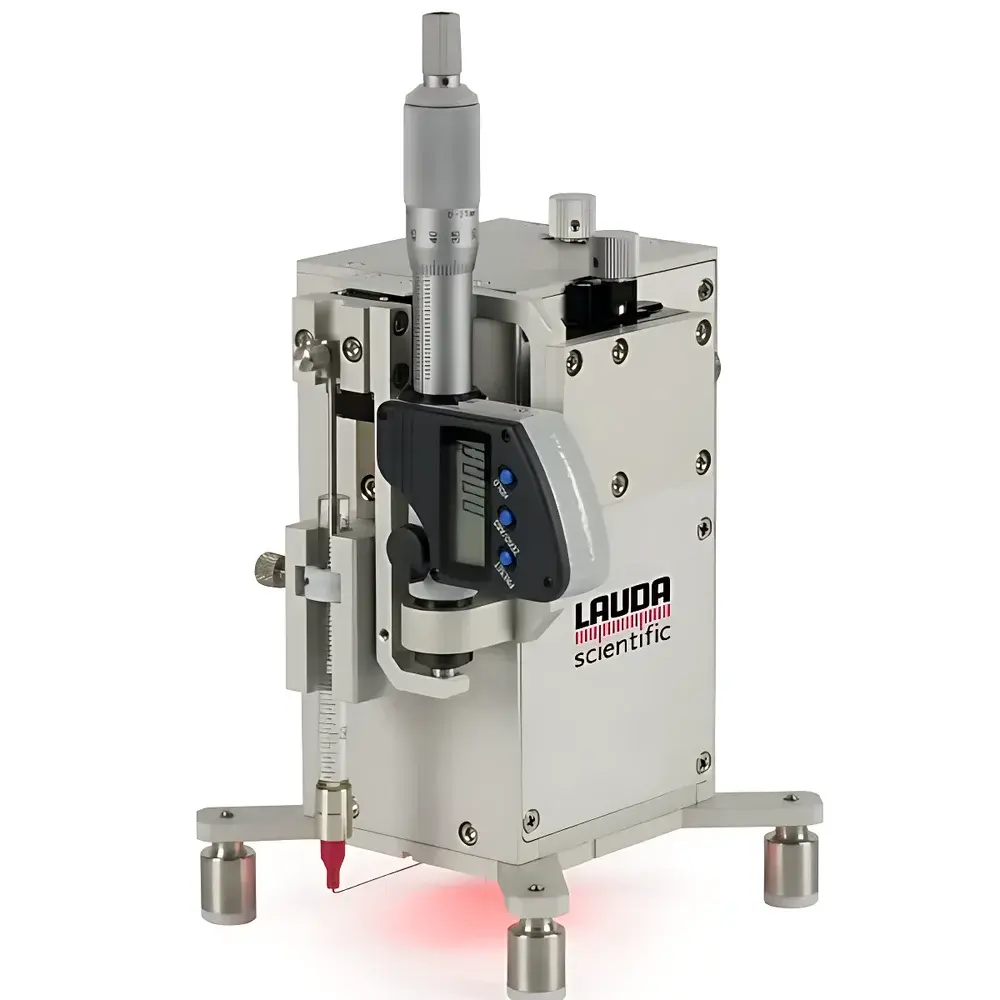
LAUDA Scientific LSA MOB-X Top-View Optical Contact Angle Analyzer
| Brand | LAUDA Scientific |
|---|---|
| Origin | Germany |
| Model | LSA MOB-X |
| Instrument Type | Portable Video-Based Optical Contact Angle Analyzer |
| Contact Angle Range | 0–180° |
| Contact Angle Accuracy | ±0.1° (0–90°), ±0.5° (90–180° for axisymmetric droplets) |
| Contact Angle Resolution | 0.1° |
| Surface Tension Range | 0.01–2000 mN/m |
| Surface Tension Accuracy | ±0.01 mN/m |
| Sample Stage Dimensions | 100 × 100 mm (fixed base) |
| Imaging System | High-resolution, low-distortion industrial fixed-focus optical lens with high-speed capture capability |
| Maximum Sample Size | Unlimited |
| Sample Stage Load Capacity | Unlimited |
| Measurement Geometry | Top-view (orthogonal overhead imaging) |
Overview
The LAUDA Scientific LSA MOB-X is a top-view optical contact angle analyzer engineered for precision surface wettability characterization under non-contact, large-area, and geometrically unconstrained conditions. Unlike conventional side-view goniometers relying on profile-based contour fitting, the LSA MOB-X employs orthogonal overhead imaging—capturing the full two-dimensional projection of sessile or spreading droplets directly from above. This geometry enables robust quantification of contact angles based on droplet footprint analysis, making it uniquely suited for surfaces exhibiting asymmetry, roughness, curvature, porosity, or macroscopic heterogeneity. The instrument operates on the principle of digital image processing of high-contrast, distortion-corrected top-down droplet silhouettes, followed by advanced edge detection and ellipse/contour fitting algorithms compliant with ISO 19403-2 and ASTM D7334 standards for contact angle determination. Its design supports both static and dynamic wettability assessment—including spontaneous spreading kinetics, absorption into porous media, and time-resolved wetting front propagation—without requiring sample tilting, repositioning, or physical contact between optics and specimen.
Key Features
- True top-view measurement geometry enabling contact angle quantification from 0° to 180°, including ultra-low angles (<5°) inaccessible to side-view systems due to meniscus occlusion or lens proximity limitations.
- Non-contact operation mode: optical head maintains a fixed 25 mm working distance from the sample surface, eliminating risk of contamination or mechanical interference—critical for soft, fragile, or temperature-sensitive substrates.
- Unrestricted sample compatibility: accommodates specimens of arbitrary size, shape, and topography—including convex, concave, corrugated, or vertically oriented surfaces—without stage modification or auxiliary fixtures.
- Multi-liquid flexibility: supports quantitative analysis using droplets of variable volume (nL to µL range) and diverse physicochemical properties (e.g., water, glycerol, alcohols, surfactant solutions, molten polymers).
- Modular architecture: interoperable with LSA MOB-M (handheld variant), LSA MOB-C (dual-side + top view synchronized acquisition), and LSA MOB-P (process-integrated inline monitoring module) for application-specific deployment.
- Integrated multi-dosing capability: optional multiple dispensing units allow sequential deposition of different liquids in a single automated sequence—enabling rapid surface free energy (SFE) calculation via Owens-Wendt, Wu, or van Oss approaches per ISO 14210.
Sample Compatibility & Compliance
The LSA MOB-X is validated for use across academic, industrial, and regulatory environments where surface functionalization, cleaning validation, coating uniformity, and adhesion performance are subject to quality control protocols. It meets requirements for GLP-compliant documentation workflows and supports audit-ready data export with timestamped metadata, user authentication logs, and instrument calibration history. Measurement traceability aligns with ISO/IEC 17025 guidelines for testing laboratories, and software functionality complies with FDA 21 CFR Part 11 for electronic records and signatures when configured with optional secure user roles and electronic signature modules. The system is routinely deployed in R&D labs evaluating hydrophilic/hydrophobic treatments of medical devices (ISO 10993-4), semiconductor wafer cleanliness (SEMI F20), packaging film barrier performance (ASTM F1249), and textile moisture management (AATCC TM79).
Software & Data Management
Operating on SCA20 software v6.x, the LSA MOB-X delivers intuitive workflow-driven acquisition, real-time droplet segmentation, and parametric post-processing without requiring programming expertise. The software includes automated baseline correction, adaptive thresholding for low-contrast interfaces, and statistical reporting of intra- and inter-droplet variability. All raw images, processed contours, and numerical outputs are stored in vendor-neutral TIFF and CSV formats. Batch analysis mode supports unattended evaluation of up to 999 droplets per session, with customizable pass/fail criteria for QC applications. Data integrity safeguards include write-protected archive folders, SHA-256 checksum verification, and optional integration with LIMS or MES platforms via OPC UA or RESTful API endpoints.
Applications
- Static and dynamic contact angle mapping of flat, curved, or textured industrial components (e.g., automotive trim, solar cell encapsulants, battery electrode coatings).
- In-process monitoring of plasma, corona, or flame treatment efficacy on polymer films and foils.
- Quantitative assessment of inkjet printability, adhesive spreadability, and solder paste wetting on PCB substrates.
- Time-lapse analysis of liquid penetration into paper, nonwovens, membranes, and sintered metal filters.
- Surface energy profiling of biomaterials, dental composites, and implant-grade titanium alloys.
- Field-deployable on-site verification of cleaning residue removal in pharmaceutical manufacturing suites (per EU GMP Annex 15).
FAQ
Can the LSA MOB-X measure contact angles on vertically mounted samples?
Yes—the top-view geometry eliminates orientation constraints; samples may be positioned upright, inverted, or at any inclination without compromising measurement fidelity.
Is calibration required before each measurement session?
No routine recalibration is needed; the system features factory-traceable geometric calibration embedded in the optical path and verified annually per ISO/IEC 17025-accredited service protocols.
Does the software support ASTM D7334-compliant surface energy calculations?
Yes—SCA20 includes built-in implementations of Owens-Wendt, Wu, and van Oss methods with automatic error propagation and confidence interval estimation per ASTM D7334 Annex A2.
Can the instrument be integrated into an automated production line?
Yes—via the LSA MOB-P configuration, which provides industrial Ethernet (PROFINET/EtherCAT), PLC-triggered acquisition, and real-time pass/fail output signals compatible with SCADA and MES environments.
What is the minimum detectable surface tension change during dynamic measurements?
The system resolves surface tension variations ≥0.01 mN/m under controlled environmental conditions (±0.5°C, <30% RH fluctuation), as validated per ISO 1409 and ISO 6295 reference methods.



