
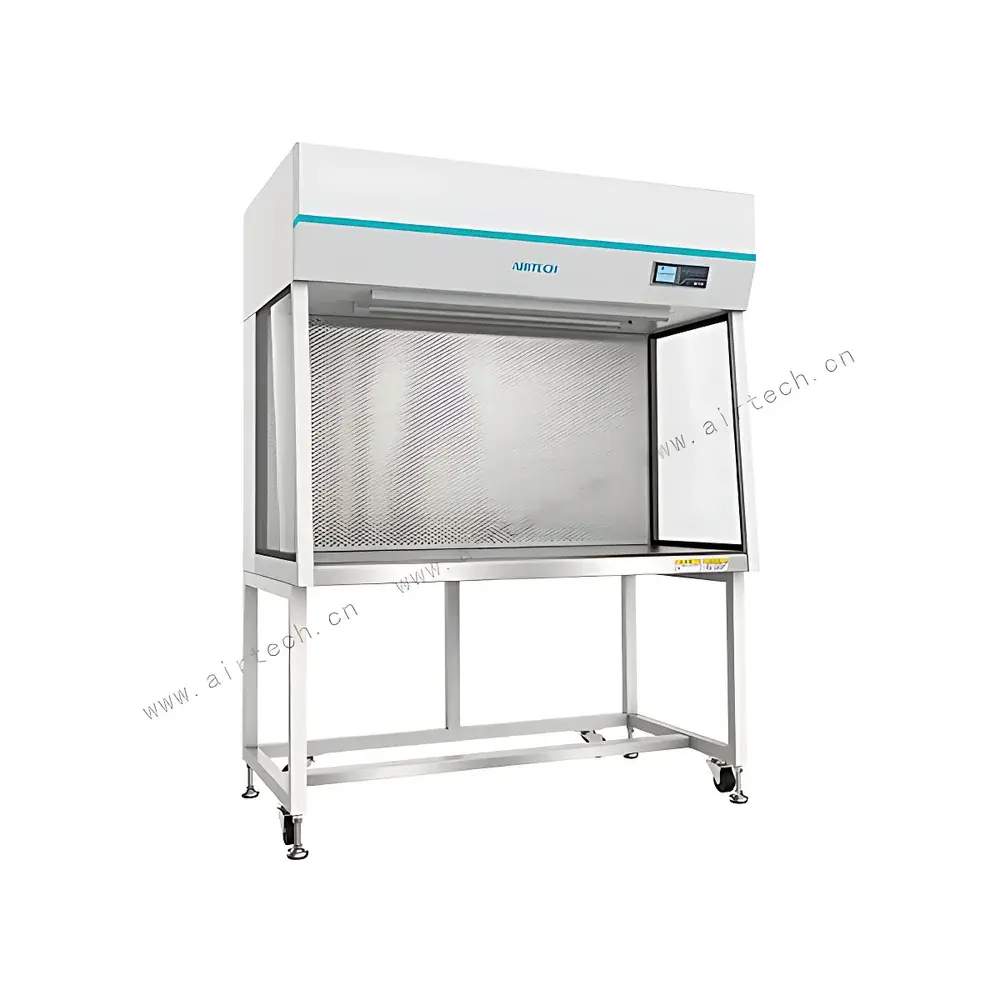
AIRTECH HHS Series Horizontal Laminar Flow Clean Benches
| Brand | AIRTECH |
|---|---|
| Origin | Jiangsu, China |
| Model Variants | HHS-1000-U / HHS-1300-U / HHS-1600-U / HHS-1800-U |
| Cleanliness Class | ISO Class 5 (100 @ ≥0.5 µm, per US FED-STD-209E) |
| Airflow Pattern | Horizontal laminar flow |
| Noise Level | ≤62 dBA |
| User Configuration | Single-user single-front or dual-user single-front |
| Compliance | YY/T 1539–2017 (China CFDA Medical Device Standard), Class II Medical Device Registration Certificate |
| Control Interface | Full-color LCD touchscreen with real-time display of airflow velocity, filter status, and fault diagnostics |
| Safety Interlocks | Integrated interlock between sash position, UV germicidal lamp activation, and LED lighting |
| Construction | Seamless curved stainless steel work surface (304 grade), ergonomically optimized for prolonged operation |
Overview
The AIRTECH HHS Series Horizontal Laminar Flow Clean Benches are engineered for precision-controlled, particle-free environments in pharmaceutical QC laboratories, biotechnology research facilities, cell culture suites, and medical device manufacturing cleanrooms. These units operate on the principle of horizontal unidirectional airflow—filtered through a high-efficiency particulate air (HEPA) filter rated at ≥99.99% efficiency for particles ≥0.3 µm—delivering ISO Class 5 (formerly Federal Standard 209E Class 100) conditions across the entire work surface. Unlike vertical laminar flow hoods, the horizontal configuration directs filtered air parallel to the work surface, minimizing turbulence-induced cross-contamination and protecting both samples and operators from airborne particulates during aseptic procedures. Each unit is fully compliant with YY/T 1539–2017, the Chinese national standard for medical-grade clean benches, and carries a Class II medical device registration certificate issued by the China National Medical Products Administration (NMPA), affirming its suitability for clinical sample handling and diagnostic reagent preparation under regulated healthcare settings.
Key Features
- Seamless, one-piece 304 stainless steel work surface with ergonomic front curvature—designed to reduce operator fatigue during extended use and facilitate rapid decontamination between operations.
- Full-color LCD touchscreen interface with intuitive touch controls; displays real-time face velocity (m/s), HEPA filter differential pressure, UV lamp operational status, and system fault codes with descriptive alerts.
- Intelligent variable-air-volume (VAV) blower system—adjustable across calibrated setpoints to maintain consistent laminar flow while optimizing energy consumption and acoustic performance (≤62 dBA).
- Integrated safety interlock architecture: UV germicidal lamps deactivate automatically when the front sash is raised above safe threshold; LED task lighting remains active only during operational mode.
- Factory-certified performance validation: Every unit undergoes pre-shipment testing per ISO 14644-3 protocols—including airflow visualization (smoke studies), uniformity mapping, and filter integrity verification (DOP/PAO scanning).
Sample Compatibility & Compliance
The HHS series supports a broad range of sensitive biological and sterile applications—including microbial inoculation, media plate pouring, tissue dissociation, and low-risk sterile compounding—where operator protection is secondary to sample integrity. As horizontal-flow systems do not recirculate air toward the user, they are unsuitable for handling hazardous or toxic agents but ideal for non-volatile, non-aerosolized materials. Regulatory alignment includes YY/T 1539–2017 (mandatory for medical device-associated clean benches in China), and design principles conform to ISO 14644-1 (cleanroom classification), ISO 14644-3 (testing methods), and EU GMP Annex 1 (2022 revision) recommendations for aseptic processing environments. While not certified to NSF/ANSI 49 or EN 12469, the units meet foundational engineering requirements for ISO Class 5 containment where regulatory jurisdiction permits horizontal-flow configurations.
Software & Data Management
The embedded control firmware supports audit-ready data logging: timestamped records of airflow velocity, cumulative filter runtime, UV exposure duration, and alarm events (e.g., filter clogging, sash mispositioning, sensor failure) are stored locally for ≥30 days. Optional RS-485 or Modbus TCP interfaces enable integration into centralized laboratory monitoring systems (LMS) or building management systems (BMS). All logged parameters comply with ALCOA+ principles (Attributable, Legible, Contemporaneous, Original, Accurate, Complete, Consistent, Enduring, Available) and support GLP/GMP traceability requirements. No cloud connectivity or remote firmware updates are implemented—ensuring data sovereignty and cybersecurity compliance in regulated environments.
Applications
- Aseptic preparation of cell culture media and reagents in academic and industrial life science labs.
- Quality control testing of sterile pharmaceutical products (e.g., injectables, ophthalmic solutions) per USP and .
- Handling of non-pathogenic microorganisms in microbiology teaching laboratories and diagnostic support units.
- Assembly and inspection of Class I and Class II medical devices under ISO 13485 quality management systems.
- Preparation of calibration standards and reference materials requiring particulate-free ambient conditions.
FAQ
Does the HHS series meet international cleanroom standards such as ISO 14644?
Yes—the units are validated to deliver sustained ISO Class 5 (100 @ ≥0.5 µm) performance across the full work plane and tested per ISO 14644-3 protocols.
Can this clean bench be used for handling hazardous chemicals or biohazards?
No. Horizontal laminar flow benches provide sample protection only—not personnel or environmental protection—and must not be used with volatile solvents, radioactive isotopes, or Risk Group 2+ pathogens.
Is filter replacement supported with documented procedures and certification?
Yes. HEPA filters are supplied with individual test certificates (including DOP scan reports); replacement kits include torque-spec tools and step-by-step SOPs aligned with YY/T 1539–2017 Annex C.
What documentation accompanies each unit for regulatory submissions?
Each shipment includes Factory Acceptance Test (FAT) report, YY/T 1539–2017 compliance statement, NMPA Class II registration certificate copy, and ISO 14644-3 validation summary.
Is the control system compatible with 21 CFR Part 11 requirements?
The local data logger supports user-level access control and electronic signature-capable audit trails; however, full 21 CFR Part 11 compliance requires site-specific configuration and validation per organizational SOPs.
Related Products



