
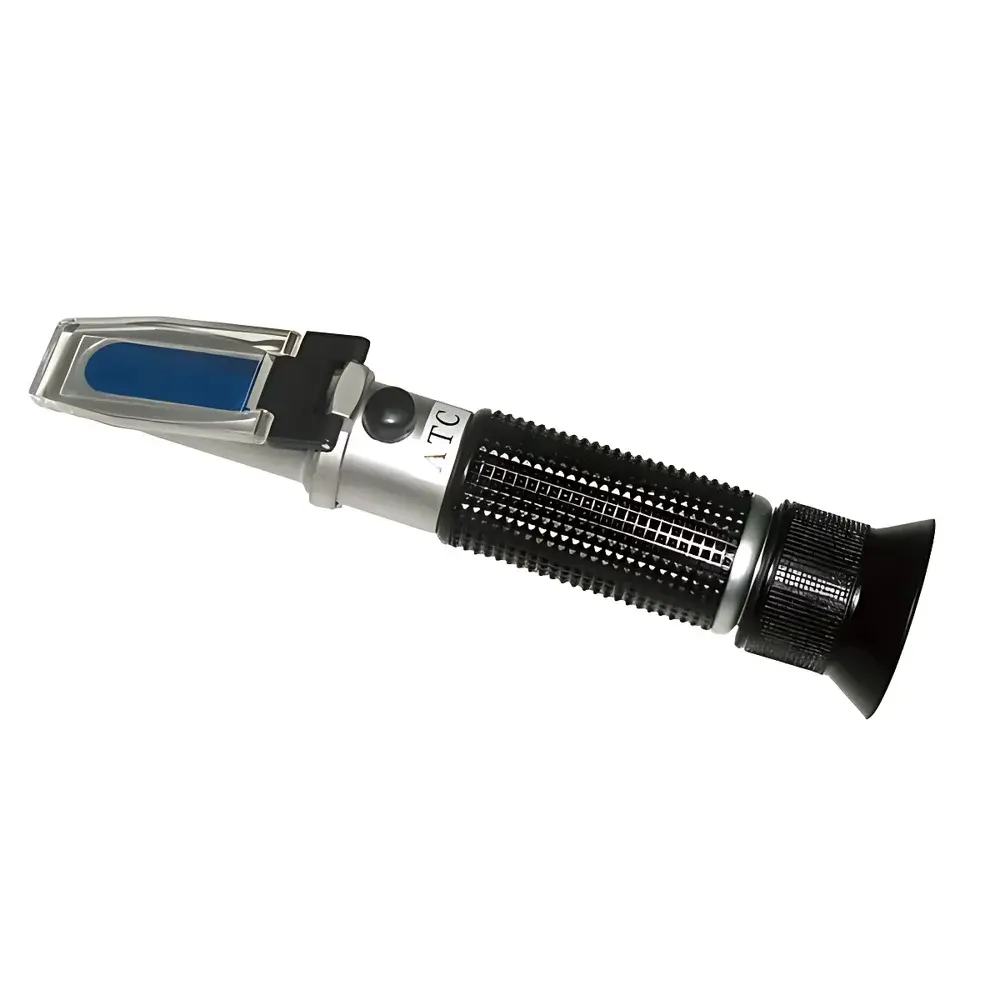
Yidian Woguang WZS Series Handheld Refractometer
| Brand | Yidian Woguang (YDWG) |
|---|---|
| Origin | Shanghai, China |
| Product Type | Handheld Refractometer |
| Display | Digital |
| Temperature Control | None |
| Measurement Ranges | Brix (0–92%), Honey (35–92% Brix, 38–43°Bé, 12–27% water), Salinity (0–100‰, 0–40 ppt, 1.000–1.070 specific gravity) |
| Accuracy | ±0.10% to ±0.50% Brix (model-dependent) |
| Minimum Scale Division | 0.10–0.50% Brix / 0.5°Bé / 1‰ / 0.005 SG |
| Dimensions | 155 × 25 × 40 mm |
| Net Weight | 160 g |
Overview
The Yidian Woguang WZS Series Handheld Refractometer is a precision optical instrument engineered for rapid, field-deployable measurement of refractive index–derived concentration parameters in liquid samples. Based on the fundamental principle of Snell’s Law, it determines solute concentration by measuring the critical angle of total internal reflection at the prism–sample interface. The device converts this optical response into calibrated digital readouts for Brix (% w/w sucrose equivalent), honey-specific scales (°Bé, water content), and salinity (‰, ppt, or specific gravity). Designed for robustness and operational simplicity, the WZS series requires only 1–2 drops of sample, delivers results in under 3 seconds, and operates without external power—making it ideal for quality control in resource-constrained or mobile environments.
Key Features
- Digital LCD display with backlight (model-dependent), ensuring legible readings under variable ambient lighting conditions
- High-stability borosilicate glass prism with anti-scratch coating and integrated temperature-compensated calibration (ATC range: 10–30 °C; no active thermoregulation)
- Multiple pre-programmed scales: Brix (0–92%), honey (Brix, °Bé, % water), and salinity (‰, ppt, specific gravity 1.000–1.070)
- Compact ergonomic housing (155 × 25 × 40 mm) and lightweight design (160 g) optimized for one-handed operation and extended field use
- No battery dependency for basic optical function; optional AAA-powered digital display module enables data retention and unit switching
- Mechanically sealed optical path resistant to dust, moisture, and incidental splashing (IP54-rated enclosure)
Sample Compatibility & Compliance
The WZS refractometer accepts aqueous solutions with low to moderate viscosity—including fruit juices, syrups, honey, brines, seawater, fermentation broths, and saline coolants. It is incompatible with strongly acidic, alkaline, or organic solvent-based samples that may etch or dissolve the prism surface. Calibration is performed using distilled water (0% Brix, 1.000 SG) and certified sucrose standards traceable to NIST SRM 84d. While not certified to ISO 2173 or AOAC 932.12 for official regulatory reporting, the instrument meets functional performance criteria outlined in ASTM D115 for handheld refractometers and supports GLP-aligned documentation when used with standardized SOPs for calibration verification and sample handling.
Software & Data Management
The base WZS models operate as standalone optical-electronic instruments without embedded firmware or connectivity. Digital-display variants store up to 20 recent measurements in non-volatile memory and support manual timestamping via external logbooks. For audit-ready workflows, users integrate the WZS into laboratory information management systems (LIMS) via manual transcription or optional USB-dongle adapters (sold separately). All models comply with general requirements for instrument qualification per FDA 21 CFR Part 11 when paired with controlled documentation practices—including defined calibration frequency (daily pre-use check recommended), operator training records, and deviation logging.
Applications
- Sugar Industry: Raw cane juice purity assessment, syrup concentration control during evaporation, molasses solids estimation
- Fruit & Beverage QA/QC: Ripeness screening of grapes, apples, and citrus; Brix consistency checks in juice blending and soft drink formulation
- Honey Grading: Determination of moisture content (critical for preventing fermentation), verification against Codex Alimentarius honey standards (≤20% water)
- Aquaculture & Marine Science: Real-time salinity monitoring in hatcheries, estuarine studies, and coral tank maintenance (‰ and specific gravity modes)
- Food Processing: Brine concentration for pickling, soy sauce fermentation tracking, and dairy whey solids estimation
- Education & Field Research: Undergraduate physical chemistry labs, environmental sampling campaigns, and agricultural extension services
FAQ
What calibration standards are required for routine use?
Distilled water (0% Brix, 1.000 SG) is mandatory for zero-point verification before each measurement session. For quantitative accuracy, certified sucrose reference solutions (e.g., 10%, 30%, 60% w/w) should be used weekly or after instrument transport.
Can the WZS measure non-sugar solutes accurately?
No. Brix scale assumes sucrose-equivalent refractive behavior. For glycerol, glucose, or NaCl solutions, users must apply solute-specific conversion tables or validate against reference methods (e.g., densitometry, titration).
Is temperature compensation automatic across all models?
Yes—built-in Automatic Temperature Compensation (ATC) corrects for sample temperature drift between 10 °C and 30 °C using a bimetallic thermal element; readings outside this range require manual correction per published ATC curves.
How often should the prism surface be cleaned?
After every sample, using lens tissue and reagent-grade isopropanol. Residual sugars or salts must be removed immediately to prevent crystallization and prism scratching.
Does the WZS series meet ISO/IEC 17025 requirements for accredited testing?
Not as a standalone device. Accredited labs must validate measurement uncertainty, establish traceable calibration intervals, and document environmental controls—tasks supported by, but not inherent to, the WZS hardware.




