
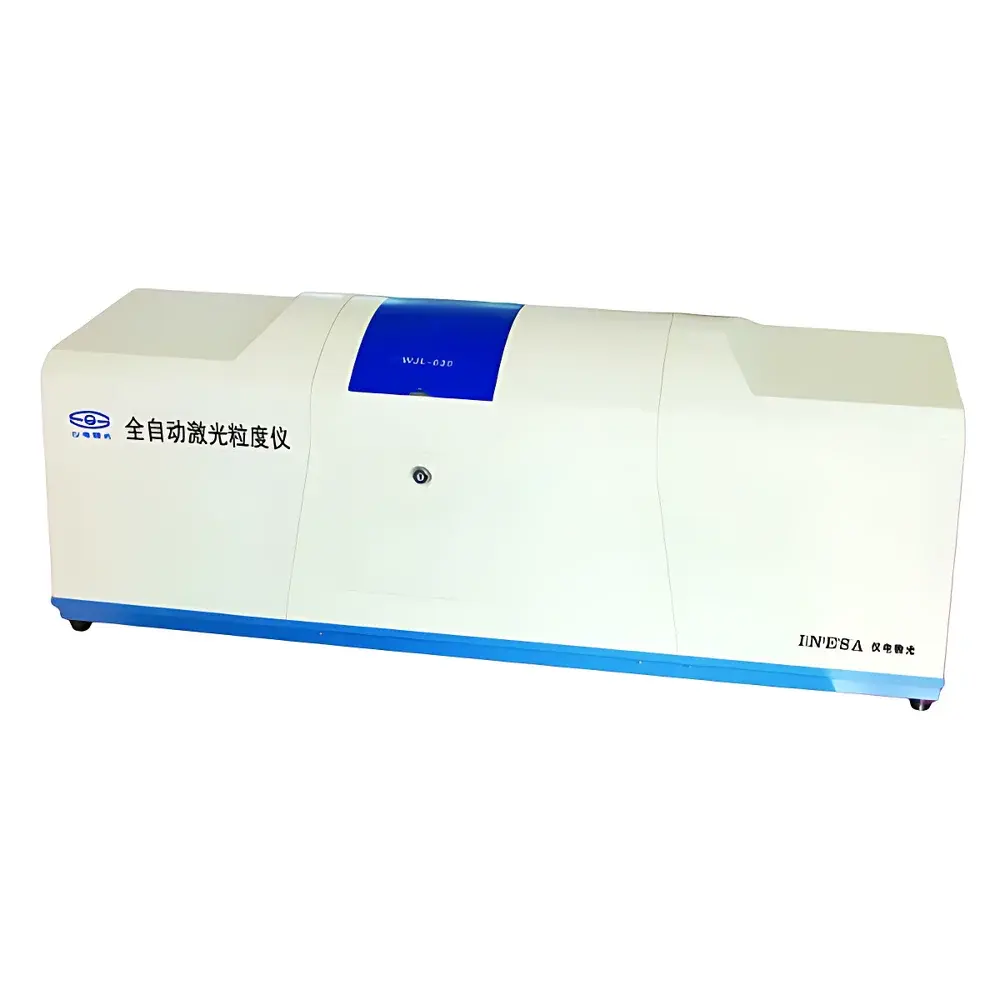
YDWG WJL-632/636/638 Series Fully Automated Laser Diffraction Particle Size Analyzer
| Brand | YDWG |
|---|---|
| Origin | Shanghai, China |
| Model | WJL-632 / WJL-636 / WJL-638 |
| Measurement Range | 0.02–2000 µm (wet dispersion) |
| Repeatability | ≤ ±0.5% (D50 of NIST-traceable standard reference materials) |
| Laser Source | He-Ne gas laser, 632.8 nm, lifetime > 25,000 h |
| Optical System | Coated single-lens design with auto-alignment |
| Detection Angle | ≥135°, with forward-, backward-, and side-scatter扇形 distribution |
| Dispersion Method | Fully automated wet dispersion |
| Compliance | ISO 13320:2020 |
| Dimensions | 1000 × 330 × 320 mm |
| Weight | 33 kg |
| Power Supply | AC 220 V ±10%, 50 Hz, 100 W |
| Interface | USB / Ethernet / RS232 / RS485 |
| Operating System Compatibility | Windows 7/8/10/11 (host PC required: i5 CPU, 8 GB RAM, SSD storage) |
Overview
The YDWG WJL-632/636/638 Series Fully Automated Laser Diffraction Particle Size Analyzer is engineered for high-precision, routine particle size distribution (PSD) analysis in research laboratories, quality control environments, and production facilities across pharmaceuticals, ceramics, battery materials, pigments, and fine chemical industries. Based on the physical principle of laser diffraction—where particles suspended in a liquid medium scatter incident monochromatic light (He-Ne, 632.8 nm) at angles inversely proportional to their size—the instrument quantifies scattering intensity across a wide angular range (≥135°), including forward, backward, and lateral detection zones. This multi-angle detection architecture enables robust resolution of submicron to coarse particles (0.02–2000 µm), with optical alignment maintained automatically via real-time feedback-controlled lens positioning. The system adheres strictly to ISO 13320:2020, ensuring traceability, method validation readiness, and compatibility with regulatory workflows requiring documented measurement uncertainty and instrument qualification.
Key Features
- Fully automated operational sequence: integrated water dosing, ultrasonic dispersion, optical auto-focusing, sample circulation, measurement acquisition, post-run cleaning, and result archiving—all executed via single-button initiation.
- Modular mechanical architecture: ABS injection-molded housing ensures dimensional stability and EMI shielding; internal subsystems (fluidics, optics, electronics) are decoupled for simplified maintenance, calibration verification, and component-level replacement.
- Thermally stabilized optical bench: dual silent fans maintain ambient temperature within ±0.5 °C during extended operation, minimizing refractive index drift in the dispersion medium and preserving long-term signal reproducibility.
- Auto-aligning optical train: motorized single-lens system with closed-loop positional feedback corrects minor misalignments caused by thermal expansion or mechanical vibration—eliminating manual recalibration between runs.
- Comprehensive data integrity framework: role-based user access control, electronic signatures, password policies, audit trail logging, and encrypted local/network storage compliant with GLP and FDA 21 CFR Part 11 requirements.
Sample Compatibility & Compliance
The WJL series supports aqueous and organic dispersions (e.g., ethanol, isopropanol) using its integrated peristaltic pump and adjustable ultrasonic probe (20–60 kHz, programmable amplitude and duration). Sample introduction is compatible with slurries up to 40% w/v solids concentration, with optional dilution modules for highly concentrated suspensions. All wet dispersion protocols are validated against ISO 13320 Annex B guidelines for refractive index selection, obscuration optimization, and multiple measurement averaging. Instrument qualification documentation—including Installation Qualification (IQ), Operational Qualification (OQ), and Performance Qualification (PQ) templates—is provided to support GMP-compliant deployment. Regulatory submissions referencing ISO 13320, USP , and EP 2.9.30 are fully supported through standardized reporting and raw data export (including full scattering pattern matrices).
Software & Data Management
Control and analysis software runs natively on Windows 7–11 platforms (minimum i5 CPU, 8 GB RAM, SSD storage) and communicates with the analyzer via USB, Ethernet, or serial interfaces. The interface provides real-time visualization of raw scattering patterns, Mie or Fraunhofer inversion parameter selection, customizable PSD reporting (D10/D50/D90, span, specific surface area), and batch processing for multi-sample comparative analysis. Export formats include PNG, CSV, Excel (.xlsx), and PDF with embedded metadata (operator ID, timestamp, instrument ID, calibration status). Raw data files are stored in vendor-neutral HDF5 format with checksum validation, enabling third-party reprocessing and long-term archival per ISO/IEC 17025 data retention mandates. Network deployment allows centralized instrument monitoring, remote diagnostics, and integration into LIMS via RESTful API endpoints.
Applications
- Pharmaceutical solid dosage development: monitoring micronization efficiency, excipient blend uniformity, and suspension stability via Dv50 trend analysis over accelerated storage conditions.
- Cathode/anode material characterization in Li-ion battery R&D: quantifying primary particle size distribution and agglomerate breakage behavior under shear-controlled wet dispersion.
- Ceramic slurry QC: detecting oversized particles (>10 µm) that induce defects in green-body sintering, with pass/fail thresholds configurable per ASTM C721.
- Pigment and ink formulation: correlating median particle size with color strength, gloss, and rheological behavior in millbase systems.
- Environmental particulate analysis: sizing clay, silt, and colloidal fractions in sediment extracts following EPA Method 9040B sample preparation protocols.
FAQ
What laser wavelength and type does the WJL series use, and how is laser stability ensured?
It employs a helium-neon (He-Ne) gas laser operating at 632.8 nm, with an operational lifetime exceeding 25,000 hours. Laser power output is continuously monitored and compensated via photodiode feedback to maintain constant irradiance across measurement cycles.
Is dry dispersion supported on this instrument?
No—this model is configured exclusively for wet dispersion. Dry powder analysis requires separate instrumentation with aerodynamic dispersion modules not integrated into the WJL platform.
How is compliance with ISO 13320 verified during routine use?
The system includes built-in reference measurements using NIST-traceable polystyrene latex standards (e.g., NIST SRM 1963). Daily verification reports compare measured D50 values against certified ranges and log deviations for review during internal audits.
Can raw scattering pattern data be exported for third-party Mie modeling?
Yes—full angular intensity arrays (intensity vs. scattering angle) are saved in HDF5 format with metadata headers, supporting external inversion using custom refractive index assumptions or advanced optical models.
What maintenance intervals are recommended for fluidic and optical subsystems?
Per manufacturer guidelines: ultrasonic transducer inspection every 6 months; flow cell cleaning after every 50 samples; optical window inspection and cleaning quarterly; annual full optical alignment verification using factory-certified alignment targets.



