
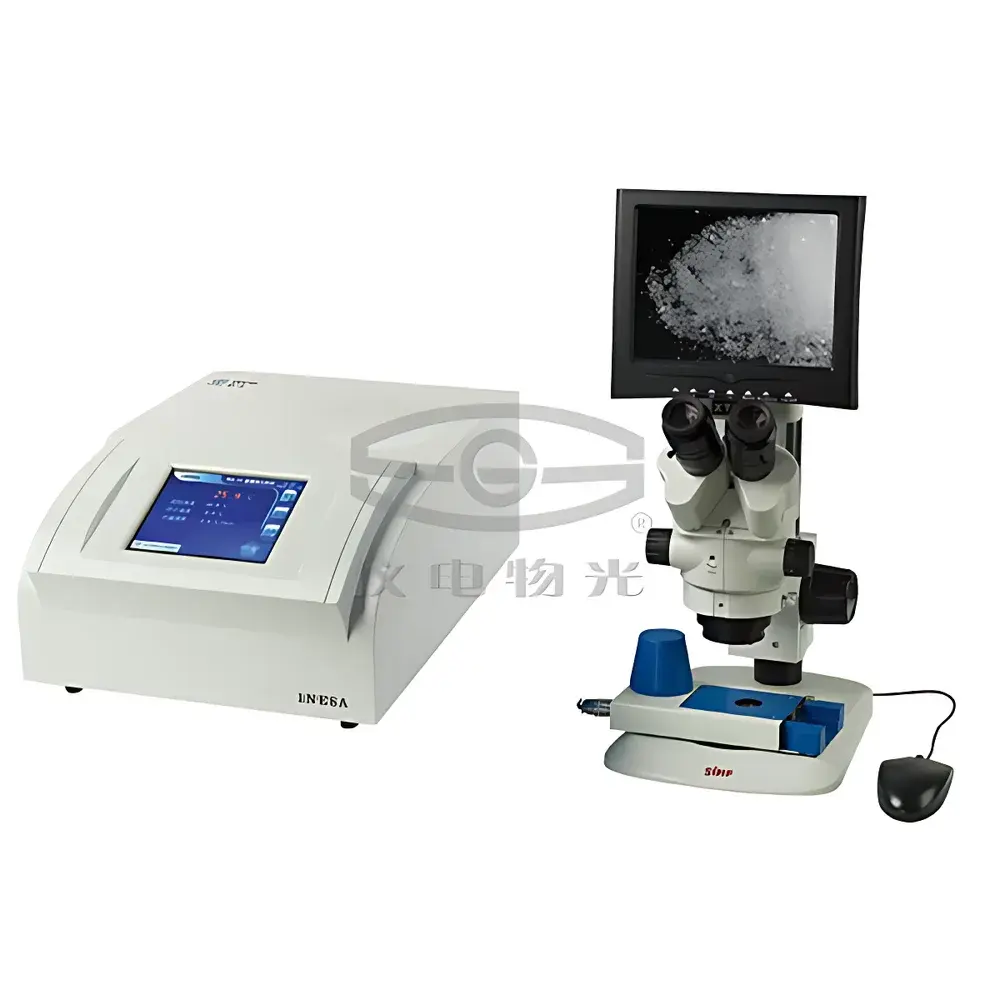
YDWG WRX-2S Microscopic Thermal Analysis System
| Brand | YDWG |
|---|---|
| Origin | Shanghai, China |
| Model | WRX-2S |
| Temperature Range | Ambient to 300 °C |
| Heating Rate | 0.1–20 °C/min (continuously adjustable) |
| Temperature Repeatability | ±0.3 °C at 1.0 °C/min |
| Temperature Accuracy | ±0.4 °C ≤200 °C |
| Temperature Resolution | 0.1 °C |
| Capillary Diameter | 0.17 mm |
| Sample Capacity | 1 |
| Stage Dimensions | 195 mm × 28 mm × 85 mm |
| Display | 7-inch color LCD touchscreen |
| Data Storage | 3,000 test records |
| Interface | USB 2.0 and RS232 |
| Power Supply | 220 V ±10%, 50 Hz ±1 Hz, 100 W |
| Net Weight | 9 kg (excluding microscope) |
Overview
The YDWG WRX-2S Microscopic Thermal Analysis System is a precision thermo-optical analysis (TOA) instrument engineered for real-time observation of thermal transitions under optical magnification. It integrates a digitally controlled heating stage with high-stability temperature regulation and synchronized visual monitoring—enabling direct correlation between thermal events (e.g., melting, crystallization, polymorphic transitions, liquid crystal phase changes) and optical morphology evolution. Unlike conventional bulk thermal analyzers, the WRX-2S operates on microgram-scale samples mounted on standard capillaries or thin-sectioned substrates, making it especially suitable for materials where sample availability is limited or spatial heterogeneity must be resolved. The system employs pulse-width modulation (PWM) for precise, low-drift thermal ramping across its full operating range (ambient to 300 °C), with programmable heating rates from 0.1 to 20 °C/min. Its core application domain spans polymer science, pharmaceutical solid-state characterization, mineralogical phase identification, forensic trace evidence analysis, and thermally responsive biomaterials research.
Key Features
- High-resolution thermo-optical coupling: Synchronized temperature control and optical imaging enable frame-by-frame correlation of thermal events with morphological change.
- PWM-based digital temperature regulation ensures minimal thermal overshoot and long-term stability—critical for reproducible melting point determination per USP & Ph. Eur. guidelines.
- 0.1 °C temperature resolution and calibrated accuracy (±0.4 °C up to 200 °C) meet ISO 11357-3 requirements for differential thermal analysis validation.
- 7-inch color LCD touchscreen interface with intuitive navigation, real-time curve plotting, and on-device parameter configuration.
- Onboard data storage for 3,000 complete test records—including timestamp, heating rate, observed transition onset/offset, and user annotations.
- Dual communication interfaces (USB 2.0 and RS232) support seamless integration with laboratory information management systems (LIMS) and optional thermal printer modules (e.g., RD-TH32-SC).
- Modular microscope compatibility: Designed for integration with industry-standard biological, stereo, polarizing, and metallurgical microscopes—including XSP-8CA, XTZ-TV, 59XC, and 69XCL models—enabling polarization contrast, transmitted/reflected light modes, and digital image capture via 1.3 MP electronic eyepieces.
Sample Compatibility & Compliance
The WRX-2S accommodates samples in sealed glass capillaries (0.17 mm inner diameter) or as thin sections (0.8–1.2 mm cover slip thickness) on standard microscope slides. Its compact heated stage (195 × 28 × 85 mm) provides uniform thermal distribution across the field of view, minimizing radial gradients that compromise morphological interpretation. The system supports GLP-compliant workflows through audit-trail-capable data export and timestamped record generation. While not a standalone regulatory instrument, its performance specifications align with ASTM E324 (Standard Test Methods for Melting Point and Melting Range) and ISO 11357-3 (Plastics — Differential Scanning Calorimetry — Part 3: Determination of melting temperature and enthalpy of fusion). When paired with validated microscope configurations and documented SOPs, the WRX-2S serves as a compliant tool for QC release testing of active pharmaceutical ingredients (APIs), excipients, and polymeric drug delivery matrices under ICH Q5E and FDA 21 CFR Part 11–enabled environments.
Software & Data Management
Data acquisition and visualization are handled entirely through the embedded firmware—no external PC software is required for basic operation. All test parameters (ramp rate, dwell time, target temperature), real-time temperature curves, and annotated optical observations are stored internally with date/time stamps. Export is performed via USB mass-storage mode: files are saved in CSV format for post-processing in Excel, Origin, or MATLAB. RS232 output enables direct connection to legacy lab printers or custom automation scripts. For advanced users, the system’s open communication protocol allows integration into Python- or LabVIEW-based custom control environments. Firmware updates are delivered via USB stick, ensuring long-term maintainability without dependency on proprietary desktop applications.
Applications
- Pharmaceutical development: Polymorph screening, eutectic mixture identification, hydrate/dehydrate behavior, and thermal stability assessment of amorphous dispersions.
- Materials science: Characterization of liquid crystal phase transitions, polymer crystallinity kinetics, and filler-matrix interfacial thermal response in composites.
- Forensic science: Identification of synthetic fibers, paint chips, and adhesive residues based on thermal-morphological fingerprints.
- Geosciences: In-situ observation of mineral dehydration, phase transformations in clays, and melt onset in silicate systems.
- Bioengineering: Thermotropic gel-sol transitions in hydrogels, thermal denaturation of protein films, and lipid bilayer phase behavior.
FAQ
What microscope models are officially supported?
The WRX-2S is mechanically and optically compatible with four reference configurations: XSP-8CA (biological), XTZ-TV (stereo video), 59XC (polarizing trinocular), and 69XCL (transmission/reflection polarizing). Each includes a specified 1.3 MP digital eyepiece and appropriate illumination alignment.
Is calibration traceable to national standards?
Yes—temperature calibration is performed using NIST-traceable Pt100 reference sensors during factory verification. A calibration certificate with uncertainty budget is supplied with each unit.
Can the system operate unattended for extended runs?
Yes—once programmed, the WRX-2S executes fully autonomous heating protocols, logs all data locally, and retains power-failure recovery functionality to resume interrupted tests.
What is the maximum recommended sample mass?
For optimal thermal homogeneity and optical clarity, capillary samples should contain 0.1–1.0 mg of material; thin-section samples should be ≤20 µm thick for transmitted-light observation.
Does the system comply with FDA 21 CFR Part 11?
The WRX-2S itself does not include electronic signature or role-based access controls. However, its CSV data export and timestamped audit log support Part 11 compliance when integrated into a validated LIMS or ELN environment with appropriate procedural controls.



