
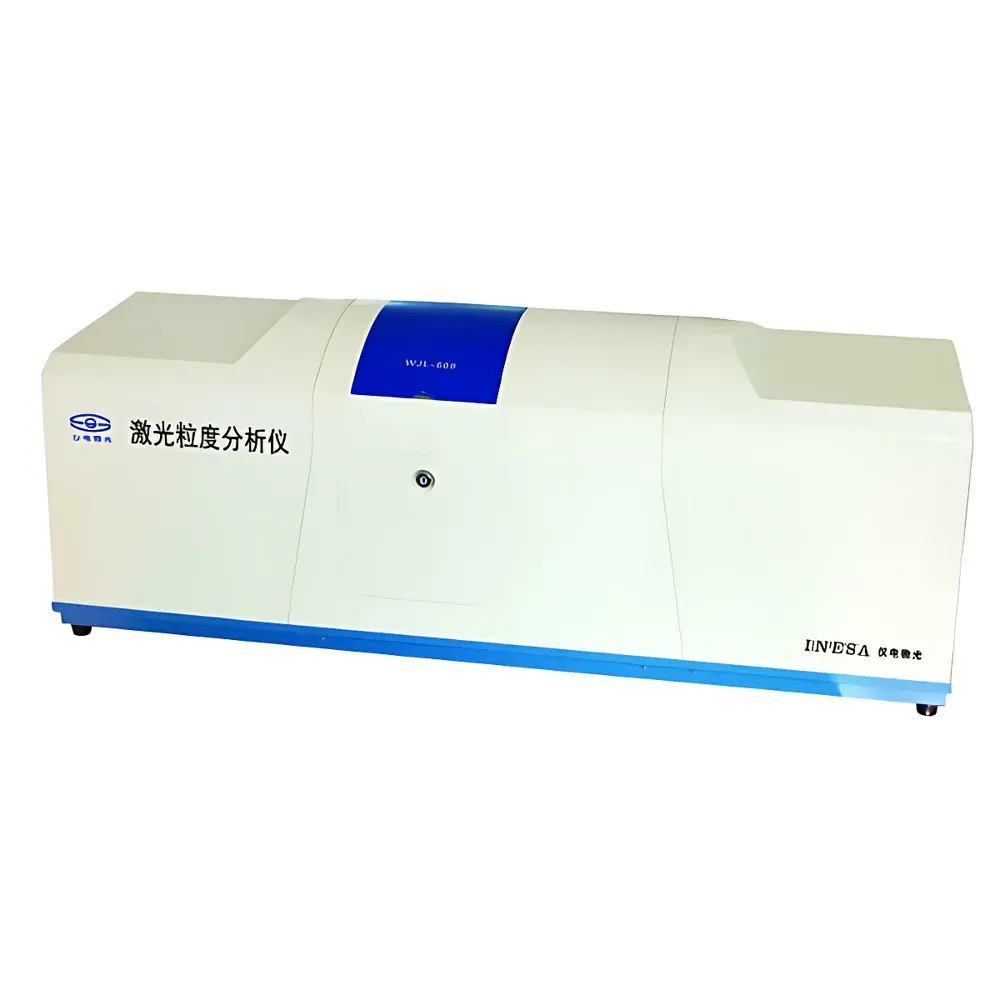
YDWG WJL-612/616/618/622/626/628 Laser Particle Size Analyzer (Dry & Wet Dispersion)
| Brand | YDWG |
|---|---|
| Origin | Shanghai, China |
| Model Series | WJL-612, WJL-616, WJL-618 (dry-only) |
| Measurement Range | 0.02–2000 µm (wet mode, WJL-628) |
| Repeatability | ≤ ±0.5% (D50 of NIST-traceable standard reference materials) |
| Dispersion Methods | Dry dispersion via high-velocity pneumatic jet |
| Compliance | ISO 13320:2020 (Laser diffraction particle size analysis — General principles) |
| Optical Model | Full-range Mie scattering theory with user-configurable refractive index and absorption parameters |
| Typical Analysis Time | < 60 s per measurement (dry mode) |
| Laser Source | He-Ne, 632.8 nm, >25,000 h lifetime |
| Power Supply | AC 220 V ±10%, 50 Hz, 200 W |
Overview
The YDWG WJL series Laser Particle Size Analyzers are laboratory-grade instruments engineered for precise, reproducible particle size distribution (PSD) characterization across diverse industrial and research applications. Based on first-principles Mie scattering theory, the system calculates particle size distributions by modeling angular light intensity patterns generated when a monochromatic He-Ne laser beam (632.8 nm) interacts with dispersed particles in air or liquid media. Unlike simplified Fraunhofer approximations, the full Mie model incorporates user-defined optical properties—including real and imaginary components of refractive index—to ensure metrological accuracy for both absorbing and non-absorbing materials (e.g., metal oxides, polymers, pharmaceutical actives, catalysts). The WJL platform supports two distinct operational configurations: dry-only models (WJL-612/616/618) optimized for free-flowing powders, and dual-mode dry/wet analyzers (WJL-622/626/628) enabling method flexibility for cohesive, hygroscopic, or aggregation-prone samples. All variants comply with ISO 13320:2020 requirements for instrument validation, data reporting, and uncertainty estimation—making them suitable for GLP-compliant quality control, R&D benchmarking, and regulatory submissions.
Key Features
- Full-range Mie scattering inversion algorithm with customizable optical constants for rigorous physical modeling of scattering behavior.
- Dry dispersion module featuring a silent oil-free air compressor (integrated condensation dryer) delivering clean, particle-free carrier gas at regulated pressure—eliminating need for solvents or surfactants.
- High-efficiency pneumatic disperser with controlled jet velocity and residence time, achieving rapid de-agglomeration without mechanical shear or thermal degradation.
- Wet dispersion unit with digitally tunable 100 W ultrasonic probe, variable-speed magnetic stirrer, and recirculating peristaltic pump—enabling independent optimization of dispersion energy and fluid dynamics.
- Real-time measurement acquisition and processing: complete PSD output (including D10, D50, D90, span, specific surface area) within 60 seconds (dry) or 90 seconds (wet), with automatic background subtraction and noise filtering.
- Robust optical bench design with thermally stabilized laser diode, multi-ring photodetector array (104 channels), and sealed optical path to minimize drift and contamination.
Sample Compatibility & Compliance
The WJL series accommodates a broad spectrum of particulate materials—from brittle ceramics and metallic alloys to soft organic powders and nanostructured emulsions. Dry mode is ideal for thermally stable, low-cohesion samples (e.g., cement clinker, toner, food powders), while wet mode supports challenging matrices such as nanocellulose suspensions, liposomal formulations, and pigment dispersions. Each instrument undergoes factory calibration using NIST-traceable polystyrene latex standards (e.g., NIST SRM 1963, 8012), and includes built-in verification protocols per ISO 13320 Annex B. Data integrity is reinforced through audit-trail-capable software (see Software section) compliant with FDA 21 CFR Part 11 requirements for electronic records and signatures—facilitating use in pharmaceutical manufacturing (ICH Q5A, USP ) and advanced materials certification (ASTM E2937, ISO 20957).
Software & Data Management
YDWG Particle Analysis Suite (v5.x) provides an intuitive Windows-based interface supporting method development, instrument control, statistical reporting, and raw-data export. Key capabilities include: batch processing with customizable pass/fail criteria; overlay and comparative analysis of up to 16 distributions; conversion between volume-, number-, and surface-area-weighted representations; and generation of industry-standard reports (e.g., ASTM E2937-compliant summary sheets). All user actions—including parameter changes, calibration events, and result approvals—are timestamped and logged with operator ID, satisfying GLP/GMP traceability mandates. Raw scattering pattern files (.scat) and processed results (.csv, .xlsx, .pdf) are stored in hierarchical project folders with optional network backup integration. Software validation documentation (IQ/OQ/PQ templates) and 21 CFR Part 11 configuration guides are supplied with each system.
Applications
- Pharmaceuticals: Excipient characterization, blend uniformity assessment, inhalation powder aerodynamic diameter profiling (in conjunction with cascade impactors).
- Advanced Materials: Sintering feedstock qualification, battery cathode/anode powder grading, additive manufacturing metal powder certification (per ASTM F3049).
- Chemicals & Coatings: Pigment dispersion stability monitoring, catalyst support particle sizing, polymer latex batch release testing.
- Geosciences & Environmental: Soil texture analysis (clay/silt/sand fractions), airborne particulate matter (PM₁₀/PM₂.₅) surrogate characterization.
- Food & Agriculture: Flour granulation control, dairy powder reconstitution behavior prediction, pesticide suspension stability evaluation.
FAQ
What optical model does the WJL series use, and why is it critical for accuracy?
The system implements full Mie scattering theory—not Fraunhofer approximation—allowing physically accurate inversion for particles comparable to or smaller than the laser wavelength, especially essential for sub-micron and highly absorbing materials.
Can I validate instrument performance in-house without external standards?
Yes. Built-in diagnostics include laser power stability monitoring, detector dark-current compensation, and automated alignment verification. Optional certified reference materials (e.g., NIST SRM 1963) are available for routine performance qualification per ISO 13320.
How does the dry dispersion system prevent sample degradation during high-velocity transport?
By eliminating mechanical grinding elements and relying solely on controlled laminar airflow and optimized nozzle geometry, the system achieves dispersion via inertial separation—not impact fracture—preserving primary particle morphology.
Is wet dispersion compatible with aggressive solvents or high-pH suspensions?
The wet module’s fluidic pathway uses chemically resistant PTFE, stainless steel, and sapphire components; compatibility with specific media must be confirmed per material safety data sheets (MSDS), but common solvents (ethanol, isopropanol, aqueous buffers) are routinely supported.
Does the software support automated report generation for regulatory submissions?
Yes. Preconfigured templates generate PDF reports containing raw scattering patterns, PSD curves, statistical summaries, instrument metadata, and electronic signatures—all compliant with 21 CFR Part 11 and EU Annex 11 requirements.



