
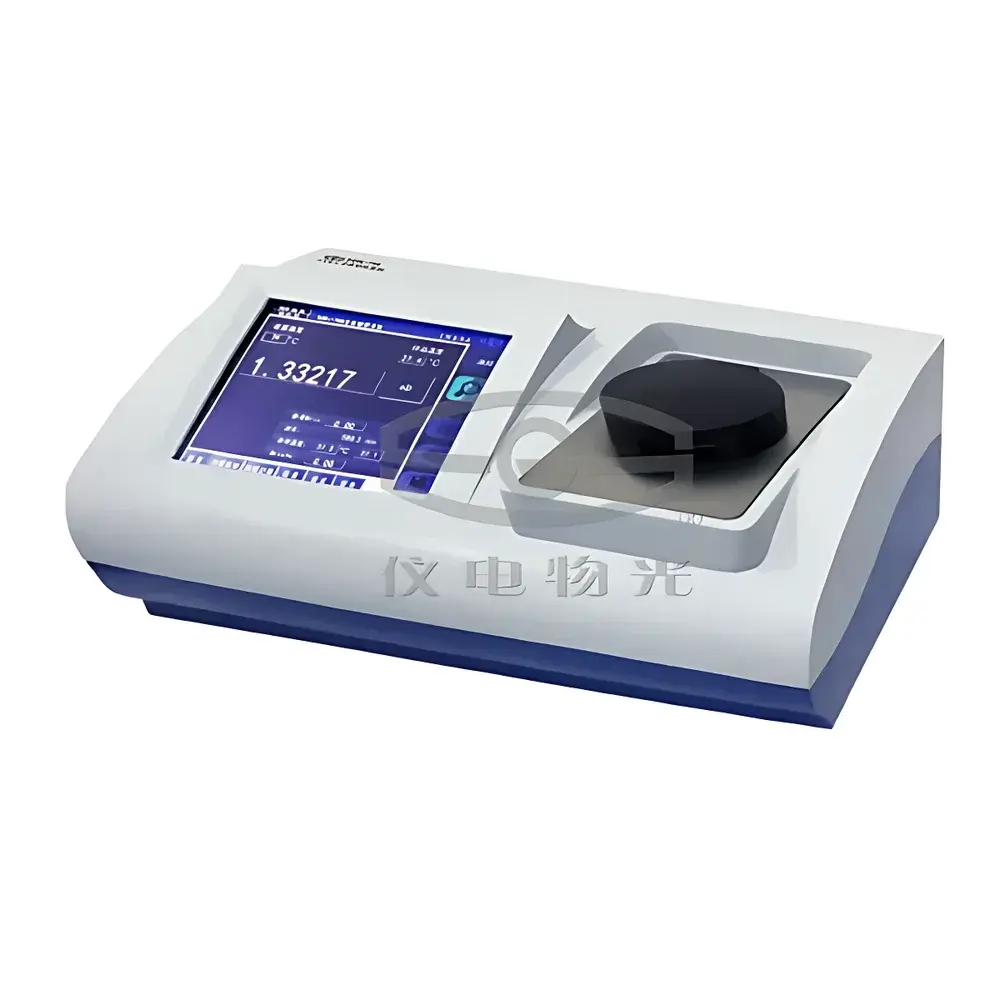
YDWG SGW®-753 Automated Temperature-Controlled Refractometer
| Brand | YDWG |
|---|---|
| Origin | Shanghai, China |
| Model | SGW®-753 |
| Instrument Type | Benchtop Refractometer |
| Temperature Control | Yes (Peltier) |
| Digital Display | Yes |
| Measurement Range | nD 1.30000–1.70000 |
| Resolution | nD 0.00001 |
| Accuracy | nD ±0.0002 |
| Precision | nD ±0.00001 |
| Temperature Control Range | 5–85 °C |
| Temperature Stability | ±0.02 °C |
| Prism Material | Sapphire |
| Data Storage Capacity | 10,000 measurements |
| Interface | USB, U-disk port, optional thermal/impact printer |
| Power Supply | 100–240 V AC, 50/60 Hz, 150 W |
| Dimensions | 430 × 260 × 150 mm |
| Net Weight | 5 kg |
Overview
The YDWG SGW®-753 Automated Temperature-Controlled Refractometer is a high-precision benchtop instrument engineered for reliable, traceable refractive index (nD) and Brix measurements in quality control, R&D, and routine analytical laboratories. It operates on the principle of total internal reflection at the prism-sample interface, where a high-resolution CCD array captures the critical angle of refraction with sub-microradian sensitivity. Integrated Peltier-based temperature control ensures thermally stable measurement conditions across a wide operational range (5–85 °C), eliminating manual water-bath dependency and enabling strict adherence to standardized test temperatures required by ISO, ASTM, and national methods. The system features a sapphire measuring prism—chemically inert, scratch-resistant, and compatible with aggressive solvents and viscous samples—ensuring long-term optical integrity and minimal maintenance. With only 0.5 mL sample volume required per measurement and non-destructive operation, the SGW®-753 supports efficient sample utilization and full recoverability, critical for high-value or limited-availability materials.
Key Features
- Automated measurement cycle with no moving mechanical parts—enhances long-term reliability and reduces calibration drift
- 8-inch full-color capacitive touchscreen interface with intuitive icon-driven navigation and multilingual support (English, Chinese, Spanish)
- Peltier thermoelectric temperature control with ±0.02 °C stability over the full 5–85 °C range, validated per ISO 21748 and ASTM D1218
- Sapphire prism (standard) offering superior hardness (Mohs 9), chemical resistance to acids, alkalis, and organic solvents, and easy cleaning without risk of surface degradation
- LED light source rated for >100,000 hours lifetime—eliminates lamp replacement cycles and maintains consistent spectral output
- Built-in compliance library: 12 pre-programmed industry-specific calculation modes including fruit juice solids (GB/T 21730-2008, GB/T 18963-2012), edible oils (GB/T 5527-2010), beverages (GB/T 12143-2008), essential oils (GB/T 14454.4-2008), liquid chemicals (GB/T 6488-2022), and reagents (GB/T 614-2021)
- User-level access control with password-protected administrator/operator accounts, electronic signatures, and audit-trail logging compliant with FDA 21 CFR Part 11 requirements
Sample Compatibility & Compliance
The SGW®-753 accommodates a broad spectrum of liquid and semi-liquid samples—including aqueous solutions, syrups, essential oils, plant extracts, food emulsions, pharmaceutical excipients, and industrial solvents—without requiring dilution or filtration in most cases. Its low-volume sampling capability (0.5 mL) and non-invasive optical measurement make it suitable for volatile, heat-sensitive, or expensive formulations. The instrument conforms to multiple national and international standards for refractometric analysis, including but not limited to GB/T 12143-2008 (soft drinks), GB/T 10786-2006 (canned foods), and GB/T 6488-2022 (liquid chemical products). Temperature-controlled operation ensures data comparability across laboratories and aligns with GLP/GMP documentation requirements for method validation and instrument qualification.
Software & Data Management
Data handling is fully integrated into the embedded operating system: up to 10,000 measurement records—including nD, Brix, temperature, timestamp, operator ID, and method name—are stored internally with automatic indexing and searchable metadata. Export options include CSV via USB or U-disk, direct printing (optional thermal or dot-matrix printer), and LIMS-compatible transmission through standard USB virtual COM port protocols. All data entries are time-stamped and linked to user authentication logs, satisfying audit requirements for regulated environments. Custom formula entry and lookup table configuration allow adaptation to proprietary concentration models beyond the 12 built-in industry templates.
Applications
- Food & beverage QC: Brix quantification in fruit juices, nectars, soft drinks, honey, and syrups per AOAC and national standards
- Pharmaceutical manufacturing: Excipient concentration verification, syrup formulation monitoring, and raw material identity testing
- Essential oil & flavor chemistry: Refractive index profiling for batch consistency and adulteration screening
- Chemical production: Purity assessment of glycols, glycerol, ethylene oxide derivatives, and halogenated solvents
- Academic research: Temperature-dependent refractive index studies in polymer solutions, colloidal dispersions, and ionic liquids
- Quality assurance in edible oil refining: Monitoring free fatty acid content indirectly via nD trends aligned with GB/T 5527-2010
FAQ
Does the SGW®-753 support 21 CFR Part 11-compliant electronic records?
Yes—it provides role-based user accounts, electronic signatures, immutable audit trails, and secure data export with timestamped metadata.
What is the minimum sample volume required for accurate measurement?
Only 0.5 mL is needed per measurement, and the sample remains chemically unaltered and fully recoverable.
Can the instrument be calibrated with NIST-traceable refractive index standards?
Yes—calibration is performed using certified liquid standards (e.g., distilled water at 20 °C, nD = 1.33300) and supports multi-point verification across the full measurement range.
Is the sapphire prism susceptible to etching by strong acids or alkalis?
No—sapphire exhibits exceptional resistance to corrosion from HCl, HNO3, NaOH, and common organic solvents; routine cleaning with ethanol or isopropanol is sufficient.
How is temperature uniformity verified across the prism surface?
The Peltier module incorporates dual-sensor feedback (prism base + sample interface) and dynamic PID regulation to maintain ±0.02 °C stability, validated during factory IQ/OQ procedures.




