
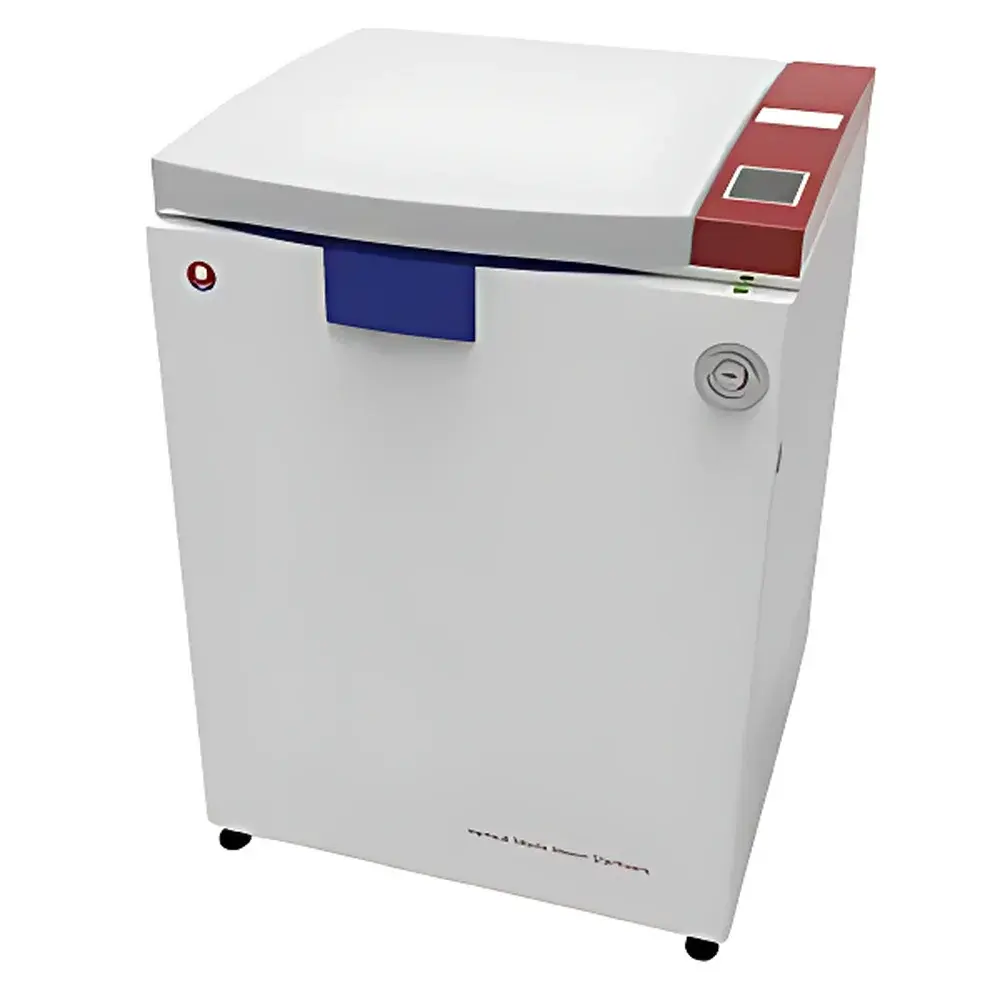
BOXUN BXM-100M Vertical Steam Sterilizer
| Brand | BOXUN |
|---|---|
| Origin | Shanghai, China |
| Model | BXM-100M |
| Instrument Type | Vertical Steam Sterilizer |
| Maximum Temperature | 135 °C |
| Maximum Working Pressure | 0.22 MPa |
| Chamber Dimensions | Ø400 × 870 mm |
| External Dimensions | 750 × 800 × 1180 mm |
| Chamber Volume | 100 L |
| Heating Power | 6.8 kW |
| Power Supply | ~220 V ± 22 V, 50 Hz ± 1 Hz |
| Ambient Operating Conditions | 5–40 °C, 20–80 % RH |
Overview
The BOXUN BXM-100M Vertical Steam Sterilizer is a fully automated, microprocessor-controlled Class B (EN 13060) steam sterilization system engineered for reliable terminal sterilization of heat- and moisture-stable laboratory and healthcare materials. It operates on the principle of saturated steam under pressure—leveraging precise thermal kinetics to achieve microbial inactivation through protein denaturation and nucleic acid disruption. Designed to meet ISO 17665-1 (Sterilization of health care products — Moist heat) and aligned with FDA-recommended validation practices for steam sterilizers, the BXM-100M delivers reproducible lethality (F0) across diverse load configurations. Its vertical orientation optimizes floor space utilization while maintaining full compliance with ASME BPVC Section VIII Div. 1 for pressure vessel integrity. The sterilizer supports three core operational modes—sterilization (105–135 °C), drying (up to 102 °C), and melting/holding (40–100 °C)—with programmable hold times up to 999 minutes per phase.
Key Features
- Robust chamber construction using medical-grade SUS304 stainless steel for both inner chamber and removable baskets—resistant to corrosion from repeated exposure to condensate, alkaline cleaning agents, and saline solutions.
- Dual automatic water supply system with independent inlets for purified water and municipal tap water—enabling operator-selectable source and auto-refill during low-level conditions.
- Integrated C.W.S. (Condensate Water Savings) recirculation system that captures, cools, and reuses sterilization condensate—reducing consumable water usage by up to 40% compared to conventional vent-and-drain cycles.
- W.P.S. (Waste Purification System) comprising HEPA-filtered exhaust path and activated carbon adsorption stage—removing particulates, non-condensable gases, and volatile organic compounds prior to atmospheric discharge per ISO 14644-1 Class 8 cleanroom air standards.
- Intelligent dual-locking door mechanism combining mechanical interlock and electronic safety verification—preventing accidental opening during pressurized operation or residual temperature hazard (>50 °C).
- 16 user-definable cycle profiles with password-protected editing, real-time graphical status display via 7-inch capacitive touchscreen, and built-in self-diagnostic routines for pressure sensor drift, temperature uniformity deviation, and door seal integrity.
- Active forced-air cooling module with variable-speed centrifugal fan—achieving post-cycle chamber cooldown to <50 °C within ≤25 minutes for standard 100 L loads.
Sample Compatibility & Compliance
The BXM-100M accommodates a wide range of sterilizable items including glassware (flasks, pipettes, Petri dishes), stainless-steel instruments, textile packs, autoclavable plastics (e.g., polypropylene containers), and liquid media in sealed bottles (with validated venting protocols). It supports gravity displacement and vacuum-assisted air removal (pulse frequency adjustable 2–99 cycles), ensuring penetration into lumened devices and porous loads per EN 285 Annex D. Chamber temperature uniformity is maintained within ±0.5 °C at setpoint across all zones during holding phases (verified per VDI/VDE 2636 Part 2). All firmware and control logic comply with IEC 62304 Class B software safety requirements. Data logging meets ALCOA+ principles (Attributable, Legible, Contemporaneous, Original, Accurate, Complete, Consistent, Enduring, Available) and supports 21 CFR Part 11-compliant audit trails when paired with optional wireless temperature sensors and validated data export workflows.
Software & Data Management
Embedded control firmware provides timestamped event logging for all critical parameters—including chamber pressure, jacket temperature, load thermocouple readings, door status, and alarm triggers—with storage capacity for ≥10,000 complete cycle records. Data export is supported via USB 2.0 interface in CSV format, compatible with LIMS integration and statistical process control (SPC) platforms. Optional wireless temperature probes (validated to ±0.25 °C accuracy at 121 °C) enable IQ/OQ/PQ documentation per ISO 13485 and GMP Annex 1. Calibration certificates traceable to NIM (National Institute of Metrology, China) are provided for three-point verification (0 °C, 60 °C, 121 °C). Firmware updates are performed offline via encrypted firmware packages to maintain system integrity.
Applications
This sterilizer serves routine sterilization needs in academic research laboratories, pharmaceutical QC labs, clinical diagnostics centers, and biomedical manufacturing facilities. Typical use cases include preparation of sterile culture media and buffers, decontamination of reusable surgical tools, validation of packaging integrity for terminally sterilized devices, and bioburden reduction in raw material processing. Its drying capability supports moisture-sensitive applications such as lyophilization pre-treatment and powder handling workflows. The system’s modular expansion options—including auxiliary lift mechanisms, softening units for hard-water regions, and external waste collection tanks—enable seamless adaptation to facility-specific infrastructure constraints and regulatory expectations.
FAQ
What sterilization standards does the BXM-100M conform to?
It complies with ISO 17665-1, EN 13060 (Class B), and incorporates design elements aligned with ANSI/AAMI ST79:2017 for healthcare sterilization.
Can the unit be validated for GMP environments?
Yes—when equipped with calibrated wireless temperature sensors and used with documented IQ/OQ protocols, it supports qualification under EU GMP Annex 1 and USP .
Is remote monitoring supported?
While native Ethernet or Wi-Fi is not included, cycle logs and alarms can be exported manually via USB; optional RS485 Modbus RTU interface enables integration with building management systems.
What maintenance intervals are recommended?
Chamber gasket inspection every 6 months, vacuum pump oil replacement annually, and full pressure vessel inspection per local jurisdictional requirements (typically every 3–5 years).
Does the system support load temperature mapping?
Yes—via optional single- or multi-point wireless temperature probes with real-time transmission and post-cycle analysis software for thermal distribution studies.



