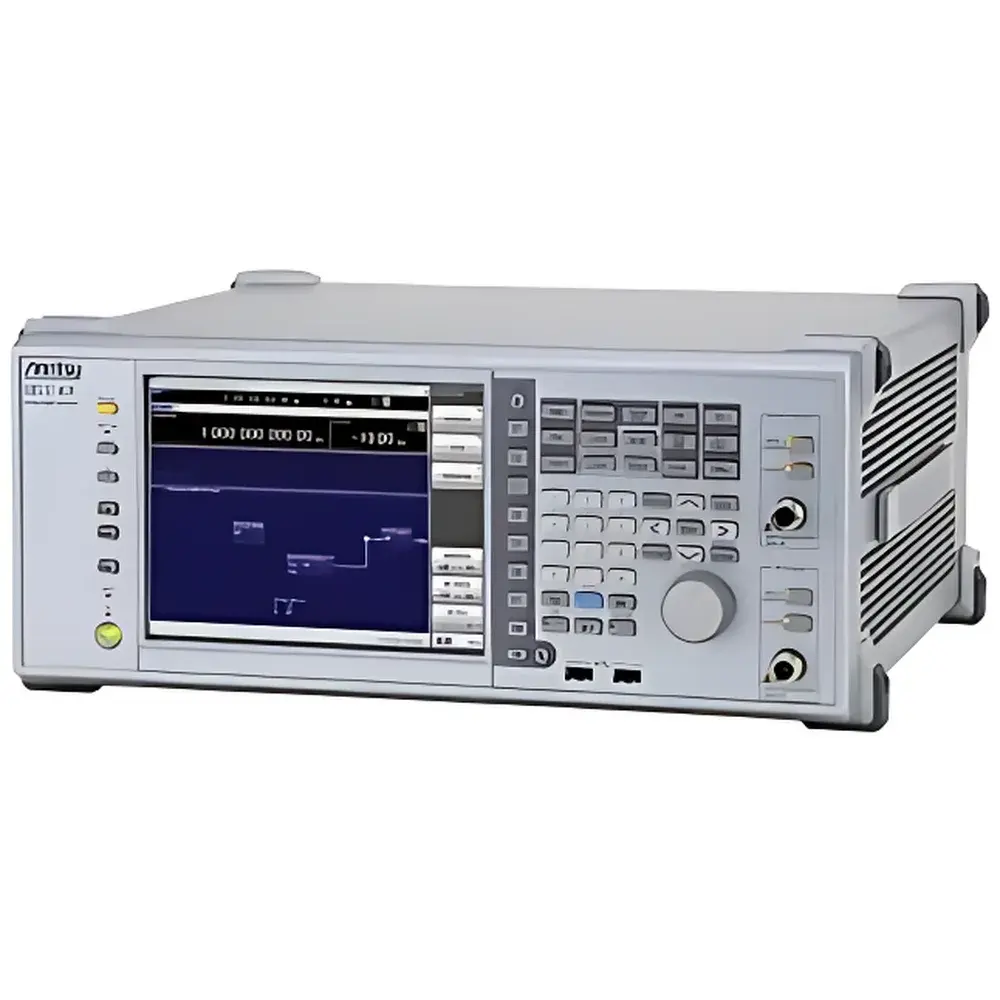
Anritsu MG3740A RF Microwave Analog Signal Generator (10 kHz to 6 GHz)
| Brand | Anritsu |
|---|---|
| Origin | Japan |
| Model | MG3740A |
| Frequency Range | 10 kHz – 6 GHz |
| SSB Phase Noise | ≤ –140 dBc/Hz @ 100 MHz (20 kHz offset, CW), ≤ –131 dBc/Hz @ 1 GHz (20 kHz offset, CW) |
| Output Level Range | –110 to +17 dBm (standard), –144 to +17 dBm (with option) |
| Switching Speed | < 600 µs (frequency/amplitude, list/scan mode) |
| Modulation | FM/AM/φM/Pulse (standard) |
| Reference Oscillator Options | Standard (±1×10⁻⁶/year), High-Stability OCXO (±1×10⁻⁷/year), Rubidium (±1×10⁻¹⁰/month) |
| Interfaces | 1000BASE-T Ethernet, GPIB, USB 2.0 |
| SCPI Compliance | Full |
| Power Meter Support | Up to two USB power sensors (optional, sold separately) |
| Digital Modulation Software | IQproducer (license required, sold separately) |
| BER Measurement Capability (option) | Input bit rate 100 bps – 40 Mbps |
Overview
The Anritsu MG3740A is a high-performance RF and microwave analog signal generator engineered for precision laboratory, production test, and R&D applications requiring exceptional spectral purity, fast switching agility, and flexible modulation architecture. Operating from 10 kHz to 6 GHz, the MG3740A delivers stable, low-noise continuous-wave (CW) and analog-modulated signals essential for characterizing receiver sensitivity, amplifier linearity (e.g., IP2/IP3), mixer conversion loss and isolation, and front-end selectivity in both legacy and emerging narrowband wireless systems. Its core architecture leverages a direct digital synthesis (DDS)-assisted phase-locked loop (PLL) design combined with high-efficiency GaAs-based output stages, ensuring excellent amplitude flatness (< ±0.5 dB across full band with calibration), high output power stability (±0.02 dB over 8 hours, with high-stability reference), and robust thermal management for extended unattended operation. The instrument meets fundamental metrological requirements for traceable RF signal generation and is designed to support compliance workflows aligned with ISO/IEC 17025-accredited test laboratories.
Key Features
- Ultra-low SSB phase noise: ≤ –140 dBc/Hz at 100 MHz (20 kHz offset), ≤ –131 dBc/Hz at 1 GHz (20 kHz offset), enabling accurate adjacent-channel interference and blocking measurements.
- Wide dynamic output range: –110 dBm to +17 dBm standard; extended to –144 dBm with optional ultra-low-level path—critical for simulating weak received signals or evaluating receiver noise floor.
- High-power CW capability: +23 dBm output from 400 MHz to 3 GHz (option MG3740A-010), supporting amplifier saturation and compression point testing without external amplification.
- Sub-millisecond switching: < 600 µs frequency and amplitude switching in list and sweep modes—optimized for automated production test sequences requiring high throughput.
- Comprehensive analog modulation suite: Built-in FM, AM, φM, and pulse modulation with user-definable deviation, depth, and duty cycle; optional dual internal modulation sources plus one external input enable synchronized two-tone stimulus generation for intermodulation distortion (IMD) analysis per IEEE Std 1057 and IEC 62037.
- Reference oscillator flexibility: Selectable aging performance—standard TCXO (±1×10⁻⁶/year), high-stability OCXO (±1×10⁻⁷/year), or rubidium (±1×10⁻¹⁰/month)—to match long-term stability requirements of calibration labs or field-deployed reference standards.
Sample Compatibility & Compliance
The MG3740A is routinely deployed in environments governed by international quality and regulatory frameworks. Its calibrated output levels and phase noise specifications are traceable to NMI-Japan (National Metrology Institute of Japan) via Anritsu’s ISO/IEC 17025-accredited calibration services. For regulated industries, the instrument supports audit-ready operation when used with optional firmware features including secure user access control, full command logging (SCPI history), and timestamped calibration records—facilitating GLP/GMP alignment and FDA 21 CFR Part 11 compliance when integrated into validated test systems. It satisfies key test requirements defined in ITU-R SM.328, ETSI EN 300 086, and MIL-STD-461G for RF immunity and emission verification setups. Dual RF outputs (option MG3740A-020) allow simultaneous delivery of desired signal and interferer—enabling standardized receiver desensitization testing per 3GPP TS 36.141 and IEEE 802.11ac/ax conformance procedures.
Software & Data Management
The MG3740A supports industry-standard remote control via 1000BASE-T Ethernet, GPIB (IEEE 488.2), and USB 2.0 interfaces, with native SCPI command compliance and backward compatibility with legacy Anritsu platforms (MG3700A, MS269xA, MS2830A, MG364xA). Optional IQproducer software licenses (TDMA IQproducer, Fading IQproducer) extend functionality to narrowband digital waveform generation (e.g., GMSK, π/4-DQPSK, FSK) with up to 2 MHz RF modulation bandwidth. When paired with optional BER measurement hardware (MG3740A-030), the system performs bit error rate analysis on demodulated baseband data streams at rates from 100 bps to 40 Mbps—supporting validation of forward-error-correction (FEC) performance in IoT, land-mobile radio, and telemetry transceivers. All configuration files, waveform datasets, and calibration logs are stored in vendor-neutral formats (CSV, XML, .iqw) for integration into LabVIEW, MATLAB, or custom Python-based test automation frameworks.
Applications
- Receiver sensitivity and selectivity characterization in VHF/UHF land-mobile radios, aviation comms (VOR/DME), and satellite telemetry receivers.
- Amplifier linearity assessment—including second- and third-order intercept point (IP2/IP3), gain compression (P1dB), and spectral regrowth under multi-tone excitation.
- Mixer evaluation: RF/LO signal sourcing with independent level and frequency control for conversion loss, port-to-port isolation, and image rejection ratio (IRR) measurements.
- EMI/EMC pre-compliance testing: Generation of calibrated disturbance signals per CISPR 16-1-1 and ANSI C63.4 for immunity margin verification.
- Calibration of spectrum analyzers, power meters, and vector network analyzers using known CW and modulated reference stimuli.
- Education and advanced RF curriculum: Hands-on instruction in modulation theory, spectral analysis, and RF system budgeting with real-world signal fidelity.
FAQ
Does the MG3740A support external reference synchronization?
Yes. The instrument accepts 10 MHz external reference inputs via BNC connector and provides buffered 10 MHz output for system-wide clock distribution.
Can the MG3740A generate digitally modulated signals without additional hardware?
No. Narrowband digital modulation (e.g., GMSK, FSK) requires the optional digital modulation license (MG3740A-025) and IQproducer software. Baseband waveform generation is performed externally or via PC-hosted IQproducer.
Is USB power sensor support limited to specific models?
The MG3740A is compatible with Anritsu’s MA2410x and MA2420x series USB power sensors (sold separately); up to two may be connected simultaneously for real-time power monitoring and closed-loop level correction.
What is the warranty and service coverage for imported units?
All MG3740A units distributed through authorized Anritsu channels include a standard 3-year return-to-factory warranty, with optional extended service agreements available globally through Anritsu’s certified service centers.
How does the dual RF output option improve test efficiency?
Option MG3740A-020 enables independent control of two RF paths—eliminating the need for external splitters, combiners, or switch matrices in two-signal receiver testing (e.g., wanted + blocker), IMD evaluation, or RF/LO stimulus for mixers—reducing setup complexity and measurement uncertainty.