
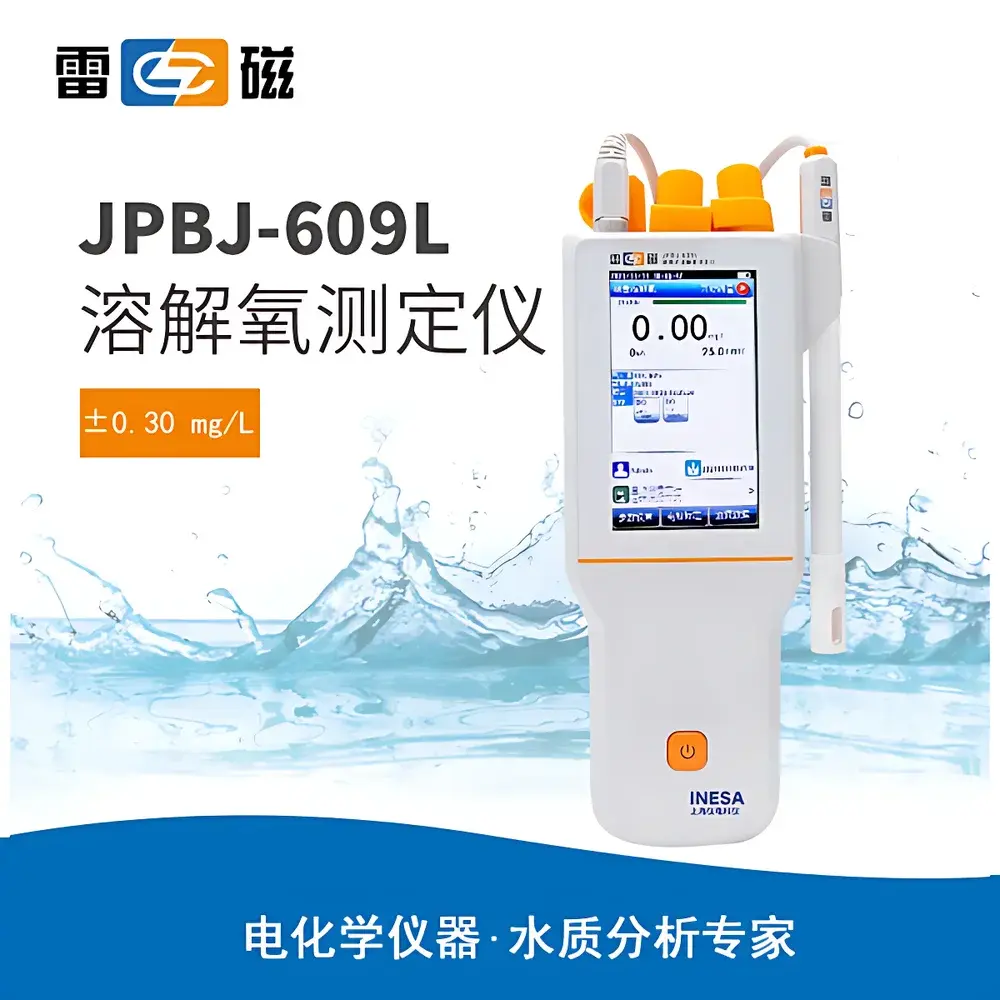
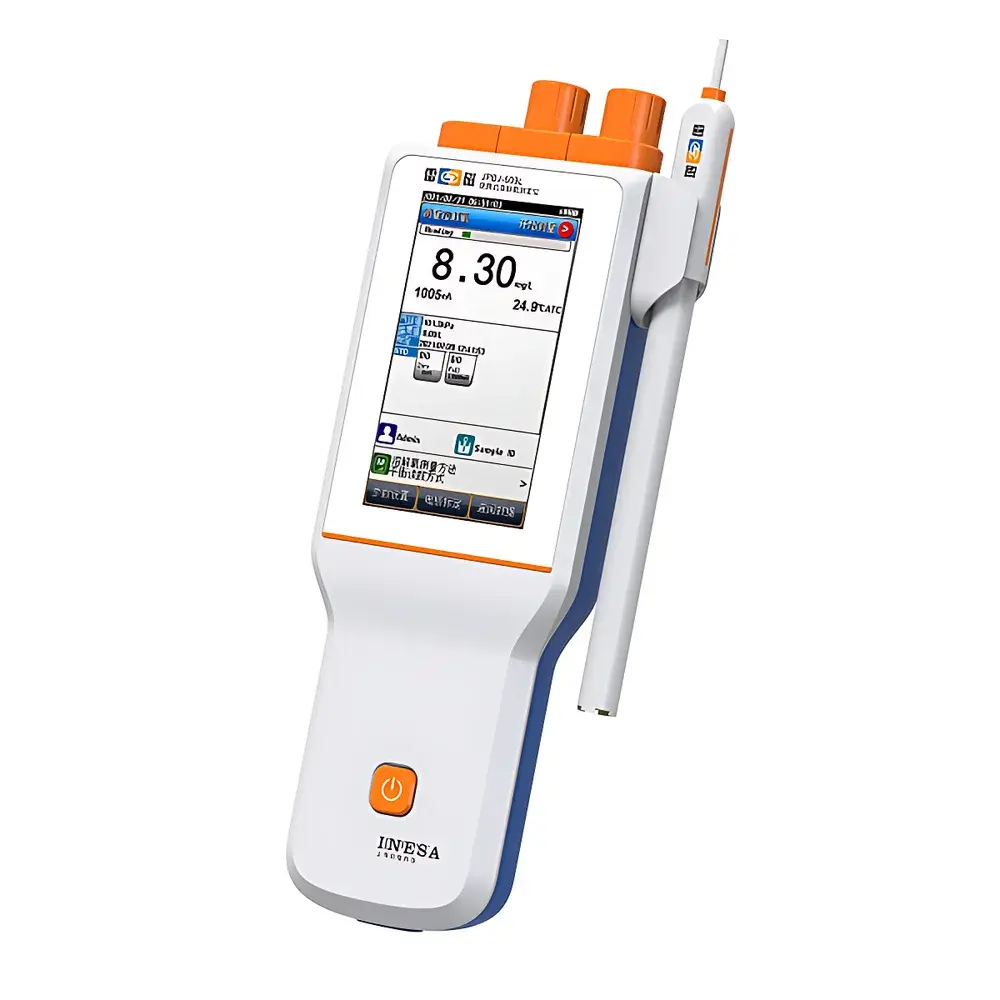
Leichi JPBJ-609L Portable Dissolved Oxygen Meter
| Brand | Leichi |
|---|---|
| Origin | Shanghai, China |
| Manufacturer Type | Authorized Distributor |
| Origin Category | Domestic (China) |
| Model | JPBJ-609L |
| Instrument Type | Portable |
| Measurement Principle | Electrochemical Probe — Clark-type Polarographic |
| Measurement Range | (0.00–50.00) mg/L |
| Accuracy | ±0.10 mg/L (0.00–50.00 mg/L) |
| Resolution | 0.01 mg/L |
| Response Time | ≤45 s (90% response at 20 °C) |
| Temperature Compensation | Automatic/Manual (−10.0 to 135.0 °C) |
| Atmospheric Pressure Compensation | kPa, mbar, Torr, atm (manual/automatic) |
| Salinity Compensation | Manual (0–50 g/L) |
| DO Saturation Range | (0.0–600.0) % |
| IP Rating | IP65 |
| Power | Rechargeable Li-ion battery (USB-C input, DC5V adapter compatible) |
| Dimensions | 90 × 255 × 40 mm |
| Weight | 0.5 kg |
Overview
The Leichi JPBJ-609L Portable Dissolved Oxygen Meter is a field-deployable, electrochemical analytical instrument engineered for precise and reliable measurement of dissolved oxygen (DO) concentration, saturation percentage, and temperature in aqueous environmental samples. It employs the Clark-type polarographic principle—where molecular oxygen diffuses through a gas-permeable membrane to a cathode surface, generating a current proportional to the partial pressure of O₂—ensuring stable, low-drift performance under variable field conditions. Designed for regulatory-compliant water quality monitoring, the JPBJ-609L meets technical requirements for routine sampling in surface water, groundwater, wastewater effluents, aquaculture systems, and drinking water distribution networks. Its robust architecture supports operation across diverse climatic zones and logistical constraints typical of environmental field work.
Key Features
- High-resolution 4.3-inch color TFT touchscreen with intuitive icon-driven interface and dual-language support (English & Chinese)
- IP65-rated enclosure ensuring dust-tightness and protection against low-pressure water jets—suitable for outdoor deployment in rain or high-humidity environments
- Integrated intelligent diagnostics: automatic self-test on startup, battery health monitoring, low-voltage alerts, and adaptive power management including adjustable backlight intensity
- Comprehensive compensation algorithms: automatic or manual temperature compensation (−10.0 to 135.0 °C), atmospheric pressure compensation across four units (kPa, mbar, Torr, atm), and user-configurable salinity correction (0–50 g/L)
- Dual calibration protocol: automated zero-oxygen and full-scale (air-saturated) calibration with audible/visual prompts and built-in calibration history tracking
- Advanced endpoint detection: supports auto-read, timed-read, interval-read, and manual acquisition modes with programmable stabilization criteria
- Modular electrode system:标配 polarographic DO probe with integrated thermistor, optimized for rapid response (≤45 s to 90% step change at 20 °C) and long-term stability
Sample Compatibility & Compliance
The JPBJ-609L is validated for use with freshwater, seawater, brackish water, treated effluent, and potable water matrices. Its polarographic sensor design minimizes interference from common ions (e.g., Cl⁻, NO₃⁻, SO₄²⁻) and suspended solids when operated within specified turbidity limits (<100 NTU). The instrument complies with fundamental metrological requirements outlined in ISO 5814:2012 (Water quality — Determination of dissolved oxygen — Electrochemical probe method) and aligns with QA/QC practices recommended by US EPA Method 360.1 and ASTM D888-20. Data integrity is reinforced through GLP-compliant audit trails—including operator ID, timestamped calibration logs, measurement metadata (temperature, pressure, salinity), and modification history—enabling traceability during regulatory inspections or third-party audits.
Software & Data Management
The meter stores up to 1,000 complete measurement records locally, each containing DO concentration (mg/L), saturation (%), temperature (°C/°F), pressure (kPa), salinity (g/L), calibration parameters, and operator ID. Data export is supported via USB-C connection to PC using Leichi’s certified communication software (Windows/macOS compatible), direct U disk read/write, Bluetooth 5.0 wireless transmission to mobile devices, and optional barcode scanning integration. All exported files are generated in CSV format with UTF-8 encoding and include embedded metadata headers. The system enforces hierarchical user access control (administrator, technician, operator) with password-protected configuration changes and encrypted data storage—meeting foundational expectations for FDA 21 CFR Part 11 compliance in non-GMP environmental laboratories.
Applications
- Field-based assessment of aquatic ecosystem health in rivers, lakes, reservoirs, and wetlands
- Wastewater treatment plant process control: aeration basin optimization, secondary clarifier monitoring, and discharge compliance verification
- Aquaculture site management: real-time DO profiling across ponds, raceways, and recirculating aquaculture systems (RAS)
- Drinking water quality surveillance: source water evaluation, distribution system stagnation detection, and disinfection by-product correlation studies
- Educational and research applications requiring portable, high-fidelity DO quantification with full parameter logging
FAQ
What is the recommended calibration frequency for routine field use?
For daily field operations, perform air-saturation calibration before first use and after significant environmental shifts (e.g., altitude change >300 m or temperature swing >10 °C); zero-oxygen calibration is advised weekly or after prolonged storage.
Can the instrument compensate for barometric pressure changes during mobile surveys?
Yes—the JPBJ-609L supports real-time atmospheric pressure input via its internal sensor or manual entry, enabling accurate DO conversion across elevation gradients up to 3,000 m above sea level.
Is the polarographic probe replaceable, and what is its typical service life?
The DO probe is a field-replaceable module with an expected operational lifespan of 12–18 months under standard usage; membrane replacement kits and electrolyte refills are available separately.
Does the device support direct integration with LIMS or cloud-based data platforms?
While native LIMS API integration is not embedded, the CSV export format and timestamped metadata structure allow seamless ingestion into most laboratory information management systems via middleware or scripted ETL pipelines.
How does the instrument handle temperature extremes during winter or summer deployments?
The electronics operate reliably from −10 °C to 50 °C ambient; the probe itself remains functional up to 45 °C continuously, with short-term excursions to 60 °C permitted under controlled immersion conditions.
Related Products







